
ASTANA – Kazakhstan is positioning itself as a key land corridor between China, Central Asia, the Caucasus and Europe while seeking to deepen cooperation with Beijing in trade, technology and investment, Kazakh political scientist and historian Daniyar Ashimbayev wrote in his Telegram channel, commenting on President Kassym-Jomart Tokayev’s Sept.1 interview with Xinhua.
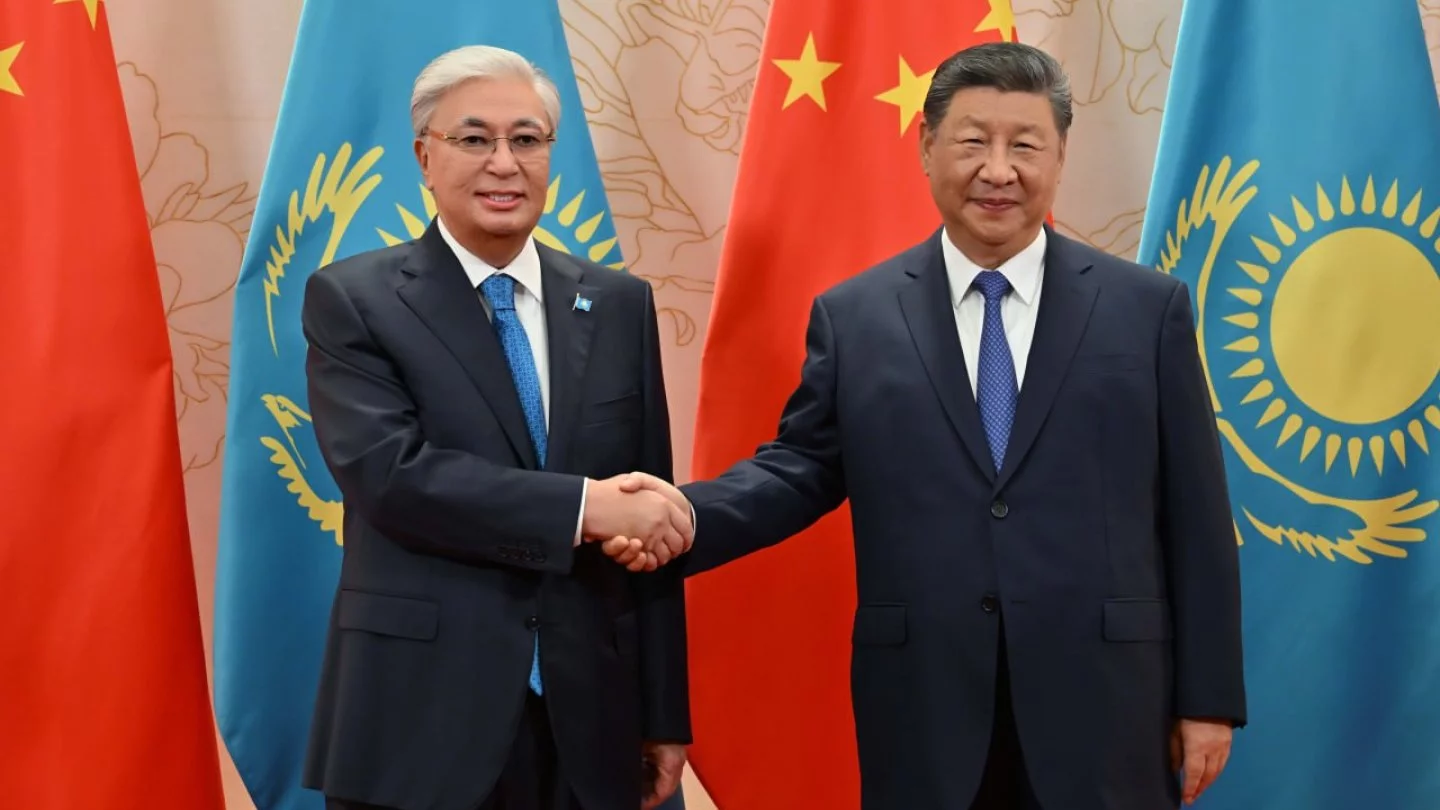
Kassym-Jomart Tokayev with Xi Jinping. Photo credit: Akorda
Ashimbayev noted that Tokayev’s interview strongly emphasized Xi Jinping’s policy and the development of Kazakhstan-China relations, highlighting trade, Chinese investment, humanitarian cooperation and the importance of ensuring Chinese transit through Kazakhstan.
The analyst also pointed to a broader strategic context. As global competition intensifies and international economic routes evolve, Kazakhstan is seeking to secure its position as a major land bridge between China and European markets.
Middle Corridor strengthens Kazakhstan’s strategic role
Tokayev described Kazakhstan-China relations as being at an “unprecedentedly high level” and reaffirmed Kazakhstan’s readiness to consistently strengthen the two countries’ “eternal comprehensive strategic partnership.”
Trade and investment remain central to the relationship, with China ranking first among Kazakhstan’s external trade partners. At the same time, transport and logistics have become a strategic pillar.
“Together with our Chinese partners, we are transforming this geographical advantage into modern transport and logistics infrastructure of Eurasian scale,” Tokayev said.
Kazakhstan is developing the Middle Corridor, including new railways, dry ports, logistics terminals and border infrastructure. The President stressed the need to make the route more competitive through “smart customs,” digital documentation, synchronized information systems and automated border procedures.
For Kazakhstan, this means turning its geographic position into a long-term economic advantage rather than relying solely on transit potential.
Technology emerges as the next growth area
Ashimbayev highlighted another key point from the interview: Tokayev’s assessment of China as a global leader in artificial intelligence, digital technologies, robotics, new energy and high-tech manufacturing.
This points to a possible new phase in bilateral cooperation as Kazakhstan accelerates its own digital transformation. Tokayev said recent meetings with Chinese technology companies had demonstrated mutual interest in projects covering the digital economy, smart manufacturing, e-commerce, research and workforce training.
“Technological cooperation can become one of the most important areas of the new stage of Kazakh-Chinese cooperation,” he said.
Kazakhstan’s decision to join the 29 founding states of the World Association of International Cooperation on Artificial Intelligence (WAICO) in Shanghai in July also reflects the country’s growing focus on international AI cooperation.
Tokayev stressed that artificial intelligence should serve humanity and that access to technology, knowledge and computing resources should be fair.
Strategic alignment without formal bloc politics
The interview also reaffirmed shared positions on the role of the United Nations, international law, mediation and peaceful settlement of conflicts.
Tokayev reiterated Kazakhstan’s adherence to the One China principle and opposition to violations of territorial integrity. Ashimbayev noted that Beijing values Kazakhstan’s consistency on this issue.
At the same time, he pointed out that Tokayev did not rank Kazakhstan’s strategic partners in the interview, as he sometimes does when speaking in a Western context. In Ashimbayev’s assessment, Beijing does not require such declarations because it already understands the depth of the bilateral relationship.
People-to-people ties add another layer
Economic and strategic cooperation is accompanied by expanding humanitarian ties. Kazakhstan and China are marking the 2026 Cross-Year of Culture, while tens of thousands of Kazakh students study in China and Chinese students study in Kazakhstan.
Chinese university branches, Luban Workshops and academic mobility programs are expanding educational links. The visa-free regime has also boosted tourism: 962,000 Chinese citizens visited Kazakhstan in 2025, up 47% from the previous year.
With diplomatic relations set to reach their 35th anniversary in 2027, the partnership is increasingly extending beyond traditional trade and energy links into transit, technology, education and broader international cooperation.
