
ASTANA – Kazakhstan’s first election to the new Kurultai is reshaping more than the country’s parliamentary architecture, said experts at an Aug. 24 meeting in Astana organized by the Kazakhstan Institute for Strategic Studies (KazISS). They pointed to voter turnout, a bigger role for political parties and growing geopolitical competition around Central Asia at a moment when Kazakhstan is seeking to translate constitutional reform into a more durable political system.
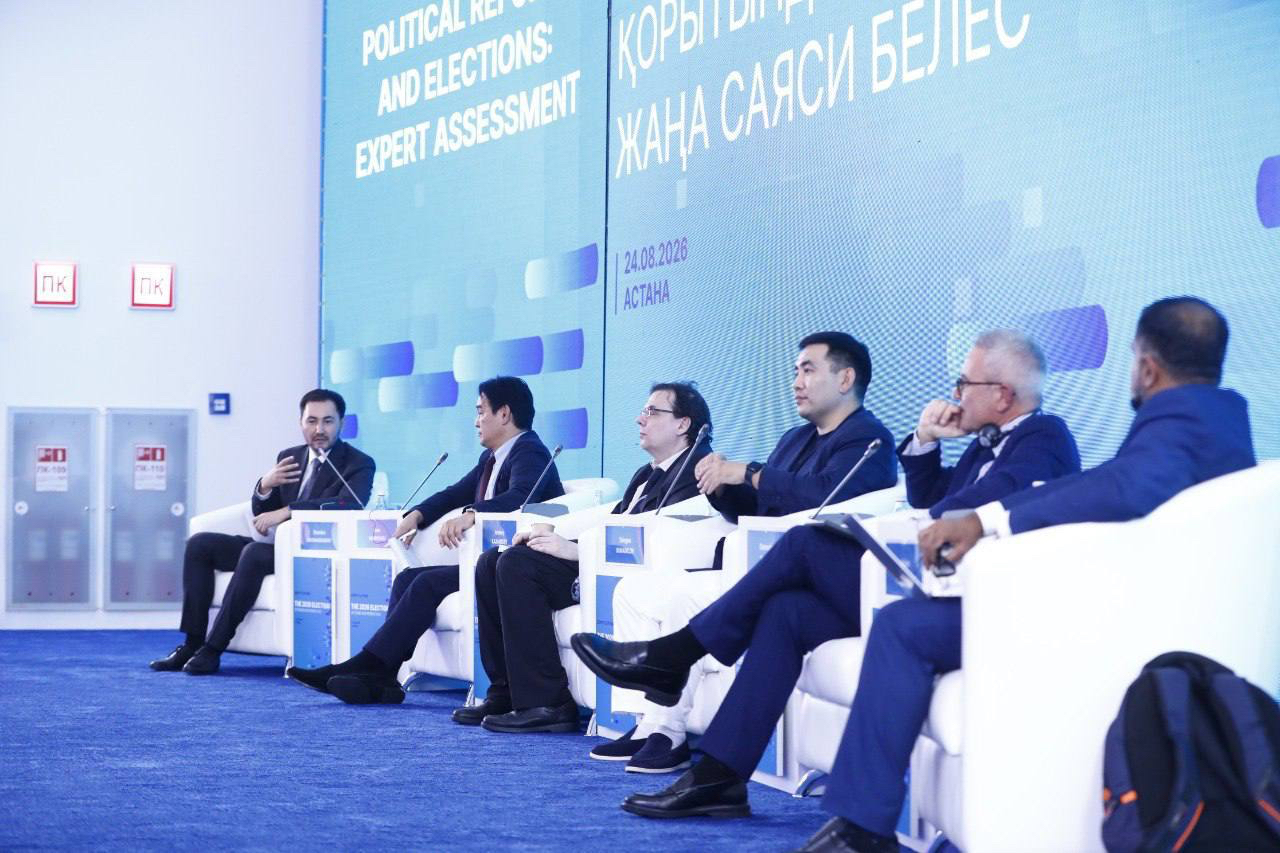
KazISS convened experts to discuss the Sunday vote and what it means for the country’s political landscape moving forward. Photo credit: KazISS
The Adilet party secured 71.17% of the vote in Kazakhstan’s first elections to the Kurultai, according to preliminary results announced by the Central Election Commission (CEC) on Aug. 24. The Auyl People’s Democratic Patriotic Party received 6.26%, followed by Respublica with 5.56%, the Aq Zhol Democratic Party with 5.21%, and the Nationwide Social Democratic Party with 5.11%.
The People’s Party of Kazakhstan received 3.11%, while the Baytaq Green Party received 1.07%. The against all option received 2.51% of the vote. Under Kazakhstan’s electoral legislation, political parties must secure at least 5% of the vote to qualify for seats in the Kurultai. Based on the preliminary figures, five parties crossed the threshold.
Zhandos Shaimardanov. Photo credit: KazISS
The Aug. 23 election marked the first test of Kazakhstan’s new constitutional architecture, moving changes adopted earlier this year from legal design into political practice, said KazISS Director Zhandos Shaimardanov. He pointed to turnout of more than 74% and the preliminary indication of five parties above the 5% threshold as two features likely to shape the new legislature: a dominant political force alongside several smaller parties represented in the Kurultai.
“The task now is to understand how this electoral choice will translate into the work of the new Kurultai, its legislative priorities and the parties’ day-to-day activities,” he added.
Election is only the beginning
Domenico Palmieri, director of the Italian Institute for Asia, said the election is just the beginning of a long path because the election itself cannot tell whether institutional reform has worked as that will be determined based on Kurultai’s performance.

Domenico Palmieri. Photo credit: KazISS
“Yesterday was a very important day for Kazakhstan, but it’s only the start of a new path. All these changes, all these reforms must be implemented and followed in the coming months and years,” said Palmieri, who has followed Kazakhstan’s presidential election in 2022, the constitutional referendum in March and the parliamentary vote on Aug. 23.
He described the transition to a unicameral parliament as a potentially more efficient model but said its effectiveness could only be assessed once the newly elected lawmakers begin legislating.
“I think we must wait six months just to see how the new parliament and new deputies will do their job,” he added.
From a technical perspective, the election proceeded smoothly, he said. What particularly stood out to Palmieri and what differs from the situation in Italy was the willingness of Kazakh citizens to vote and express their views on the country’s development. Citing nearly 75% of eligible voters casting ballots in Kazakhstan, the expert said in Italy, turnout of 50% would be considered a success.
Parties have to meet voters’ demands
Andrey Kazantsev, doctor of political sciences and a professor at the Almaty-based Narxoz University, placed Kazakhstan’s turnout in a broader context of declining political engagement in many countries, which he linked partly to growing individualization and weaker public interest in conventional politics.
However, he said the high turnout should not necessarily be interpreted as evidence that voters have become more interested in party politics itself. Instead, he noted, it may reflect a broader concern about the country’s direction at a time of growing international uncertainty.

Andrey Kazantsev in the center. Photo credit: KazISS
“This is an indicator of a strong interest of the society, probably not in politics as much. I am not sure that if you talk with ordinary people, they are specifically interested in party politics. But what they are interested in is the future: what will happen to them, what will happen to their children and they see every day on TV information about what is going on in the world,” he said.
This could become increasingly important under Kazakhstan’s redesigned political system. As Kurultai deputies are now elected through party lists rather than territorial constituencies, Kazantsev said political parties will assume greater responsibility for translating public expectations into legislative priorities.
“The demand is high. Now the parties have to provide the supply side,” said the expert, noting that it will require parties to modernize the way they operate, understand voters’ concerns more closely and offer a clearer vision of the country’s future, he said. Whether they manage to do so could become an early indicator of whether the new constitutional model is functioning as intended.
Implications beyond Kazakhstan
According to Ken Moriyasu, a senior fellow at the Washington D.C.-based Hudson Institute, the implications of Kazakhstan’s political transition extend beyond its domestic institutions.
Addressing the meeting, he pointed to growing international attention to Central Asia’s resources, trade routes and geopolitical position.
He said interest in the region has risen sharply in Washington D.C. as the United States seeks to reduce its reliance on China for critical minerals, while Beijing looks increasingly to overland Eurasian routes that are less vulnerable to disruptions along maritime trade corridors.
“Both China and the U.S. are trying to escape each other, and they’re meeting each other in Central Asia. That’s why there is so much interest,” he added.
In this context, Moriyasu described Kazakhstan’s political transition as part of a broader consolidation underway across Central Asia, where states have increasingly sought greater regional coordination and a stronger collective role internationally. The expert cited the Kyrgyz Republic’s election to the United Nations Security Council in June as one sign of that trend, stressing that greater regional backing helped Bishkek secure the seat.
“I think there is gradual integration in the region. I think it started in 2016 when Uzbekistan had a new president [Shavkat Mirziyoyev], and I think this consolidation of power and stability in Kazakhstan is a part of this big process,” he added.
According to him, greater clarity in Kazakhstan’s domestic political system could also strengthen the country’s ability to navigate intensifying competition among larger powers and continue implementing its balanced foreign policy.
What comes next
The institutional transition is already moving into its next phase. On Aug. 24, President Kassym-Jomart Tokayev reappointed the heads of the National Bank, National Security Committee and Supreme Judicial Council, as well as the Commissioner for Human Rights, as Kazakhstan begins implementing changes under the new constitutional framework.
According to the country’s Constitution, once the election results are formally announced by the Central Election Commission, President Tokayev is expected to convene the first session of the Kurultai, which by law must take place within 30 days of the publication of the final results.
The sitting government will then be required to resign after the new Parliament begins its work. Under the new Constitution, the President will nominate a candidate for prime minister after consultations with the factions of political parties represented in the Kurultai. Once appointed, the prime minister will have 10 days to propose the structure and composition of the government, while cabinet members will be appointed by the President following consultations with the Kurultai.
The Constitution also envisages the office of vice president. Tokayev said the decision will be announced soon. The President must appoint the vice president with the approval of the Kurultai within two months of the opening of the new legislature’s first session. The vice president may not serve as a lawmaker or belong to a political party, and would assume presidential powers if the head of state leaves office before the end of the presidential term.
