
ALMATY – Paris Saint-Germain’s decision to open its first football academy in Kazakhstan this September is more than another international expansion for the French club. It reflects Kazakhstan’s growing attractiveness as a destination for elite youth football development, following a series of milestones that have elevated the country’s profile.
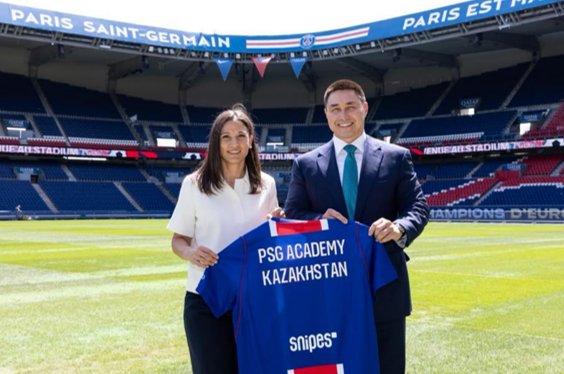
From L to R: Nadia Benmokhtar, PSG Diversification Director & CRO Chief of Staff and Almaz Alsenov, founder of PSG Academy Kazakhstan. Photo credit: PSG.
Located in Astana, the new PSG Academy Kazakhstan will welcome up to 300 boys and girls aged six to 14 during its inaugural season. Training will follow the official Paris Saint-Germain methodology, modeled on the club’s renowned youth academy in France and emphasizing technical excellence, game intelligence, discipline and teamwork.
While the academy’s opening marks Kazakhstan as the 24th country in PSG’s global network, it also fits into a broader pattern that has accelerated over the past two years: the country is increasingly positioning itself not only as a participant in international football, but as a place where future talent can be developed.
A broader football ecosystem is taking shape
The arrival of PSG follows several developments that together suggest Kazakhstan’s football strategy is evolving beyond isolated infrastructure projects or individual success stories.
Earlier, Atlético Madrid announced the creation of its football academy at the Akbulak Olympic Center in the Almaty Region. The project aims to introduce the Spanish club’s training methodology while improving the qualifications of Kazakh coaches and developing young players capable of competing at the highest international level.
Institutionally, Kazakhstan also reached an important milestone when the Kazakhstan Football Federation’s national academy became only the ninth association in the world and the second UEFA member to receive official FIFA Talent Academy recognition. The designation confirms that the country’s youth development system meets international standards and places Kazakhstan among a small group of national federations participating in FIFA’s global talent development initiative.
From exporting talent to building pathways
The growing interest from international clubs coincides with increased visibility of Kazakh football talent abroad. Earlier this year, teenage player Dastan Satpayev completed a record transfer to Chelsea, becoming one of the country’s most promising young exports.
Kazakhstan’s domestic football also enjoyed a breakthrough season. FC Kairat became the first Kazakh club to qualify for the UEFA Champions League group stage after eliminating Scotland’s Celtic FC in a dramatic penalty shootout in Almaty.
The club was later ranked among the world’s top 500 football clubs by the International Federation of Football History and Statistics (IFFHS), becoming the only Kazakh representative on the list.
Another milestone came when goalkeeper Anarbekov became the first Kazakh footballer to be named UEFA Champions League Player of the Match following his performance against Olympiacos. UEFA awarded him a 9.2 rating, while two of his saves were selected among the competition’s best moments of the round.
Taken individually, these achievements represent important milestones. Together, they suggest Kazakhstan’s football system is becoming increasingly visible within international scouting and development networks.
Why Kazakhstan?
For PSG, Kazakhstan offers more than a new commercial market. Football participation has grown steadily in recent years, accompanied by increasing investment in sports infrastructure and youth development. The Astana academy will initially operate from Air Arena, a modern indoor complex with a FIFA-standard pitch that allows year-round training despite Kazakhstan’s climate.
PSG also announced plans to expand beyond Astana, signaling that the project is intended as a long-term investment rather than a standalone academy.
“We are proud to bring the PSG Academy to Kazakhstan and provide young players with access to the Club’s world-class training methodology and football philosophy, “ said Almaz Alsenov, founder of PSG Academy Kazakhstan.
“Through this partnership, we aim to contribute to the long-term development of youth football in Kazakhstan by creating an environment where children can grow both as athletes and as individuals,” he added.
PSG officials similarly described Kazakhstan as part of the club’s strategy to broaden access to its football methodology worldwide while strengthening its international academy network.
Beyond international recognition
The arrival of another European football giant does not, by itself, transform Kazakhstan into a football powerhouse. Elite player development depends on far more than academy brands. Coaching quality, domestic competition, scouting systems and clear pathways from youth football to professional clubs remain equally important.
Yet the sequence of recent developments, from FIFA recognition and international partnerships to the emergence of players attracting attention from Europe’s top clubs, suggests Kazakhstan is gradually building many of those foundations.
If these initiatives continue to reinforce one another, the opening of PSG Academy Kazakhstan may come to represent more than the expansion of one of Europe’s biggest clubs. It could mark another step in Kazakhstan’s evolution from a country that occasionally produces exceptional footballers into one that is increasingly recognized as part of football’s global talent development ecosystem.
