
ASTANA — President Kassym-Jomart Tokayev outlined Kazakhstan’s new investment agenda centered on artificial intelligence, digitalization, critical minerals and value-added manufacturing at the 38th plenary session of the Foreign Investors’ Council on July 2, reaffirming the country’s commitment to maintaining its position as Central Asia’s leading investment destination.
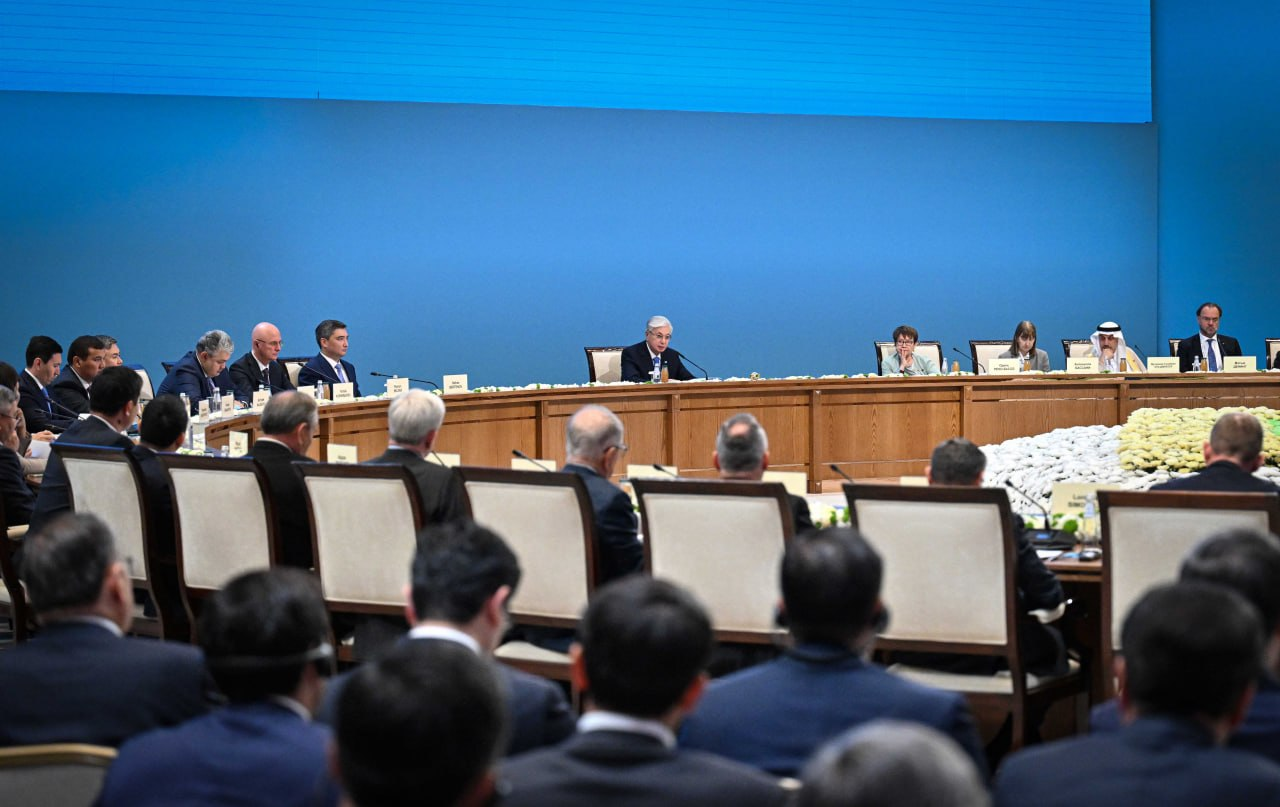
President Kassym-Jomart Tokayev outlined Kazakhstan’s new investment agenda at the 38th plenary session of the Foreign Investors’ Council. Photo credit: Akorda.
Addressing international investors, Tokayev said Kazakhstan has continued to demonstrate economic resilience despite global uncertainty and has implemented reforms designed to strengthen investor confidence, Akorda reported.
“Despite an unfavorable external environment, Kazakhstan’s economy grew by 6.5% last year. The country’s gross domestic product exceeded $300 billion. Kazakhstan intends to maintain its leadership in Central Asia in attracting investment,” Tokayev said.
According to him, net accumulated foreign direct investment has surpassed $150 billion, accounting for nearly 70% of all investment in the region.
Tokayev noted that Kazakhstan’s newly adopted Constitution, which entered into force one day before the council’s meeting, further strengthens legal protections for investors.
Digital reforms aim to simplify investment
Tokayev said Kazakhstan has created a modern institutional environment designed to make investing in the country faster and more transparent.
The government has launched a National Digital Investment Platform, serving as a one-stop shop for investors, while the Investment Headquarters continues to coordinate government support for strategic projects.
“Today, foreign entrepreneurs can benefit from our Altyn Visa program, which provides tax preferences and simplified migration procedures. At the same time, we are not going to stop here. We still have much work ahead,” he said.
Artificial intelligence takes center stage
Artificial intelligence featured prominently throughout Tokayev’s address, with the president describing AI as one of the principal drivers of future economic growth.
He said Kazakhstan has become the first country in Central Asia to commission two advanced supercomputers and is now moving forward with plans to establish Data Center Valley, a flagship initiative designed to attract global technology companies and international capital.
“According to UNCTAD forecasts, the global artificial intelligence economy will reach approximately $5 trillion by 2033. In just ten years, this figure will increase nearly twenty-fivefold, clearly demonstrating AI’s growing role in the global economy. Kazakhstan intends to move actively in this direction,” Tokayev said.
According to him, international technology companies, including Amazon and G42, have also begun exploring opportunities to participate in the emerging ecosystem.
AI expands across education and public administration
Tokayev said artificial intelligence is also becoming a key component of Kazakhstan’s education reforms.
According to him, two new-generation schools, TUMO and Tomorrow School, have opened at the Alem.ai International Artificial Intelligence Center, while research laboratories have been established in cooperation with international partners, including Telegram and Presight.
President Tokayev also recently signed a decree designating AI as a central element in the modernization of secondary education. The initiative includes personalized learning mechanisms, expanded digital infrastructure, updated educational standards and a nationwide pilot project aimed at narrowing educational disparities between urban and rural schools.
Kazakhstan is also establishing the region’s first specialized university dedicated to artificial intelligence.
“By investing in education, talent and technology, we are creating a strong foundation for Kazakhstan’s national artificial intelligence ecosystem,” Tokayev said.
Digital technologies transform logistics and energy
Beyond education, Kazakhstan is expanding AI applications across transport, logistics and energy. Tokayev highlighted the rollout of the Smart Cargo digital platform, which digitizes key transport corridors by seamlessly integrating logistics systems.
He also pointed to advances in the oil and gas sector, including the use of digital twins for production facilities, end-to-end digital traceability of oil products and AI-powered predictive maintenance technologies designed to improve operational reliability and efficiency.
The Astana International Financial Centre, he added, continues to serve as a testing ground for financial technology and AI innovations through its FinTech Lab regulatory sandbox.
Critical minerals become strategic priority
President Tokayev identified critical minerals as one of Kazakhstan’s most promising areas for future investment, saying global demand for these resources is reshaping industrial development.
“We have launched the Unified Subsoil Use Platform, which has automated the provision of 22 public services related to licensing and monitoring the fulfillment of obligations by subsoil users. More than 4.7 million archival geological documents and materials, previously available only in paper and magnetic formats, have already been transferred to the unified national digital fund,” he said.
AI is also now being used to convert historical geological records into machine-readable data, while Kazakhstan is establishing a Regional Research Center for Rare Earth Metals in Astana to provide international investors with high-quality geological information.
“Critical minerals are becoming a key strategic resource of the new industrial era. Kazakhstan continues to improve its regulatory framework and industry governance, creating the most favorable conditions possible for cooperation with leading global companies,” Tokayev said.
Moving beyond raw material exports
Tokayev also outlined his vision for transforming Kazakhstan’s agricultural sector from a commodity exporter into a regional center for advanced food processing. He said the country aims to create greater value domestically through modern food manufacturing, AI-powered production technologies, robotics and Industry 4.0 solutions.
“We seek not merely to export raw materials but to create high added value within the country through the development of modern food industries, advanced technologies and integrated production chains. We invite international investors, leading food producers, technology companies and developers of artificial intelligence solutions to participate in this large-scale transformation,” he said.
The strategy also includes investment in smart logistics systems, automated warehouses, cold-chain infrastructure and modern packaging technologies to create fully integrated digital supply chains across Kazakhstan’s agricultural sector.
