
ASTANA – Global oil demand is expected to continue growing through 2050, reaching 124.1 million barrels per day, according to the latest World Oil Outlook 2026 released by the Organization of the Petroleum Exporting Countries (OPEC).
Photo credit: Reuters
Demand is forecasted to reach 113.3 million barrels per day (mb/d) by 2030 from 105.1 mb/d in 2025.
The report projects that global oil demand will increase by approximately 19 mb/d between 2026 and 2050, with growth driven primarily by developing economies, particularly India, Asian countries, the Middle East, Africa and Latin America.
“The primary driver for this is non-OECD countries, where demand increases by 7.4 mb/d between 2025 and 2030, and 26.9 mb/d between 2025 and 2050. OECD demand is expected to increase by around 0.7 mb/d in the period to 2030 but decline in the long term. The OECD decline is almost 8 mb/d between 2025 and 2050,” said the report.
According to OPEC, oil will remain the world’s largest energy source by mid-century, accounting for nearly 30% of the global energy mix in 2050. Oil and natural gas are forecast to maintain a combined share of approximately 54% of the global energy mix by 2050.
The organization does not anticipate a peak in oil demand during the forecast period.
Global primary energy demand is expected to rise by 23% between 2025 and 2050, increasing from around 312 million barrels of oil equivalent per day to nearly 383 million. The growth is projected to come almost entirely from developing countries as populations expand, urbanization increases and economies continue to grow.
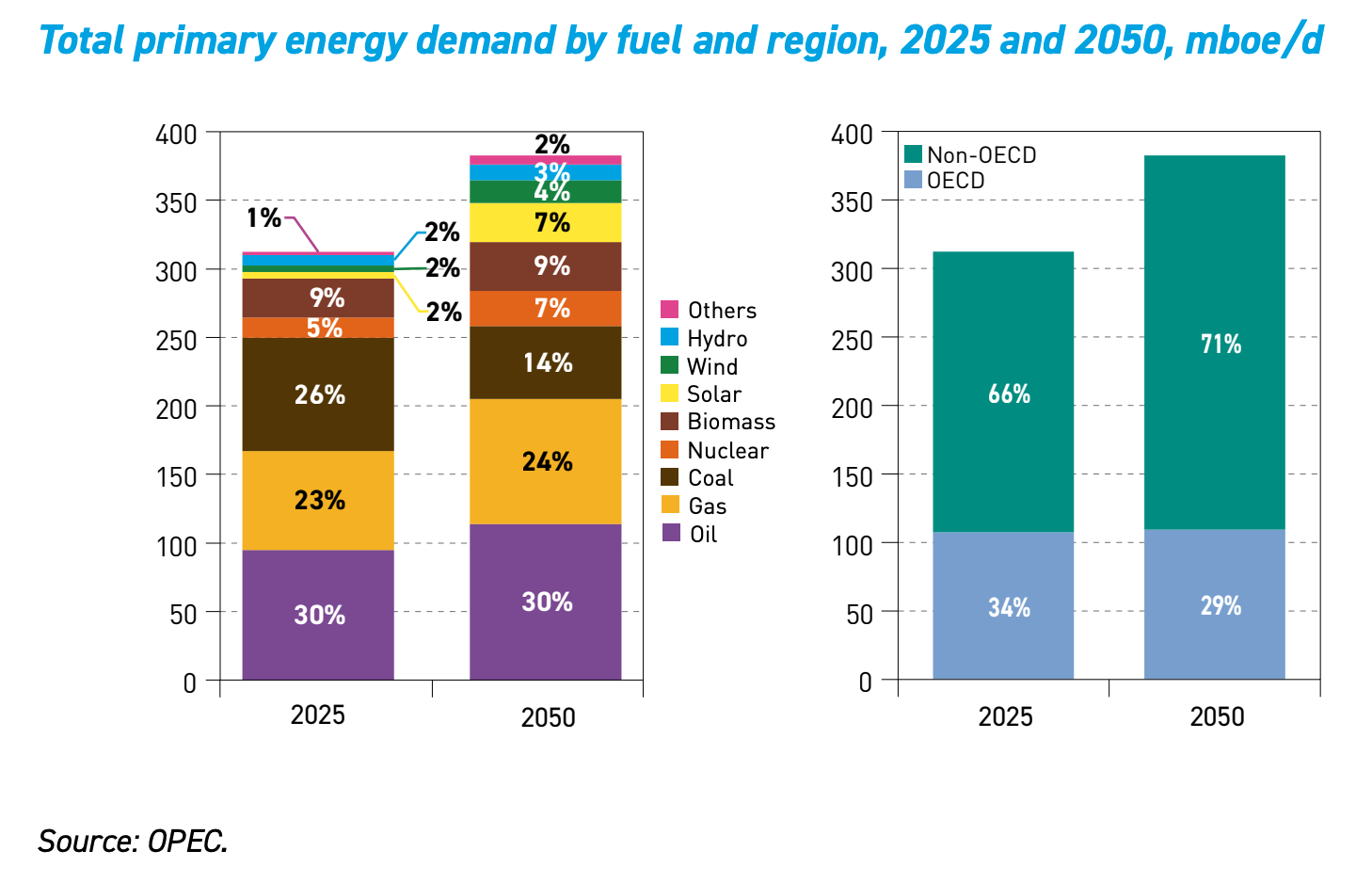
Energy demand by fuel and region. Photo credit: OPEC
The report draws on estimates that the world’s population will rise from approximately 8.2 billion people in 2025 to nearly 9.7 billion by 2050. During the same period, the global economy is expected to more than double in size, expanding from $177 trillion to $359 trillion on a purchasing power parity basis.
Although renewable energy sources are expected to experience the fastest growth, OPEC said that all forms of energy will be required to meet future demand. Renewable energy, including solar, wind, hydro and biomass, is projected to increase significantly, while coal demand is expected to decline.
“The future is not one in which the world can choose some energies while disregarding others. The scale of humanity’s energy consumption means that we need to embrace all available energy sources. Indeed, just as our energy history was one of additions – a fact that was particularly evident in 2025, when oil, gas, coal and renewables all reached record demand levels – our energy future will be too,” said OPEC Secretary General Haitham Al Ghais.
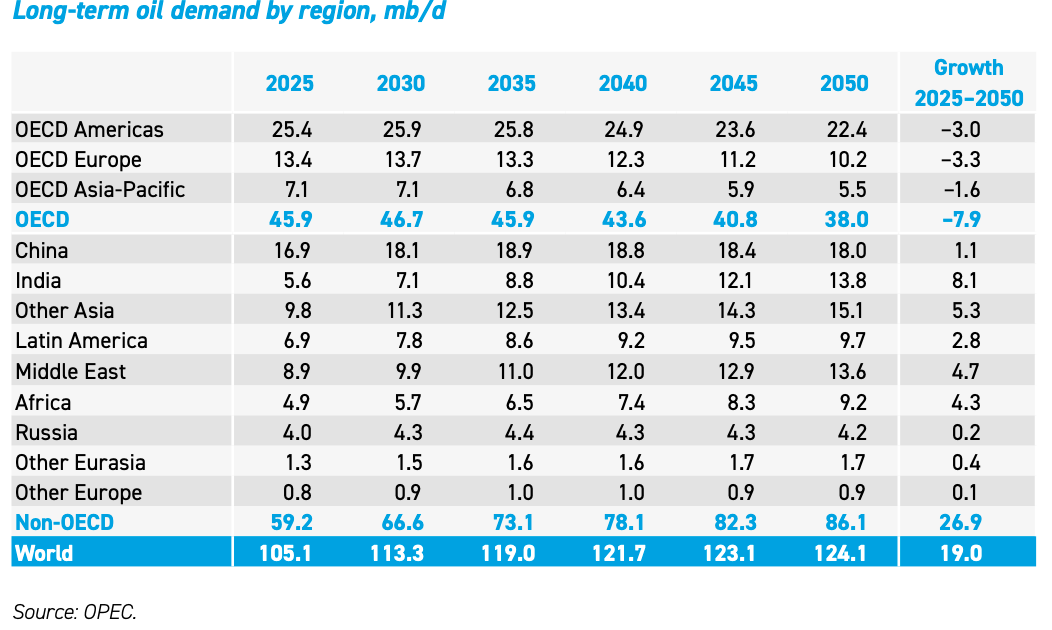
Long-term oil demand. Photo credit: OPEC
India is expected to become the largest contributor to future oil demand growth, adding 8.1 million barrels per day in demand between 2025 and 2050. Demand growth is also projected to be strong in developing Asia, Africa and the Middle East.
In Eurasia, OPEC forecasts a moderate growth in oil demand from 5.8 million barrels of oil equivalent per day in 2025 to 7.6 million barrels of oil equivalent per day by 2050.
“This is driven by economic development and population trends in countries such as Kazakhstan, Azerbaijan and Georgia, alongside continued efficiency improvements that moderate growth,” said the report.
Sectoral growth is expected to come primarily from road transportation, aviation and petrochemicals, with increases of 5.7 mb/d, 4.2 mb/d and 4.6 mb/d, respectively.
OPEC estimates that the global vehicle fleet will increase from 1.75 billion vehicles in 2025 to nearly three billion by 2050. Despite rapid growth in electric vehicles, conventional internal combustion engine vehicles are projected to account for approximately 73% of the global fleet in 2050.
The organization also emphasized the importance of continued investment in the oil industry. OPEC estimates that cumulative oil-related investments totaling $17.7 trillion will be required between 2026 and 2050 to meet future demand. Of this amount, $14.5 trillion is expected to be directed toward upstream activities, while downstream and midstream investments are projected to reach $1.9 trillion and $1.3 trillion, respectively.
The report also highlights the growing role of developing regions in global energy markets. Non-OECD countries are expected to account for the overwhelming majority of future energy demand growth, while oil consumption in OECD economies is projected to decline over the long term.
OPEC’s outlook suggests that the global energy transition will involve a more diversified
energy mix rather than a rapid replacement of conventional fuels, with oil continuing to play a central role in the world economy through 2050.
