
ASTANA – The Kazakh government is implementing a package of measures to increase household incomes, reduce debt burdens, maintain macroeconomic stability and expand energy capacity, as part of the president’s instructions to transition to a new model of economic growth.
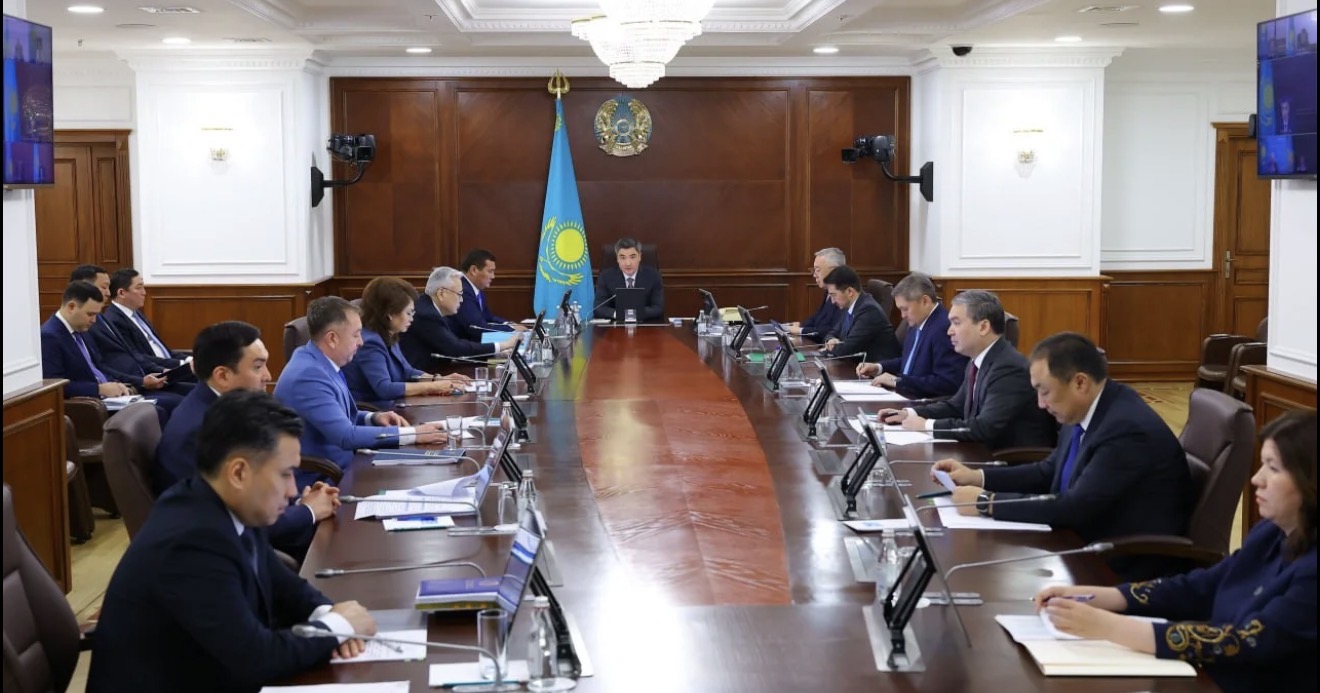
Photo credit: gov.kz
Speaking at a July 1 government meeting, Deputy Prime Minister and Minister of National Economy Serik Zhumangarin said improving citizens’ welfare remains the government’s top priority. In cooperation with the National Bank and the Agency for Regulation and Development of the Financial Market, the government is implementing the 2026-2028 macroeconomic stabilization and public welfare program, alongside a separate income growth program adopted this year, reported the Prime Minister’s press service.
The measures include raising wages, creating high-quality jobs, reducing household debt and supporting entrepreneurship. The government will also consider increasing the minimum monthly wage, civil servants’ salaries, and employees’ incomes through mutually agreed-upon obligations. Particular attention will be given to addressing household credit burdens and the rapid growth of consumer lending. The government aims to ensure annual real income growth exceeding 2-3%.
Non-oil economy drives growth as inflation eases
Despite a challenging external economic environment, Kazakhstan’s economy continues to expand, driven increasingly by non-resource sectors.
The economy grew by 3.7% in January-May, following 6.5% growth in 2025, one of the country’s strongest performances in recent years. According to Zhumangarin, growth excluding oil production exceeded 5%, reflecting a gradual diversification of the economy and the increasing contribution of non-oil industries.
The government also reported progress in curbing inflation. Annual inflation slowed to 10.3% in June, approaching the government’s target of bringing it below 10% this year.
Officials attributed the slowdown to coordinated fiscal and monetary policies implemented jointly by the government, the National Bank and the financial regulator under the macroeconomic stabilization program. Additional measures include promoting competition, expanding domestic production, improving market supply and reducing business costs.
Prime Minister Olzhas Bektenov instructed government agencies to ensure strict implementation of anti-inflation measures in coordination with the National Bank. He also ordered continued support for domestic manufacturing, expansion of storage and logistics infrastructure, regulation of pricing mechanisms and implementation of the Investment Order instrument. The Ministry of National Economy was tasked with developing a balanced tariff policy that protects both consumers and regulated utility companies.
Kazakhstan targets power surplus by 2029
The government is also accelerating the modernization of the energy sector to strengthen long-term energy security.
Energy Minister Yerlan Akkenzhenov said Kazakhstan plans to fully meet domestic electricity demand from the beginning of 2027, with a power surplus expected by 2029.
The country’s power system currently comprises 254 generating facilities, of which 172 are renewable energy installations, with a combined installed capacity of 27.1 gigawatts (GW). Electricity generation reached a record 123.1 billion kilowatt-hours (kWh) in 2025, while consumption totaled 124.6 billion kilowatt-hours (kWh).
By 2029, Kazakhstan plans to commission 13.3 gigawatts (GW) of additional generating capacity, including 12.56 gigawatts (GW) of new generation. The energy development plan through 2035 provides for the introduction of 26.3 gigawatts (GW) of capacity through modernization of existing plants, construction of new power stations, renewable energy projects and nuclear power development.
The expansion is expected to meet growing domestic demand while supporting the development of energy-intensive industries, including artificial intelligence infrastructure and large-scale data centers.
