
When Chinese novelist Mo Yan won the Nobel Prize in Literature in 2012, some argued that the award was related to his criticism of the Chinese system. Yet through the works he produced afterward, he indisputably proved himself worthy of that distinction. Time has spoken, and in June 2026 we were happy to welcome in Astana the classic writer recognized by history itself.
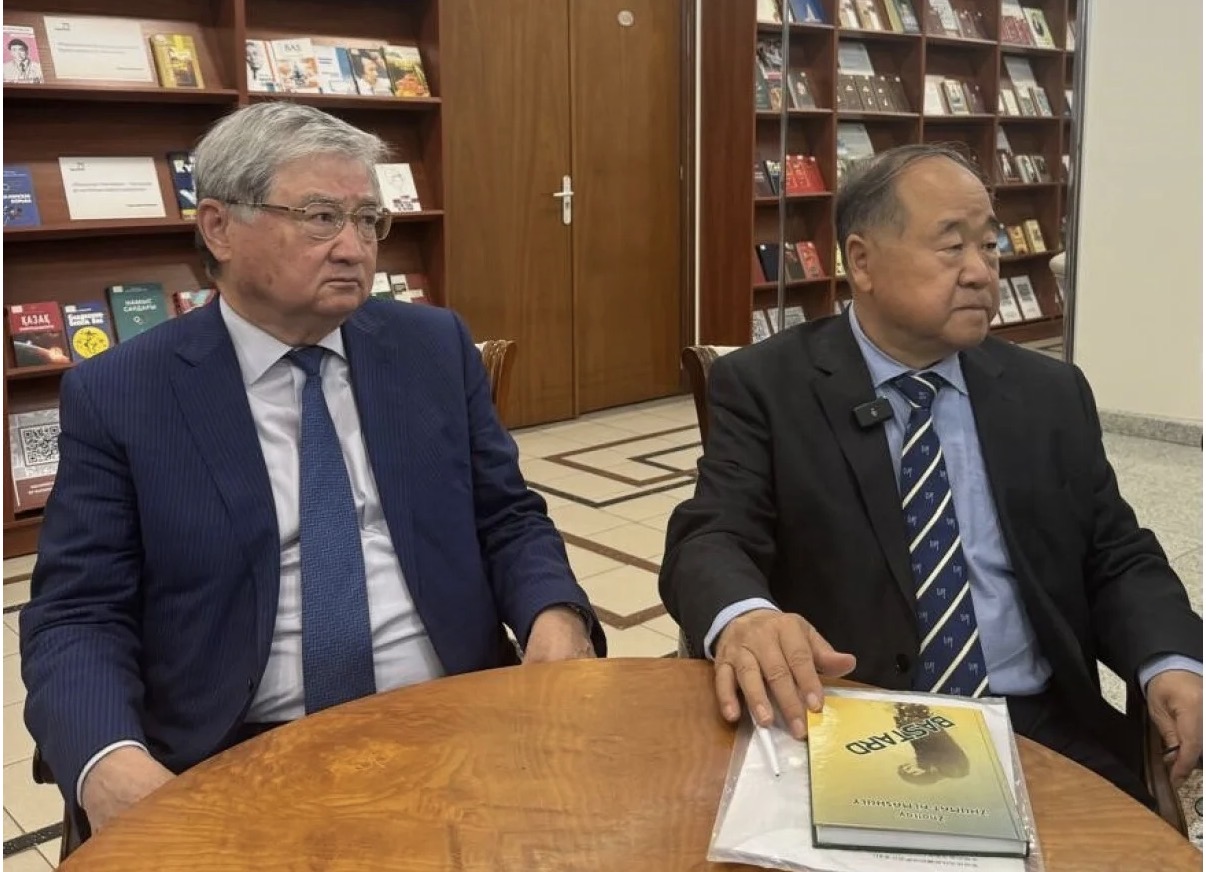
Sauytbek Abdrakhmanov and Mo Yan during his visit Kazakhstan. Photo credit: Adebi Portal.
A certain western author wrote in the 19th century, “There is a giant sleeping in the East. Let him sleep, for when he awakens, he will shake the world.” The quote reflects the attitude of many Westerners once held toward the East. Yet countless inventions and discoveries originated in China. Chinese statehood is believed to stretch back five thousand years, and written records alone cover three and a half millennia.
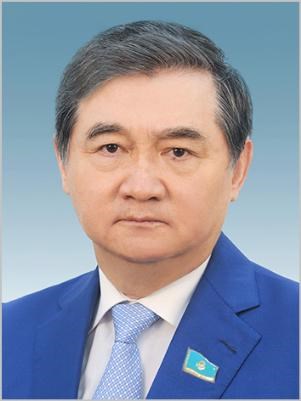
Sauytbek Abdrakhmanov.
Nevertheless, for centuries, a great nation such as China did not occupy a place in world history commensurate with its stature. The giant finally awoke at the turn of the second and third millennia.
Today, the world recognizes the Chinese miracle, including its achievements in literature. A particularly important milestone was Mo Yan’s receipt of the Nobel Prize in 2012. We take pride in this as a triumph for Eastern culture as a whole and for the great spiritual heritage of our great neighbor. For this, we thank Mo Yan.
Although I am a literary scholar, I must admit that I am not yet fully acquainted with all his works. So far, I have read the Russian translation of the novel, “Big Breasts and Wide Hips.” I have also seen excerpts of its Kazakh translation online. We all know the international success of the Berlinale Golden-Bear winning 1988 film “Red Sorghum.”
World literature contains many family sagas. Among the greatest are Thomas Mann’s “Buddenbrooks,” John Galsworthy’s “The Forsyte Saga,” and Gabriel García Márquez’s “One Hundred Years of Solitude.” I believe Mo Yan’s novel belongs to this selection of works.
After reading William Faulkner, I realized that it is not necessary to depict the entire world; showing just one corner of it can be enough. Just as Faulkner invented Yoknapatawpha County, Mo Yan created Gaomi County in Shandong Province.
I believe Mo Yan’s prose will enter literary history as a phenomenon that married Chinese folklore with magical realism.
The central theme of his novel Big Breasts and Wide Hips is also very close to the Kazakh soul.
Kazakh families do not differentiate between sons and daughters, yet they traditionally place special value on sons as continuers of the family line. Therefore, the fate of a mother who finally bears a son after seven daughters resonates deeply with us. Kazakhs, too, often give daughters names such as Ulbosyn (“May a son be born”), Ulmeken, Ulzhan, or Uldana when hoping for a son. His heroine’s daughters bear names expressing similar wishes.
Through this novel, Mo Yan wrote an epic of the entire twentieth century. He revealed the destinies of ordinary people against the backdrop of history. He created a remarkable image of motherhood and portrayed the contradictions between traditional China and the revolutionary upheavals of the last century. At the same time, Mo Yan expressed faith in the great future of the Chinese people despite all the tragedies they endured.
The image of the Mother, who survived the Japanese occupation, the civil war, the Great Leap Forward, and the Cultural Revolution while preserving her family and lineage, is one of the rare great maternal figures in world literature. Through her, Mo Yan showed that women embody the essence of a people, while men often carry the ideas that propel that people forward.
The Mother symbolizes China itself, and her children symbolize the Chinese nation.
Mo Yan employs some of the most beautiful poetic metaphors for the female breast: mountains are the breast of the earth, waves the breast of the sea, words the breast of thought, flowers the breast of grass, and the sun the breast of the universe. Everything returns to the breast; it connects the entire material world. Thus, in his works, the female breast acquires a profound spiritual dimension.
I have read that the author carried this novel within himself for nearly ten years, and that the death of his mother inspired him to begin writing it. The manuscript was completed in just eighty-three days. Such works can perhaps only be born from such inspiration.
His literary mastery is evident in the harmonious way Mo Yan connects the history of a people with the life of an individual. The blending of realism and fantasy is astonishing. That, indeed, is the essence of magical realism.
The Power of the Phenomenon called Mo Yan will continue to delight readers around the world for many years.
In Kazakhstan, President Kassym-Jomart Tokayev initiated measures to strengthen the culture of reading. I am confident that Mo Yan’s magnificent literary legacy will contribute to this endeavor.
We also hope that the first visit of Mo Yan to Kazakhstan will help make our own literature better known to the world. And we ask Mo Yan to explore and promote Kazakh literature too.
The author is Sauytbek Abdrakhmanov, Kazakh journalist, a Laureate of the 2020 Abai State Award of Kazakhstan in Literature and Arts
