
ASTANA – Archaeologists have uncovered burials from two distinct historical periods within a single ancient mound in Kazakhstan’s Karagandy Region, offering new insights into the region’s ancient cultures, the akimat’s (regional administration) press service reported on June 22.
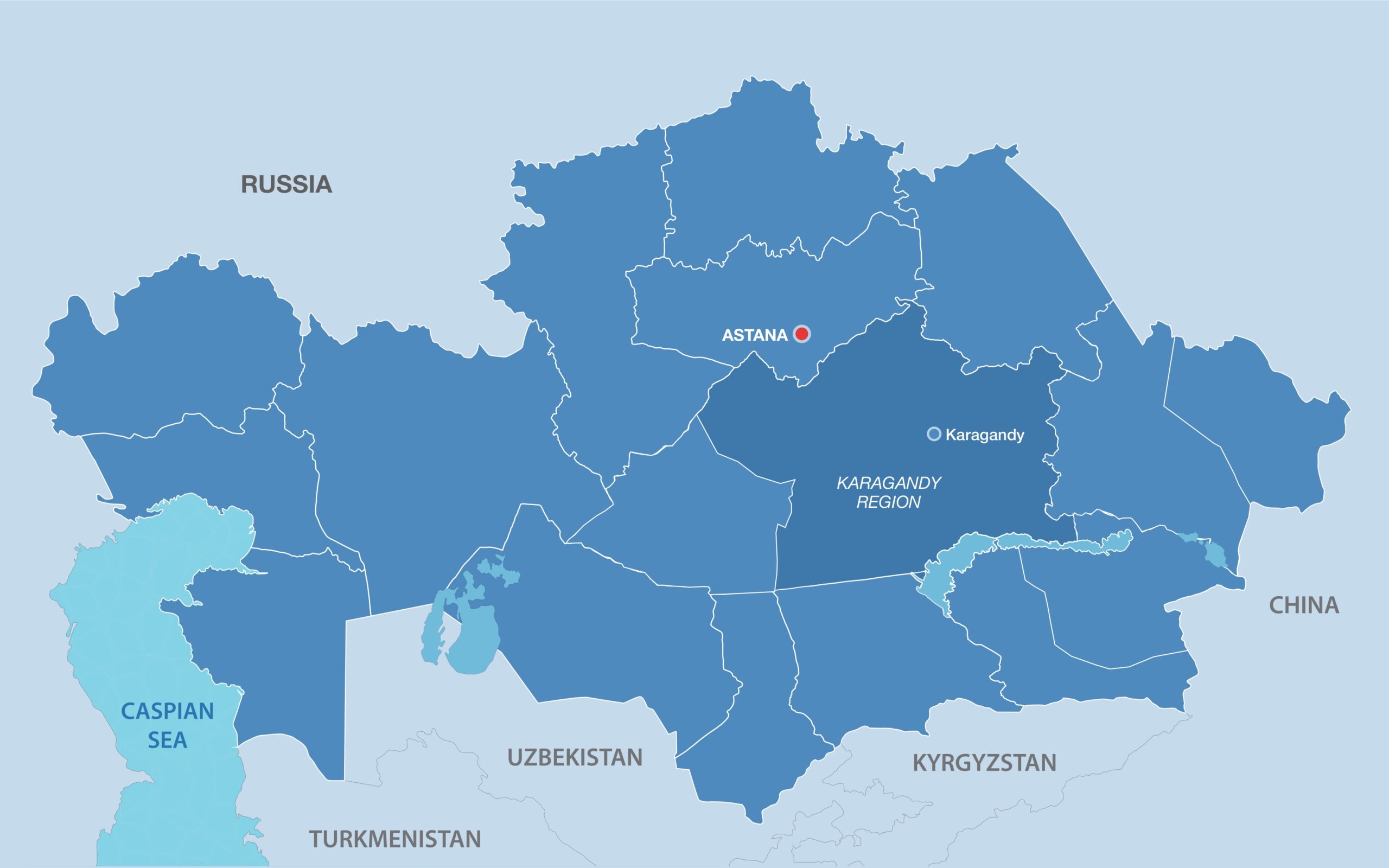
The site consists of a circular mound measuring around 10 meters in diameter and up to 40 centimeters in height. Photo credit: gov.kz. Click to see the map in full size. The map is designed by The Astana Times.
The discovery was made during excavations at the Kulaigyr-1 burial site near the village of Kulaigyr in the Abai District. The research was conducted at the request of the Karagandy Regional Center for the Preservation of Historical and Cultural Heritage.
The burial mound, measuring around 10 meters in diameter and 40 centimeters in height, contained a circular enclosure of stone slabs arranged in several rows around a stone embankment.
At the center of the mound, archaeologists found an Early Iron Age burial associated with the Tasmola culture. The deceased was buried in a supine position along a northwest-southeast axis. Artifacts recovered from the grave included a bronze mirror, a belt fitting and human skeletal remains.
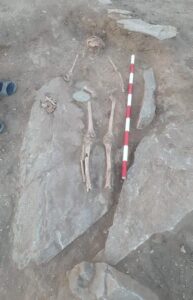
Human skeletal remains were among the finds, along with a bronze mirror and a belt fitting. Photo credit: gov.kz
Beneath the stone embankment, researchers uncovered an older burial dating to the Nurin culture of the Middle Bronze Age, estimated to have existed between the 18th and 16th centuries B.C.
The earlier burial was constructed as a stone cist and aligned along a north-south axis. Unlike the later grave, it followed a cremation rite, with charred human remains found in the southern section of the burial chamber.
“We documented burials from two different historical periods within a single mound, separated by many centuries,” said Tulkibai Tuleuov, head of the Center for the Preservation of Historical and Cultural Heritage under the Karagandy Region’s Department of Culture, Archives and Documentation.
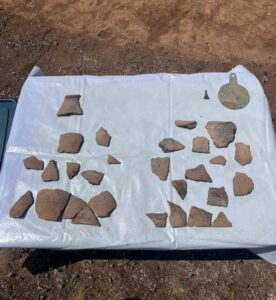
Archaeologists also recovered fragments of ceramic vessels decorated with geometric patterns characteristic of the Nurin culture. Photo credit: gov.kz
Additional finds included fragments of ceramic vessels decorated with geometric patterns characteristic of the Nurin culture, a bronze plaque and parts of another ornamented vessel.
Fieldwork at the site has been completed, and the artifacts will undergo laboratory analysis. Researchers hope the findings will shed further light on the burial practices and daily lives of ancient communities that once inhabited Central Kazakhstan.
