
ASTANA – The Almaty State Nature Reserve, one of Kazakhstan’s oldest protected areas, has safeguarded the unique ecosystems of the Northern Tien Shan for nearly a century. It preserves a remarkable diversity of landscapes, wildlife and ecosystems.
The reserve was first established in 1931 in the Small Almaty Gorge and has undergone several territorial changes throughout its history. After being dissolved in 1951, it was re-established in 1961 and today occupies 71,700 hectares in the central part of the Trans-Ili Alatau mountain range in the Almaty Region.
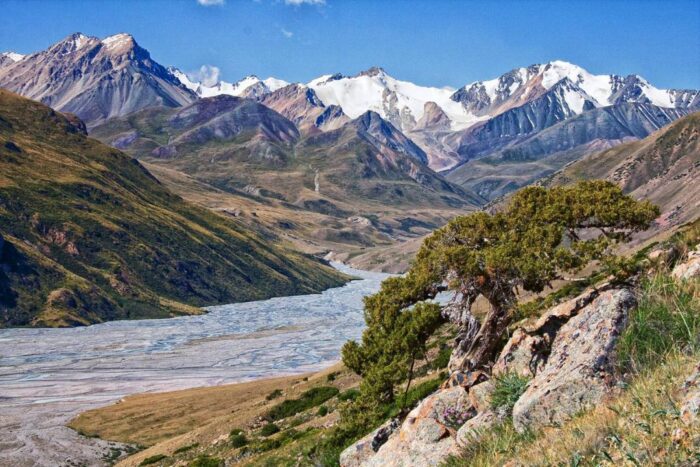
The Almaty State Nature Reserve located in the central part of the Trans-Ili Alatau mountain range in Kazakhstan’s Almaty Region. Photo credit: gov.kz
Located at elevations ranging from 1,200 to nearly 5,000 meters above sea level, the reserve encompasses a wide variety of natural zones, from deciduous forests and spruce-covered slopes to alpine meadows, glaciers and snow-capped peaks. Its highest point is Talgar Peak, which rises to 4.98 kilometers.
The reserve protects the headwaters of the Talgar, Yesik and Shilik rivers, which supply drinking water to surrounding communities. It is also home to 160 glaciers and several mountain lakes, including Akkol and Muzkol.
The area supports exceptional biodiversity. More than 1,400 plant species have been recorded here, including 29 listed in Kazakhstan’s Red Book, according to the Ministry of Ecology and Natural Resources. Among the most notable are Sievers apple, the wild ancestor of modern cultivated apples, as well as Ostrovsky’s tulip and Albert’s iris.
Wildlife is equally diverse. The reserve provides habitat for more than 1,100 animal species, including 41 mammals and 177 bird species. Rare and endangered animals include the snow leopard, Tien Shan brown bear, Turkistan lynx and stone marten. Notable bird species include the golden eagle, bearded vulture, Himalayan griffon and ibisbill.
In recognition of its ecological significance, the reserve was designated at the United Nations Educational, Scientific and Cultural Organization (UNESCO) Biosphere Reserve in 2020.
Research and education
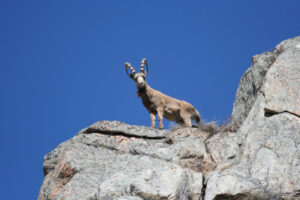
The reserve provides habitat for more than 1,100 animal species, including 41 mammals. Photo credit: esgrs.org
Scientific research remains a core function of the reserve. Specialists conduct long-term environmental monitoring through the Nature Chronicle program, tracking changes in wildlife populations, vegetation, weather patterns and hydrological conditions.
Annual surveys of mammals and birds help researchers assess ecosystem health and support conservation planning. Findings are published in scientific journals and educational materials.
The reserve also plays a key role in environmental education. Its nature museum, established in 1967, attracts more than 5,000 visitors annually and features over 3,000 exhibits showcasing local flora and fauna.
Ecological trails
The reserve offers several ecological trails that provide visitors with an opportunity to experience the landscapes of the Northern Tien Shan while minimizing human impact on fragile ecosystems.
The Left Talgar Trail, located in the Left Talgar Gorge, is a 6.5-kilometer one-day hiking route that can accommodate up to 1,200 visitors annually. The Right Talgar Trail passes through the Right Talgar Gorge and extends for 10.5 kilometers, while the Yesik Trail, situated in the Yesik Gorge, stretches 9.6 kilometers. Both trails are designed for one-day excursions and can each host approximately 1,200 visitors per year.
To protect wildlife and sensitive habitats, visitor access is regulated. The most favorable period for excursions is from August through November. Seasonal restrictions are in place during periods of heightened avalanche, mudflow and tick-borne disease risks.
