
ASTANA — A Kazakh delegation led by Deputy Prime Minister and Minister of National Economy Serik Zhumangarin arrived in Kabul with a humanitarian and business mission on June 20, delivering 318.8 tons of humanitarian aid and deploying a team of Kazakh medical specialists to provide healthcare services in Afghanistan.
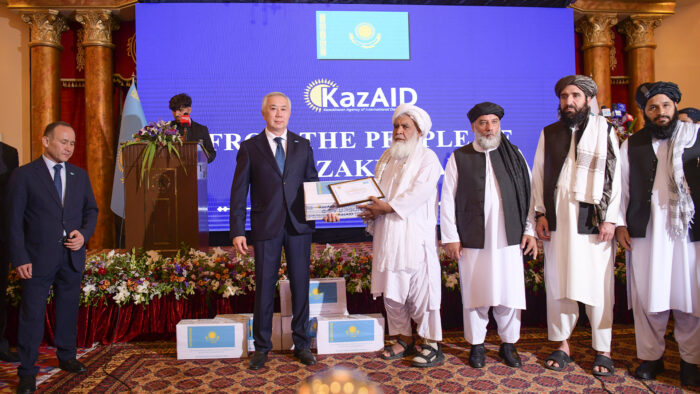
Photo credit: Prime Minister’s press service
According to the Prime Minister’s press service, the humanitarian assistance was sent on the instructions of President Kassym-Jomart Tokayev as part of Kazakhstan’s support for the Afghan people. The aid shipment includes 1.867 tons of medicines and medical supplies, 300 tons of sugar, 100 summer tents, bedding and other essential items. The medicines include antiviral, hypoglycemic, gastroenterological, cardiovascular and bronchodilator drugs. Most of the cargo, transported in eight railway wagons, was delivered to Hairatan station in Afghanistan’s Balkh Province. Part of the medical supplies arrived by air together with the delegation.
The delegation includes nine specialists from leading medical institutions in Kazakhstan. During the Days of Kazakh Medicine in Afghanistan, doctors will spend a week providing consultations and medical assistance to residents and conducting training sessions and master classes for Afghan healthcare professionals.
“We view Afghanistan as one of our priority and strategically important partners in South and Central Asia. We are confident that a stable and prosperous Afghanistan is an important condition for peace and sustainability throughout the region,” Zhumangarin said.
“This humanitarian assistance is not only an act of support but also a manifestation of solidarity, respect and responsibility. Today, nine leading specialists from Kazakhstan’s medical institutions arrived with us, including pediatricians, gastroenterologists, surgeons, traumatologists and doctors from other specialties. They will provide assistance to local residents and conduct master classes for Afghan specialists. We are continuing the medical mission launched last year,” he added.
The visit comes shortly after President Tokayev signed a law on June 17 establishing the United Nations Regional Center for Sustainable Development Goals for Central Asia and Afghanistan in Almaty. According to Kazakh officials, the center will focus on strengthening cooperation with international organizations, coordinating regional and international efforts to implement the 17 Sustainable Development Goals, developing trade and economic ties and attracting investment.
Business forum targets trade growth
Zhumangarin and Afghanistan’s Minister of Industry and Commerce Haji Nooruddin Azizi also opened the annual Kazakhstan-Afghanistan Business Forum in Kabul. More than 50 Kazakh companies representing agriculture, technology, engineering, the chemical industry and information technology are participating in the forum, alongside representatives of government and quasi-government organizations.
Bilateral trade between Kazakhstan and Afghanistan totaled $541.8 million in 2025. The two sides discussed measures to increase trade turnover to $3 billion. Kazakhstan and Afghanistan also discussed expanding trade, creating conditions for investment, reducing logistical and certification barriers, strengthening direct business-to-business ties and developing electronic trading platforms.
“On our side, we are ready to provide Afghan partners with competitive supplies of grain, flour, oilseeds, construction materials, pharmaceuticals, industrial equipment and other goods. Kazakhstan is interested not only in exports but also in implementing joint production projects in Afghanistan, particularly in food processing, agricultural processing and textiles,” Zhumangarin said.
Kazakh business representatives highlighted the results of previous cooperation. Yadykar Ibragimov, chairman of Kazakhstan’s Oil and Fat Industry Association, said sunflower oil exports to Afghanistan increased from 17,000 tons during the 2022–2023 season to 75,000 tons in the current season.
“Over three seasons, we increased supplies by more than four times. Our goal for the next season is to increase sunflower oil exports to 110,000–120,000 tons,” Ibragimov said.
At the forum, Zhumangarin presented Afghan officials with a BARK VibroLUNG device developed by Kazakhstan-based BARK Technology. The device is designed to improve respiratory function and clear airways through vibroacoustic therapy and can be used in the treatment and rehabilitation of patients with respiratory diseases.
Participants also presented a mobile diagnostic complex equipped with the HES-7 system developed by Kazakhstan’s Konsung Technology. According to the company, the artificial intelligence-based system can perform electrocardiograms, functional diagnostics, rapid laboratory tests and screening for cardiovascular, liver, kidney, blood and lung diseases, as well as diabetes. According to Kazakh officials, agreements are expected to supply 4,500 units of the equipment to Afghanistan, valued at approximately $45 million.
High-level talks focus on investment and infrastructure
During the visit, Zhumangarin held talks with Afghan Prime Minister Mohammad Hassan Akhund and Deputy Prime Minister Abdul Ghani Baradar. According to the Prime Minister’s press service, the meeting between Zhumangarin and Akhund was the first of its kind in the four years of active humanitarian and business cooperation between the two countries. Akhund welcomed the Kazakh delegation and expressed appreciation to President Tokayev for Kazakhstan’s support for the Afghan people, according to Kazakh officials.
The sides discussed humanitarian cooperation, trade, investment and education. Kazakhstan has provided scholarships for Afghan students to study at Kazakh universities and has supported professional training and healthcare initiatives.
The talks also covered cooperation in the mining and metallurgical sector. Kazakh officials said Kazakhstan’s mining industry has expertise in processing non-ferrous, ferrous, rare and precious metals. During discussions with Afghan officials, the Kazakh side raised the issue of exporting technical aquamarine from Afghanistan for processing in Kazakhstan.
Kazakhstan’s state mining company Tau-Ken Samruk visited Afghanistan’s Bamyan Province in October 2025 and collected samples from the Pami-Kakrak zinc deposit. Subsequent analysis conducted by specialists from Kazzinc indicated the possibility of processing the ore at facilities in Kazakhstan, according to Kazakh officials.
“We are interested in supplies of zinc ore from Afghanistan. Kazakh enterprises have the necessary expertise in technological modernization, engineering, equipment supply and commissioning support,” Zhumangarin said.
The parties also discussed the possible participation of Eurasian Resources Group (ERG) in the exploration and development of chromium deposits in Afghanistan.
Transport corridors and market access
Transport and logistics cooperation was another focus of the talks. According to the Kazakh delegation, Kazakhstan is completing construction of the Khaf-Herat railway section and is interested in participating in additional infrastructure projects in Afghanistan.
“We support the implementation of the Central Asia–South Asia (CASA) Trans-Afghan Transport Corridor, which could facilitate the transportation of up to 10 million tons of cargo to the Pakistani ports of Karachi and Gwadar. We are also prepared to participate, together with Uzbek and Turkmen partners, in railway construction projects through Mazar-i-Sharif and Turgundi toward Herat,” Zhumangarin said.
The two sides also discussed expanding agricultural trade. Afghan agricultural products are expected to be supplied to Kazakhstan’s retail chains Small and Magnum under existing agreements. Products discussed include pomegranates, grapes, apricots, plums, watermelons, melons, early-season vegetables, nuts and other fruit and vegetable products. Kazakh officials also informed their Afghan counterparts about increased flour supplies to Afghanistan, particularly to Herat.
The discussions additionally addressed financial and settlement-related barriers affecting bilateral trade. The two sides reviewed measures aimed at facilitating cooperation in trade, transport, industry, telecommunications and humanitarian affairs.
