
ASTANA — In Kazakh culture, grief has traditionally been a collective experience, shaped by shared rituals and community support. But do these practices continue to define how people cope with loss today?
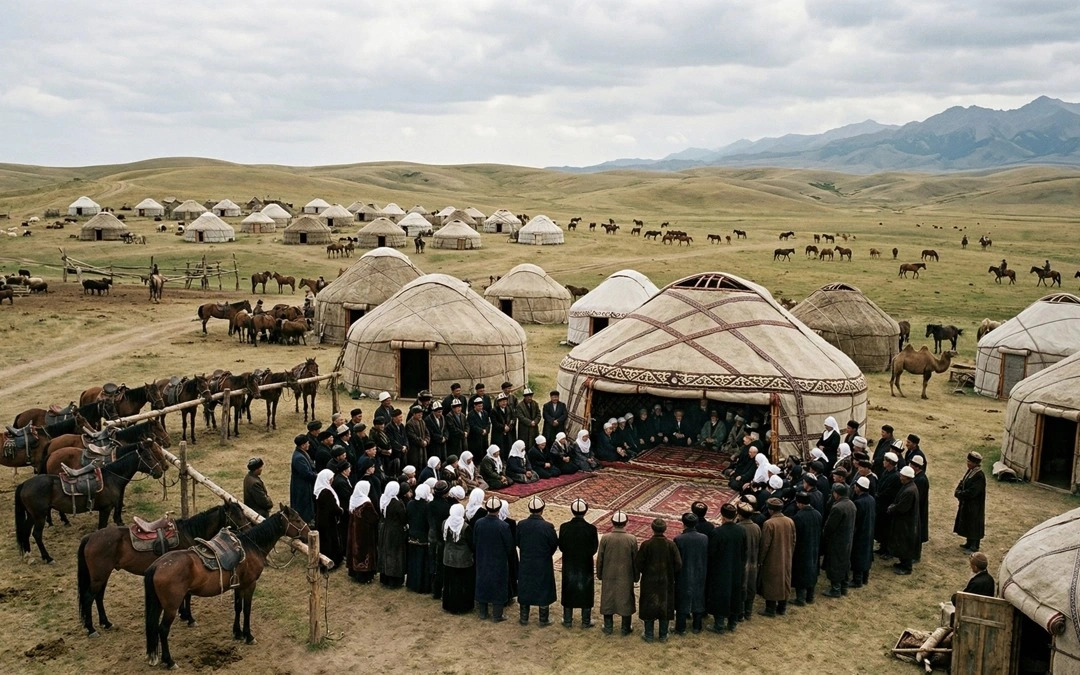
Photo credit: Kazinform
Despite changes in daily life, many of these traditions remain visible, particularly in how communities gather around families during times of loss. The doors of the bereaved family’s home remain open, with a steady flow of visitors coming to offer condolences, share memories and take part in remembrance.

Bibiziya Kalshabayeva, a professor of archaeology, ethnology and museology at Al-Farabi Kazakh National University. Photo credit: Kazinform
According to Bibiziya Kalshabayeva, a professor of archaeology, ethnology and museology at Al-Farabi Kazakh National University, these practices reflect long-standing social structures where communities functioned as closely connected groups.
“Historically, each household had its own seasonal pastures. People lived in tightly connected communities, and thus joys and sorrows, victories and hardships were perceived as shared. If hardship came to one family, the entire clan carried that burden,” said Kalshabayeva.
This is reflected in the expression ‘zhumyla kotergen zhuk zhenil,’ a burden is lighter when lifted together.
“Even those with modest means contributed, bringing livestock, flour, or food. The absence of such support was considered a disgrace for the whole clan,” Kalshabayeva added.
Shared grief and communal support
Kalshabayeva said the idea of shared loss continues to shape mourning practices today. During the first seven and 40 days after a death, which are important periods in Kazakh remembrance traditions, families are rarely left alone.
“Death is perceived as a collective loss for all those close to the person. In fact, being present during times of grief is often considered more important than gathering for celebrations,” she said.
This sustained presence is reflected in the tradition known as konil shai, literally “tea of condolence,” in which visitors gather to express sympathy, share conversation and provide comfort.
“Expressing condolences is seen as a duty. It is a support for a family. Communication helps people endure loss more easily,” she said.
Rituals of expression and emotional support
Traditional practices such as zhoqtau (lamentation), estirtu (the announcement of death) and synsu (a bride’s farewell song) continue to illustrate how emotions are expressed and managed within Kazakh culture.
“Zhoqtau is an expression of grief through poetry. It is not only a farewell but also a way to relieve inner pain. As Abai Kunanbayev wrote, a person cannot remain silent when consumed by sorrow – ‘soilemei pende shydamas, qaigy otyna ashyngan’ – through lament, emotions find an outlet,” said Kalshabayeva.
She noted that historically, lamentations could continue until the first anniversary of death. Ethnographer Aubakir Divaev described these songs as reflecting both the intellect and emotional depth of women.
“Zhoqtau is not a chaotic outburst, but a drawn-out, melodic expression of grief. Even today, people may say someone ‘could not properly mourn’ a loved one. Some memorize texts, while others are encouraged to express what they feel inside. This highlights the strong psychological role of the tradition,” said Kalshabayeva.
The practice of estirtu demonstrates a careful approach to delivering difficult news, historically avoiding direct statements and instead relying on symbolic or mediated forms.
“In earlier times, tragic news was delivered delicately. For example, in the legend of ‘Aksak Kulan,’ the death of Jochi Khan’s son was conveyed through a kui [a musical composition],” she said.
“Today, unfortunately, such news is often shared immediately on social media, which contrasts with traditional norms,” she added.
Preparing for uncertainty
Kazakh traditions also address emotional challenges beyond grief. One example is tokym kagar, a send-off ceremony for someone departing on a journey.
“This ritual was meant to set a person on a positive path and instill confidence. It was especially important for young people leaving for independent life. It symbolized both coming of age and overcoming fear of the unknown,” said Kalshabayeva.
The ritual of synsu similarly shows how song is used to process emotional transitions.
“Moving from house to house, a bride would share her feelings in song – anxiety, sadness and longing. It helped her psychologically prepare for a new stage of life,” she said.
The article was originally published in Kazinform.
