
ASTANA – Kazakhstan and the United States (US) have strengthened their strategic partnership through high-level meetings in Washington, D.C., focused on expanding economic cooperation, investment, energy collaboration, and infrastructure development.
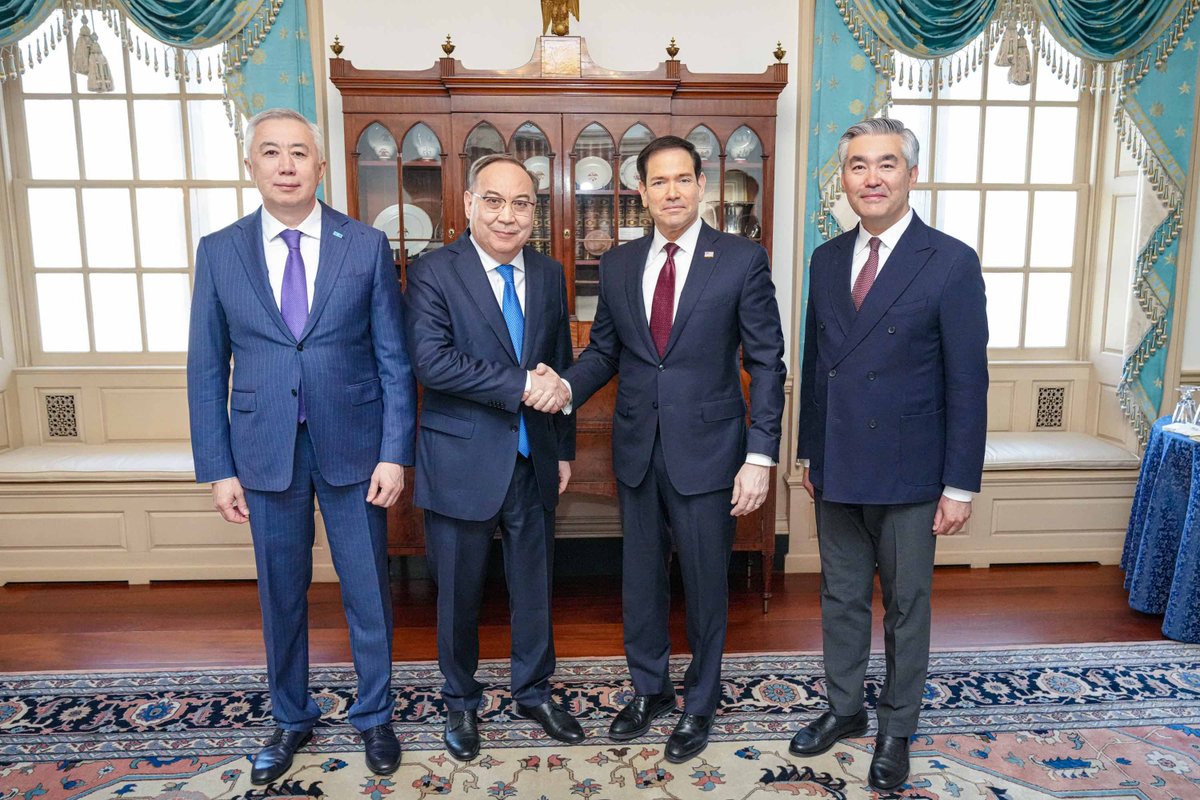
Photo credit: Secretary Marco Rubio/ Twitter
Rubio meets Kazakhstan officials to address bilateral cooperation
U.S. Secretary of State Marco Rubio met with Kazakhstan Deputy Prime Minister and Minister of National Economy Serik Zhumangarin and Special Representative for Negotiations with the US Yerzhan Kazykhan to expand opportunities for bilateral cooperation. The sides discussed Kazakhstan’s role in peacemaking and regional initiatives, as well as ways to expand economic ties. Rubio welcomed Kazakhstan’s participation in the C5+1 platform and its role in regional cooperation. The US reaffirmed its support for Kazakhstan’s sovereignty, independence, and territorial integrity and expressed its commitment to further strengthening the strategic partnership, the U.S. Department of State reported on April 15.
Kazakhstan, World Bank discuss expanding investment partnership
Kazakhstan outlined its proactive economic growth strategy focused on investment, diversification, and industrial development at a roundtable at the World Bank. Zhumangarin said reforms aim to expand the investment base, develop new industries, and strengthen institutional frameworks in tax, budget, and corporate sectors. Presidential adviser Asset Irgaliyev noted that the public sector is coordinating efforts to develop a long-term, sustainable economic model.
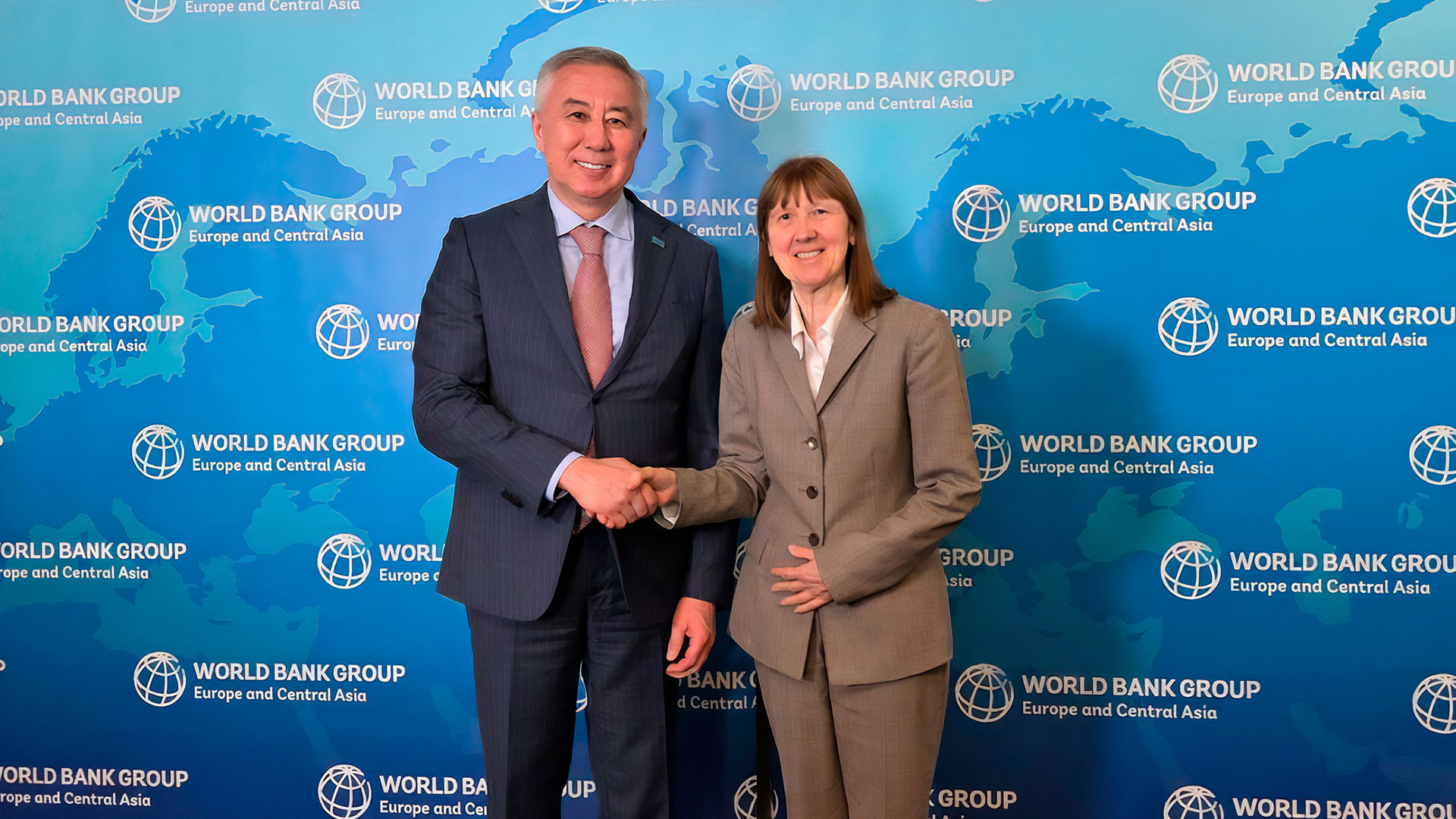
Photo credit: gov.kz
Kazakhstan’s economy remains resilient, with GDP growth reaching 6.5% in 2025 and continuing into 2026 despite oil supply disruptions linked to Tengizchevroil and constraints on the Caspian Pipeline Consortium. Investment increased 13% to $43.6 billion in 2025, while foreign direct investment reached $20.5 billion. International reserves rose to $129.5 billion, and public debt remains at 22.8% of GDP, reported the Prime Minister’s press service.
The government is targeting $400 billion in total investment over five years, prioritizing manufacturing, petrochemicals, agriculture, and high-value industries. A portfolio of 274 projects worth 700 billion tenge (US$1.5 billion) is underway, alongside development of Alatau as a new economic hub expected to generate up to $50 billion in regional output and create around 1 million jobs by 2050. World Bank officials supported the reforms while noting risks related to inflation and productivity.
Meeting with World Bank Vice President Antonella Bassani
Zhumangarin also met with World Bank Vice President for Europe and Central Asia Antonella Bassani to discuss expanding cooperation on investment and reforms. The officials reaffirmed a strategic partnership that has delivered more than $8 billion in over 50 projects since 1993, spanning transport, education, environment, and digitalization.
The meeting also focused on the 2026-2030 partnership framework, including transport connectivity, energy, water management, digitalization, climate policy, and renewable energy. Ongoing projects include highway reconstruction and digitalization initiatives, with additional large-scale infrastructure programs under development.
KazAvtoZhol, World Bank, AIIB sign highway financing deal
In infrastructure development, KazAvtoZhol national company, the International Bank for Reconstruction and Development (IBRD), and the Asian Infrastructure Investment Bank (AIIB) signed a 650 billion tenge (US$1.4 billion) agreement to finance the construction of the 457-kilometer Karagandy-Zhezkazgan highway. The project aims to improve regional connectivity, transit capacity, road safety, and economic activity in Central Kazakhstan, with construction expected to begin this year.
Cooperation in the peaceful use of nuclear energy
Kazakhstan and the US also discussed expanding cooperation in the peaceful use of nuclear energy during a meeting with the U.S. Department of State and Kazakhstan’s Atomic Energy Agency. The sides focused on expert exchange, institutional cooperation, and coordination amid global energy transitions, reaffirming commitment to the continued development of bilateral cooperation in the nuclear sector.
Kazakhstan engages U.S. companies to expand investment cooperation
The Kazakh delegation, led by Yerzhan Kazykhan, engaged with U.S. policymakers, experts, and business leaders to expand bilateral economic cooperation and promote Kazakhstan’s investment opportunities, reported Kazinform on April 16.
As part of the spring sessions of the World Bank and the International Monetary Fund, discussions focused on strengthening trade and investment ties and positioning Kazakhstan as a key economic partner in Central Asia.
At a roundtable hosted by the U.S. Chamber of Commerce, representatives of major U.S. companies, including Chevron, ExxonMobil, PepsiCo, Morgan Stanley, Citi, Nasdaq, and Meta, explored opportunities for cooperation.
Key areas included energy, critical minerals, infrastructure, digitalization, artificial intelligence, and logistics. Kazakhstan was highlighted as a growing market and a strategic hub for trade and transit across Eurasia.
Kazakhstan’s economic performance was also noted, with GDP reaching $300 billion, placing the country among the world’s top 50 economies. Kazakhstan’s National Bank Chair Timur Suleimenov emphasized macroeconomic stability and the country’s role as a regional investment destination.
Both sides expressed interest in expanding partnerships, with a focus on attracting U.S. investment and supporting joint projects in priority sectors.
