
ASTANA — Kazakhstan and Georgia moved to accelerate development of the Trans-Caspian International Transport Route (TITR) during Kazakh Foreign Minister Yermek Kosherbayev’s April 7 visit to Tbilisi, reinforcing its role as a strategic pillar of regional connectivity.
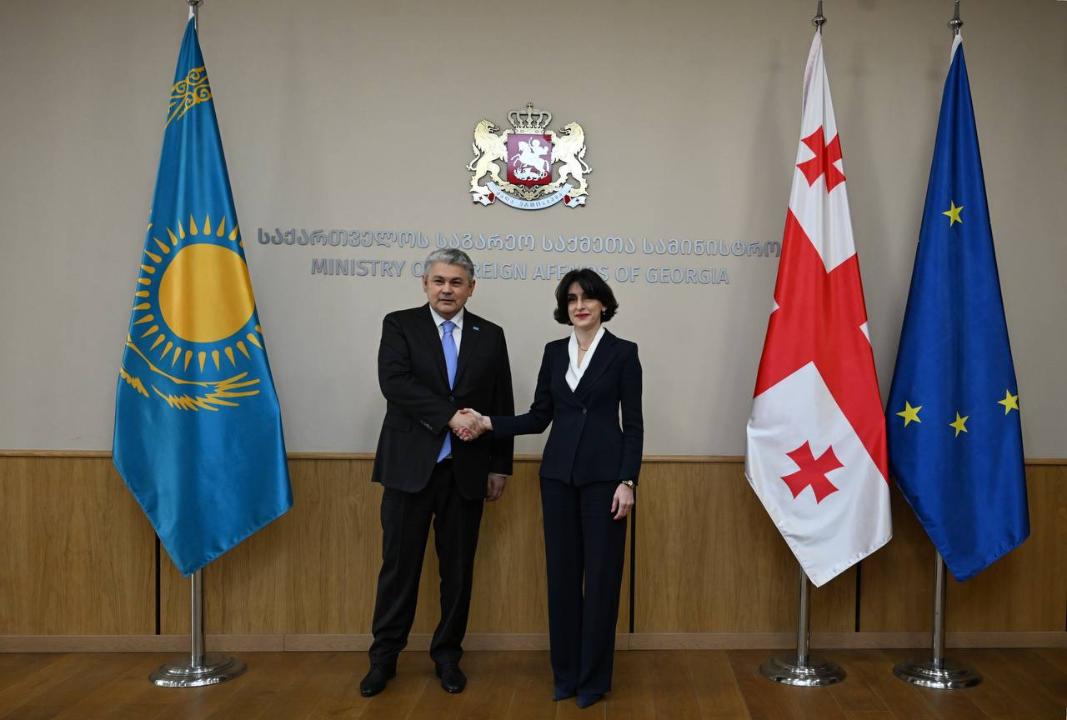
Photo credit: gov.kz
Kosherbayev held talks with Georgian Foreign Minister Maka Bochorishvili, the ministry’s press service reported. The discussions placed particular emphasis on enhancing the capacity, reliability, and transparency of the Trans-Caspian corridor, a key route increasingly seen as a strategic alternative for connecting Asia and Europe.
“Our common task is to consistently expand its capacity, improve the predictability of transport services, and ensure transparency in tariff policy,” Kosherbayev said.
The route, also known as the Middle Corridor, has gained renewed geopolitical and economic significance amid shifting global supply chains.
Economic cooperation remains on an upward trajectory. The ministers welcomed the steady growth in trade turnover and highlighted that Kazakh investments in Georgia have surpassed $600 million. Kazakh companies continue to expand their presence in key sectors, including logistics, energy, and finance, all of which are directly linked to the efficiency of the TITR.
Beyond transport, the ministers reviewed the broader state of Kazakh-Georgian relations, describing them as pragmatic, multifaceted, and grounded in shared economic interests.
“Kazakhstan views Georgia as a reliable political and economic partner in the South Caucasus,” Kosherbayev noted, highlighting Tbilisi’s role as a vital logistical bridge between Europe and Asia.
The talks also built on the momentum generated by Georgian Prime Minister Irakli Kobakhidze’s February 2025 visit to Kazakhstan, which both sides said elevated bilateral ties to a new level.
At the same time, both sides acknowledged untapped potential in agriculture, digital economy, and financial services, signaling a gradual diversification beyond traditional sectors.
Kosherbayev also drew attention to President Kassym-Jomart Tokayev’s proposal to establish an International Water Organization under the United Nations, aimed at strengthening global water security. This issue increasingly intersects with regional stability and economic planning.
The negotiations concluded with the signing of a Cooperation Program between the two foreign ministries for 2026–2027, formalizing the next phase of engagement.
