
ASTANA – Life in the Kazakh steppe followed a strict seasonal order shaped by nature, customary law and pastoral rhythms. Far from chaotic wandering, nomadic society functioned as a structured system in which livestock breeding determined social organization, legal norms and even political decisions. Surviving winter was the central objective of this system.
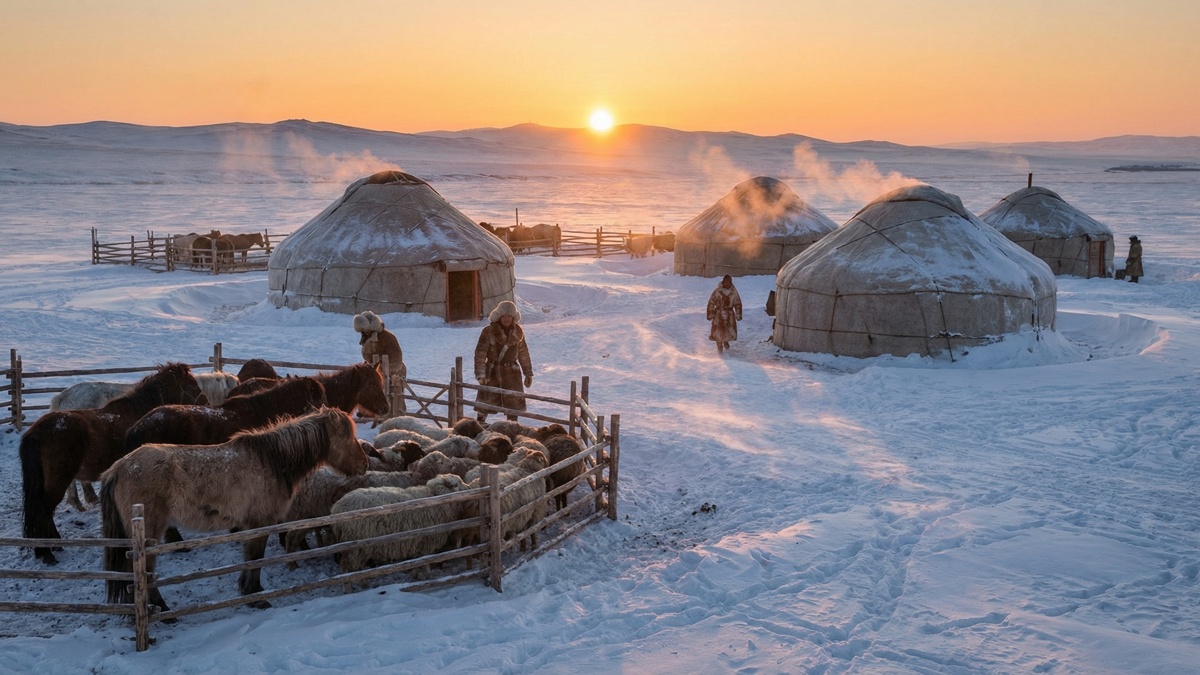
Photo credit: Nano Banana Pro
Bereket Karibayev, a professor at Al-Farabi Kazakh National University and Doctor of Historical Sciences, told Kazinform that pastoralism was not merely a way to survive but the foundation of Kazakh social, economic and political life.
“There were four types of livestock breeding: nomadic, semi-nomadic, semi-sedentary and sedentary. Each had its own geographic and environmental characteristics,” Karibayev said.

Bereket Karibayev, a professor at Al-Farabi Kazakh National University and Doctor of Historical Sciences. Photo credit: abai.kz
Seasonal migration followed a clearly defined cycle. Pastures were divided into winter (kystau), spring (kokteu), summer (zhailau) and fall (kuzeu). Salt marshes, deserts and semi-desert regions were particularly suited to semi-nomadic livestock breeding.
According to Karibayev, movement across the steppe was deliberate and environmentally adapted. Nomadic communities did not rush to leave winter camps at the first signs of spring. The priority was preserving livestock health rather than reaching summer pastures quickly.
“The goal was to fatten the animals. Kazakhs called this kon jinatu. They remained in fall pastures until the first snowfall. Abai [a Kazakh prominent author] wrote: ‘Fearing I might exhaust my land by arriving too early, the rich man stays on the autumn pasture behind shelter.’ This reflects careful planning and rational pasture use,” Karibayev said.
Seasonal pastures had various legal statuses. Summer pastures were communal property shared by clans or tribes, while wintering grounds were privately owned.
“Zhailau never belonged to one individual. shared by a clan, tribe or community. However, winter camps, including land and wells, were the property of specific families and legally protected,” Karibayev said.
Land disputes were resolved in the courts of biys (judges), and customary law norms were strictly observed.
Winter risks and settlement strategy
For nomadic communities, the greatest threat was zhut, a mass livestock mortality caused by severe winters, deep snow, or ice that prevented grazing. Food shortages and disease often accompanied such periods.
Winter camps were selected according to strict criteria, such as access to water, protection from blizzards, availability of reeds for fuel and pastures suitable for tebeneu, a practice of grazing through snow. The lower and middle reaches of the Syrdarya became strategically important wintering areas.
Karibayev noted that livestock measured wealth and power. “Some wealthy pastoralists owned 15,000 to 20,000 horses, 10,000 to 15,000 sheep and up to 1,000 camels,” Karibayev said.
Animals provided food, transport, clothing materials, military capacity and functioned as a form of currency.
During winter, clans settled far apart, a pattern Karibayev described as a “law of dispersion.” “To preserve pastures, clans dispersed widely, and regular communication nearly stopped,” he said.
This vulnerability was exploited by enemies. According to Ruzbihan Isfahani’s chronicles, many of Muhammad Shaybani Khan’s campaigns occurred in winter, when Kazakh communities were scattered.
Karibayev noted that seasonal priorities also influenced state policy. In the 16th century, Abu Sa’id Bahadur Khan proposed a military alliance to Kassym Khan against Muhammad Shaybani Khan. Kassym Khan declined.
“He responded that autumn had arrived and preparation for winter was more important than war. This is recorded by Muhammad Haidar Dulati. It shows that survival outweighed military ambition,” he said.
Spring renewal and summer prosperity
Spring migration was gradual and tied to lambing season. Daily movement did not exceed eight to ten kilometers to ensure young livestock were fed and watered. Shearing began in spring: sheep and goats were clipped, horses’ manes trimmed, and camels’ extra wool removed. Migration to summer pastures typically began in early May, once young animals had strengthened.
Spring marked the renewal of both nature and social life.
“Connections between auls (villages) resumed after lambing and with the arrival of spring. This is the origin of the Korisu tradition during Nauryz, when youth visited elders in neighboring settlements to show respect,” Karibayev said.
Summer pastures were located in grass-rich areas with clean water, often between steppe and mountain zones. Communities remained there for one and a half to two months. Mares were milked and kymyz prepared. Ensuring proper livestock fattening during summer was essential for winter survival.
Seasonal work included washing lambs’ wool by driving them through rivers and later shearing them. Women of all ages participated in felting wool for carpets and household items. Weddings, festivals and communal gatherings were often held in summer pastures.
