
ASTANA — Kazakhstan is seeking to reposition its beef industry from a commodity-based supplier to a value-added premium exporter, as industry leaders unveiled a comprehensive export ecosystem and market consolidation strategy at the Dala.Camp Forum 2026 in Burabai on Feb. 14.
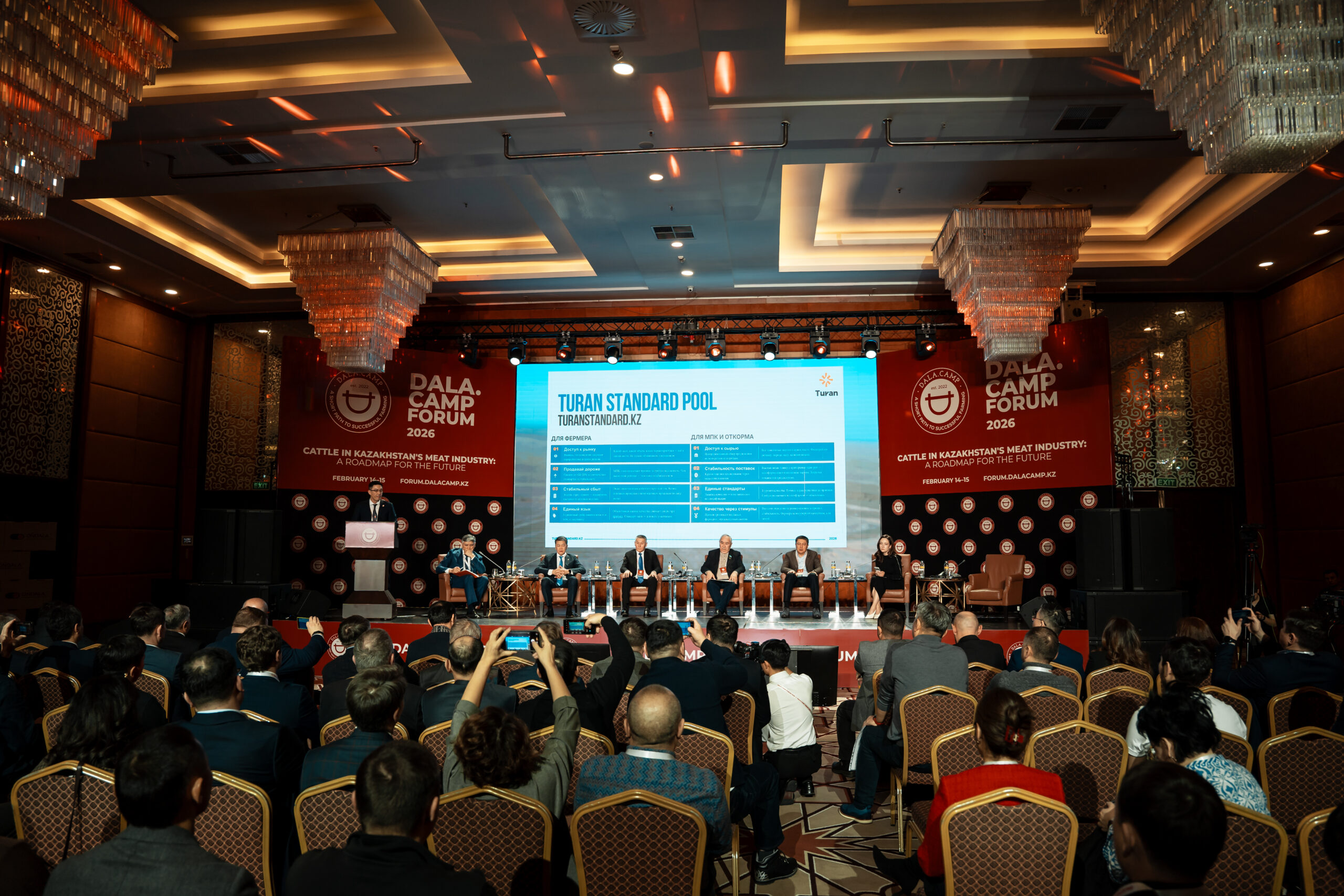
Photo credit: Turan Livestock Association.
Opening the forum, Chairman of the Board of the Turan Association of Livestock Breeders Zhanibek Kenzhebayev said the sector should move beyond fragmented production models and adopt unified standards, coordinated management and internationally recognized certification systems to compete in high-value global markets.
“We have gathered here at a very important, I would even say historic, moment for our industry. A moment when Kazakhstan’s livestock sector is gradually moving to a new level — more systemic, more mature and focused on long-term results,” Kenzhebayev said.
He stressed that livestock production is no longer merely a traditional way of life, but a strategic sector directly linked to national food security, regional development and export potential. According to Kenzhebayev, the industry’s transformation is taking place amid growing state attention to the agro-industrial complex.
“At the state level today, serious attention is being paid to the development of the agro-industrial complex. President Kassym-Jomart Tokayev has repeatedly emphasized the need to streamline the support system, strengthen cooperation and increase transparency and efficiency in agriculture. We fully support this course. Without systemic approaches, clear rules of the game and consolidation of efforts, the industry will not be able to fully unlock its potential,” he said.
From fragmentation to institutional consolidation
The forum participants discussed the architecture of Kazakhstan’s export-oriented livestock sector and the need to institutionalize the market. Mereke Taitubayev, head of the sub-regional representation for Central Asia of the World Organisation for Animal Health, noted that meat exports should be viewed not as a standalone initiative, but as a comprehensive ecosystem encompassing state policy, veterinary standards, investment mechanisms, financial instruments, and critically, farmers as the backbone of the sector.
Global practice shows that up to 70% of value added in the meat industry is generated beyond the farm — through cooperation, processing and market access. Without integrating farmers into sustainable export models, even countries with substantial livestock numbers risk remaining raw material suppliers.
Kenzhebayev, who is also the founder of the Dala.Camp community, presented Turan’s ecosystem concept, a next-generation livestock model based on institutional market consolidation. Founded in August, the association now brings together more than 200 market participants. Its members collectively operate feedlots with a capacity of 115,000 head, breeding facilities for 30,000 head and meat processing capacities of up to 72,000 tons annually.
China is a key export market
The association positions exports as the main driver of growth. China has been identified as a priority market, importing approximately 3.8 million tons of beef and accounting for around 30% of global imports. Over the past decade, China’s beef imports have increased sixfold.
Kazakhstan, Kenzhebayev noted, holds a logistical advantage in delivery times to China, creating tangible competitive opportunities for domestic producers.
As part of the forum, Turan unveiled the architecture of its broader ecosystem. It includes the Zengi Group holding, the management and consulting arm Zengi Farms, the 20+1 scaling investment model in Arkalyk, the Ondala brand of Kazakh beef, Dala.Camp Education, the Dala.Camp Conference professional dialogue platform, Dala.Camp Media and a digital ERP system aimed at ensuring transparent farm management.
The structure is designed to cover the entire value chain — from genetics and farm management to branding and international market entry. According to Kenzhebayev, Turan is intended not as a closed association, but as an institutional mechanism capable of synchronizing the interests of the state, business and farmers to create a managed export ecosystem.
Focus on the premium beef segment
Kenzhebayev highlighted premium beef as a strategic growth niche where quality, standards and origin determine competitiveness. To enter this segment, he said, Kazakhstan should build an integrated system, from farm to export, aligned with international quality and traceability standards. This includes breed improvement and product characteristics such as higher intramuscular fat content, uniform structure and consistent texture.
A formalized assessment and certification system is also essential, incorporating internationally recognized grading and traceability approaches, such as the United States Department of Agriculture Grading System, Meat Standards Australia, and the European Union Carcass Classification System, as well as compliance with halal and organic requirements.
Origin and trust represent the third pillar. Transparent supply chains, controlled feedlot conditions, ethical production practices and environmental responsibility are increasingly decisive in premium markets. In this segment, traceability is as important as meat quality itself. Kenzhebayev said that establishing such standards would allow Kazakhstan to move beyond a raw-materials export model toward building its own value-added, premium beef brand.
He also introduced the Turan Standard Pool initiative, a live cattle consolidation platform designed to establish unified production standards, a transparent pricing mechanism and guaranteed supply pools for processors. Under the model, farmers would gain stable market access and receive price premiums of up to 10–15% for meeting quality standards, while processors would benefit from reliable raw material supplies, standardized requirements and reduced price volatility.
The Dala.Camp Forum brought together 250 delegates from 11 countries, including Kazakhstan, Uzbekistan, Kyrgyzstan, Azerbaijan, Tajikistan, the United States, Brazil, the Netherlands, France, the United Arab Emirates and Türkiye.
