
ALMATY – Germany has described Kazakhstan as a key political and economic partner in Central Asia, as Kazakh Foreign Minister Yermek Kosherbayev held talks with German Foreign Minister Johann Wadephul on Feb. 11 in Berlin ahead of the C5+1 format talks.
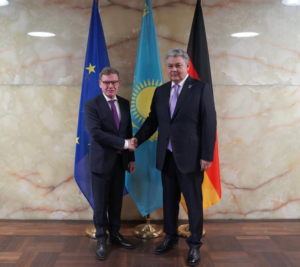
From L to R: German Foreign Minister Johann Wadephul and Kazakh Foreign Minister Yermek Kosherbayev. Photo credit: MFA.
Both sides reaffirmed their commitment to deepening bilateral cooperation across political, economic, and sustainable development spheres, reported the Ministry of Foreign Affairs’ press service.
According to Kosherbayev, Germany is a key partner of Kazakhstan not only in Europe but also globally. He stressed that Kazakhstan is playing an active role in international relations, promoting what he described as mutually beneficial diplomacy and maintaining a balanced position on major regional and global issues.
“We are ready to work with the German side on pressing multilateral issues within the UN, the OSCE, and other international organizations,” he said.
Wadephul, in turn, emphasized that for Germany, Kazakhstan is an economic, political, and strategic anchor country in Central Asia.
C5+1 format seen as strategic platform
Later the same day, Kosherbayev took part in the Central Asia – Germany foreign ministers’ meeting, where he described Central Asia as a “new point of growth for the global economy.”
“We view the ‘Central Asia – Germany’ format as a strategic platform for developing joint responses to common challenges and implementing concrete projects for the benefit of the entire region,” he said in his address.
He noted that the economies of Central Asian states are complementary and, when combined with Germany’s advanced technologies, create strong potential for mutually beneficial partnerships. For Kazakhstan in particular, he highlighted the importance of cooperation in energy and natural resource development.
Kosherbayev reaffirmed Kazakhstan’s interest in expanding trade and economic cooperation with Germany, attracting German investment, and developing industrial partnerships. Germany was singled out as a leading technology partner and a major investor, with strong prospects for cooperation in energy supplies, renewable energy, and decarbonization projects.
Focus on energy, transport and the Middle Corridor
Kosherbayev underlined Kazakhstan’s advantages as a key transit hub between Europe and Asia and expressed interest in closer cooperation with Germany on developing sustainable transport and logistics routes, including the Middle Corridor.
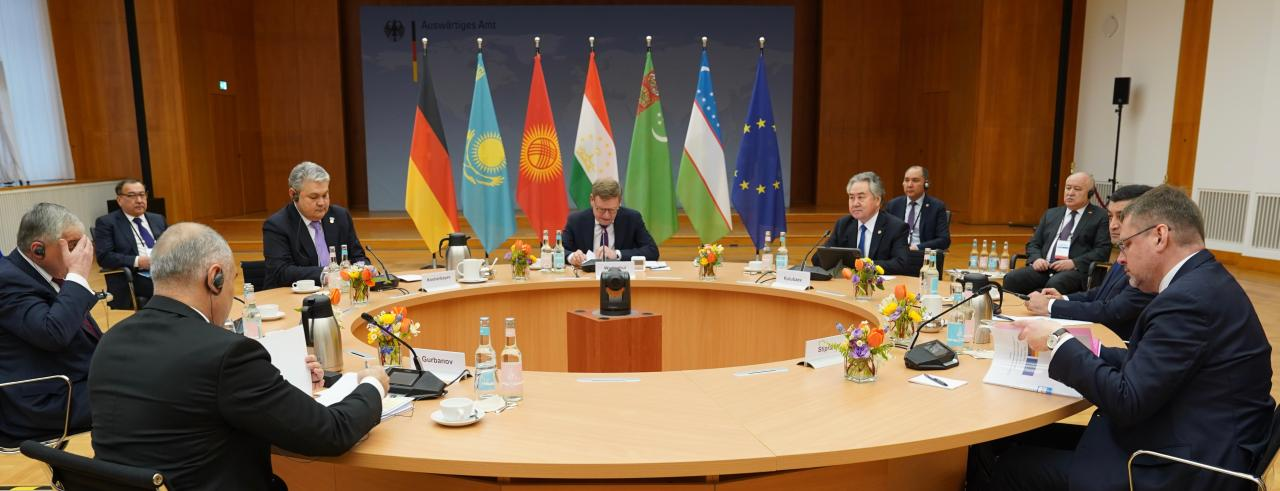
German Federal President Frank-Walter Steinmeier received the foreign ministers of the Central Asian states participating in the C5+1 meeting. Photo credit: MFA.
Regional stability was also high on the agenda as participants stressed that Central Asia remains a region of strategic stability and that strengthening regional cooperation is a foreign policy priority for Kazakhstan. Cooperation with Germany was described as important for ensuring sustainable development, water resource management, and the prevention of cross-border risks.
Kazakhstan also confirmed its commitment to the climate agenda and voiced interest in expanding cooperation with Germany in environmental protection, climate adaptation, sustainable natural resource management, and the introduction of green technologies.
Beyond economics and infrastructure, the ministers highlighted the importance of strengthening the humanitarian dimension of cooperation, including education, science, vocational training, and academic exchanges.
Meeting with German President Steinmeier
As part of the talks, German Federal President Frank-Walter Steinmeier received the foreign ministers of the Central Asian states participating in the C5+1 meeting.
In his remarks, Kosherbayev confirmed Kazakhstan’s readiness to actively contribute to filling the C5+1 format with practical content. He also noted that this year Kazakhstan marks the 35th anniversary of its independence, highlighting the country’s progress in modernization and reforms, which have helped it enter the ranks of the world’s 50 leading economies.
“We see all the prerequisites for Kazakhstan to become a leading partner for Germany in diversifying external economic ties, creating new points of economic growth, and advancing the green transition across key sectors – energy, industry, mobility, and digitalization,” Kosherbayev said.
He also pointed out the symbolism of the date, noting that Feb. 11 marks 34 years since diplomatic relations were established between Kazakhstan and Germany. Kosherbayev handed President Steinmeier a message from President Kassym-Jomart Tokayev, recalling that Berlin was the first European capital Tokayev visited after his election in 2019.
