
ASTANA – The efficiency of the digital economy depends on the quality of connectivity infrastructure, said Deputy Prime Minister – Minister of Artificial Intelligence and Digital Development Zhaslan Madiyev at an expanded government meeting on Feb. 10 in Astana.
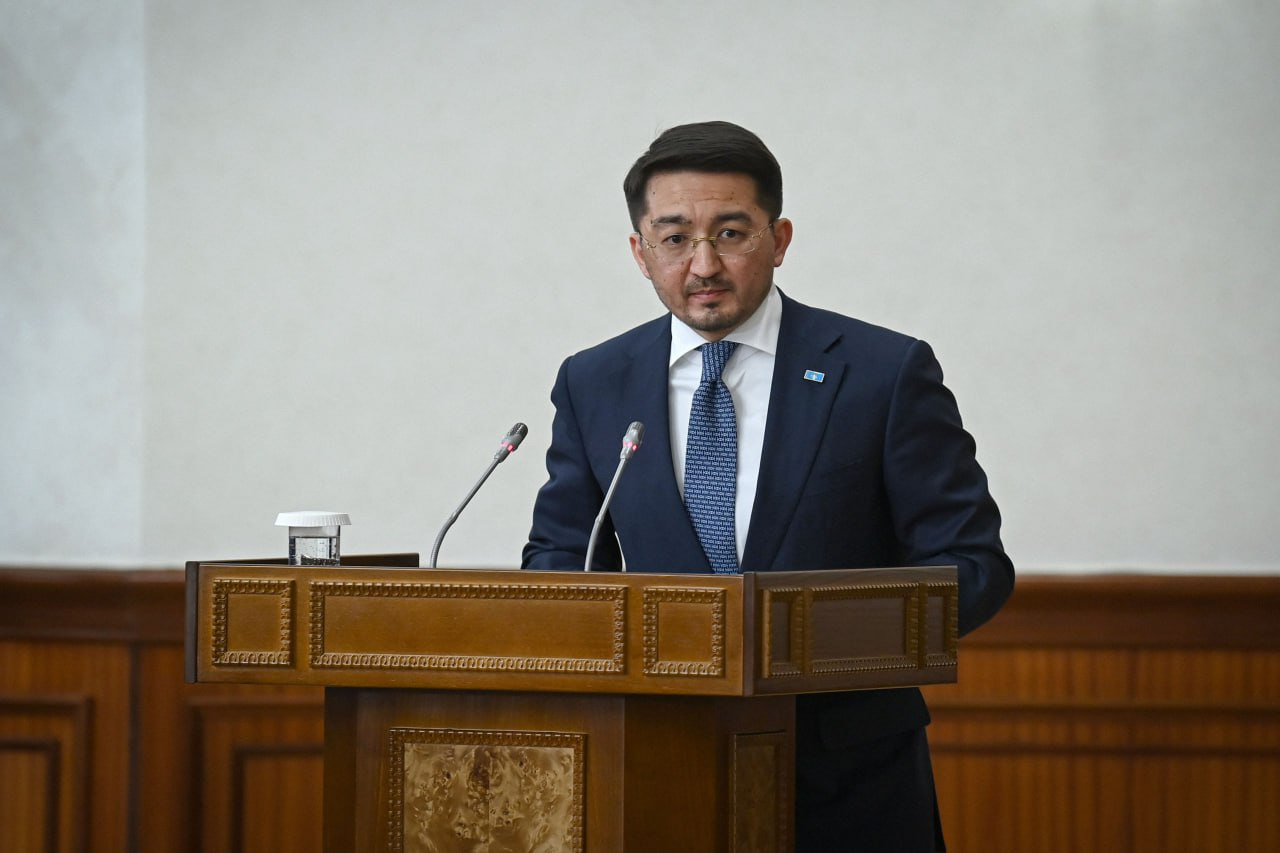
Zhaslan Madiyev. Photo credit: Akorda press office
Delivering a report at a meeting chaired by President Kassym-Jomart Tokayev, Madiyev spoke about the major projects in this area launched last year, with most of the work set to be completed this year.
“Specifically, an additional 1,900 villages will gain access to fiber-optic internet. By next year, more than 90% of villages nationwide are expected to be connected. All national highways will be equipped with communications infrastructure,” said Madiyev.
All border checkpoints were provided with internet access in December last year.
“Internet connectivity will also be available along all major passenger routes operated by Kazakhstan Temir Zholy. For the first time, passengers will be able to use the internet on board a domestic airline,” he added.
This digital infrastructure will also enable Kazakhstan to strengthen its role as a regional leader in digital connectivity. The Kazakh official noted that through gateway stations built by Starlink in Kazakhstan, satellite internet services will be extended to neighboring countries.
“Traffic for Tajikistan is expected to begin this year, with Mongolia and Kyrgyzstan next in line. Under the Trans-Caspian fiber-optic cable project, Uzbekistan has already proposed an offtake contract,” said Madiyev.
Establishing a world-level computing hub, a target the nation has set, hinges upon the availability of cross-border connectivity infrastructure and affordable electricity.
“This project is already in active implementation. A land plot has been allocated in the Pavlodar Region, and 300 megawatts of capacity have been reserved at GRES-1 [refers to Ekibastuz power plant]. Negotiations are underway with international investors,” said Madiyev.
He also announced an AI-focused data center with an initial capacity of 50 megawatts to be built by Kazakhtelecom in the second quarter of next year.
“The facility’s capacity will be ten times greater than that of the new government data center housing the national supercomputer,” he added.
High-quality data
Madiyev reiterated high-quality data is the core resource for artificial intelligence. The ministry began the work to create sector-specific AI models.
“AI products built on such models operate faster, deliver greater accuracy and can be deployed locally at production facilities. However, digitization levels in the real sector of the economy remain insufficient for large-scale AI adoption,” he said.
The average level of digital readiness for sectoral data is 57%, whereas globally successful AI implementation requires a level above 90%.
Rapidly growing IT ecosystem
Madiyev also outlined the government’s efforts to create a thriving ecosystem for tech entrepreneurs and startups, commending the rapid growth of the country’s IT market. Over the past five years, exports of IT services jumped 15-fold, and the IT market’s revenue reached two trillion tenge (US$4.1 billion) per year.
“The example of Higgsfield illustrates it is time for Kazakhstan’s own unicorns. We need to push that further. The nation needs researchers, engineers, and tech entrepreneurs,” he said, adding that the government will work with Telegram to bring the strongest sport IT specialists to the country.
By the end of last year, Astana Hub’s infrastructure covered all regions of the country. Work will continue to scale this infrastructure and identify and nurture talent across Kazakhstan.
“A special role in this effort will be played by the Alem AI center,” he added.
Madiyev noted that countries that are at the forefront of digitalization and AI integration globally are committing significant resources, equivalent to 4–6% of GDP, to develop the sector over a three-year period. The return on these investments carries a five-to-one multiplier effect, delivering an additional annual increase in GDP of up to 1.5 percentage points.
