
ASTANA – President Kassym-Jomart Tokayev will pay a state visit to Pakistan on Feb. 3–4, where he is expected to hold talks with Prime Minister Shehbaz Sharif and President Asif Ali Zardari and attend the Kazakhstan-Pakistan business forum.
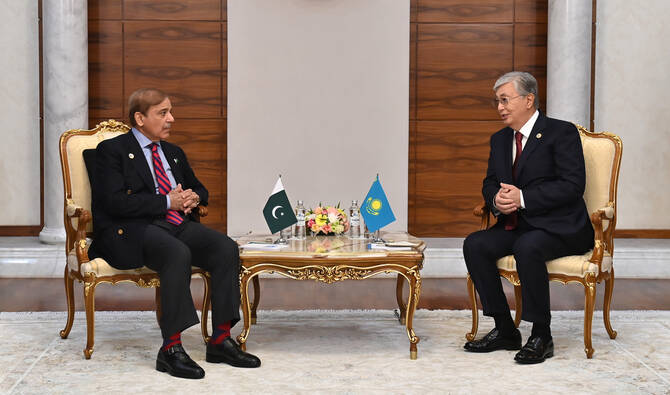
Kazakhstan President Kassym-Jomart Tokayev (right) and Pakistan Prime Minister Shehbaz Sharif holding meeting in Astana, Kazakhstan, on October 13, 2022. Photo credit: Akorda
The talks will focus on strengthening political dialogue and expanding trade, economic, cultural, and humanitarian cooperation.
According to Pakistani international relations expert Khalid Taimur Akram, the two countries have an opportunity to position their partnership as a model of cooperation between Central and South Asia.
Kazakhstan and Pakistan have maintained friendly relations since Kazakhstan gained independence in 1991. Pakistan was among the first countries to recognize the new state, and diplomatic ties were established in 1992.
“The bilateral relations of both countries are based on mutual respect, cooperation, and economic integration. In the present time, both countries view each other as natural partners capable of contributing to regional connectivity, economic development, and long-term stability,” said Akram.
Geography as opportunity
He noted that despite the absence of a shared border, Kazakhstan and Pakistan increasingly see their geographic positions as complementary. Kazakhstan is a major Central Asian economy with substantial agricultural and energy resources, while Pakistan offers access to the Arabian Sea and lies at the crossroads of South Asia, Central Asia and the Middle East.
This geographic logic underpins recent efforts to strengthen transport and transit cooperation. Pakistan has offered Kazakhstan access to its major seaports, including Karachi, Port Qasim and Gwadar – a development of strategic importance for landlocked Kazakhstan as it seeks more reliable routes to global markets.
“In this context, both countries are planning to sign the Pakistan-Kazakhstan Transit Trade Agreement (TTA). It is a planned accord that aims to enhance regional connectivity by linking Central Asia with South Asia through road, rail, and seaports,” Akram said.
Progress has been supported by institutional mechanisms such as parliamentary exchanges, bilateral political consultations and the Joint Intergovernmental Commission, which has held 13 sessions to date, most recently in 2025.
“These mechanisms ensure continuity in dialogue and help align positions on regional and international issues,” Akram said.
Trade ambitions and sectoral focus
Economic cooperation has become the central pillar of the bilateral agenda. Kazakhstan and Pakistan have set a goal of increasing trade turnover to $1 billion.
“Considering the global economic uncertainties and the complex geopolitical environment, this goal is a challenging one, but it also reflects the political commitment and confidence of both countries in economic complementarities,” Akram said.
Key sectors identified for cooperation include agriculture, leather, small and medium-sized enterprises, and information technology. Kazakhstan exports grain, fertilizers, chemical products, and sunflower oil, while Pakistan offers textiles, pharmaceuticals, sports goods and surgical instruments.
At a meeting in Islamabad on Sept. 9, 2025, Pakistan’s Commerce Minister Jam Kamal Khan and Kazakhstan’s Minister of Trade and Integration Arman Shakkaliyev reviewed the outcomes of the latest Intergovernmental Commission session and the Pakistan-Kazakhstan Business Forum. They agreed to expand business-to-business ties through trade missions, exhibitions and sector-specific cooperation in IT, SMEs and e-commerce.
Akram highlighted that this focus reflects a gradual shift from symbolic cooperation toward practical economic engagement.
“The challenge now is translating agreements into visible outcomes. For doing so, continued engagement between governments, businesses, and civil society is essential,” he said.
Regional corridors and connectivity
Connectivity projects are another area of growing interest. Akram pointed to the potential role of the China-Pakistan Economic Corridor (CPEC) in linking Central Asia with South Asia.
“In this context, Pakistan and Kazakhstan focus on using CPEC for trade, diversifying energy sources, and developing digital and educational ties. Railways, highways, Gwadar Port, and other CPEC projects offer Kazakhstan an alternative as well as economical route to access South Asian and global markets,” he said.
Kazakhstan and Pakistan are also working on the Trans-Afghan Corridor and have strengthened air connectivity with direct flights between cities such as Almaty and Lahore. Simplified customs procedures are expected to further facilitate trade, tourism and people-to-people contacts.
Digital cooperation has emerged as a new dimension of the partnership. The two countries are exploring collaboration in artificial intelligence, cybersecurity, fintech and e-government. Memorandums of understanding have been signed between Pakistan’s Ignite program and Kazakhstan’s Astana Hub to support joint innovation projects.
Energy and human capital
Energy cooperation is another area with untapped potential. Kazakhstan’s oil and gas resources position it as a potential supplier for Pakistan’s growing energy needs, opening opportunities for investment and technical cooperation.
At the same time, educational and scientific cooperation continues to expand. More than 1,000 Pakistani students currently study in Kazakhstan, a figure expected to rise as Kazakhstan strengthens its role as an international education hub.
The Organization of Islamic Cooperation’s Standing Committee on Scientific and Technological Cooperation (COMSTECH) has played a key role in advancing collaboration in science, technology, and innovation, particularly through cooperation with the Islamic Organization for Food Security, which is headquartered in Kazakhstan.
According to Pakistani Prof. Dr. Muhammad Iqbal Choudhary, Coordinator General, OIC-COMSTECH, Kazakhstan’s broader strategy to attract foreign universities has further supported academic ties.
“Kazakhstan’s ongoing efforts to establish itself as an International Education Hub create additional opportunities for deepening educational ties. Currently, 33 branches of leading foreign universities from the United States, the United Kingdom, the Republic of Korea, China, France, and other countries are operating in Kazakhstan, with seven more planned to open in 2026,” he said.
At the Kazakhstan-Pakistan University Forum in 2025, participants proposed establishing a Kazakhstan-Pakistan University Consortium aimed at institutionalizing academic cooperation and ensuring the long-term sustainability of partnerships.
“Within the framework of the expected official visit of the Kazakh president to Islamabad in 2026, three academic centers, members of the COMSTECH Consortium of Excellence, are planned for launch,” said Choudhary.
These include the Satbayev Center for Science and Technology at the National University of Sciences and Technology in cooperation with Satbayev University; the Al-Farabi Center at Quaid-i-Azam University with the support of Al-Farabi Kazakh National University; and the Khoja Ahmed Yasawi Center at the International Islamic University with the support of Khoja Ahmed Yasawi International Kazakh-Turkish University.
From intent to implementation
Experts say the next phase of Kazakhstan-Pakistan relations will depend less on new agreements and more on implementation.
“The priority now is to move from planning to execution. Infrastructure and logistics projects must advance, trade facilitation measures should be accelerated, and joint investment initiatives need institutional support,” Akram said.
