
ASTANA — Artificial Intelligence (AI) is predicted to raise productivity for approximately 70% of Kazakhstan’s workforce, transforming up to 53% of job functions, said Minister of Science and Higher Education Sayasat Nurbek at a government meeting on Jan. 6. Experts say that AI’s main impact will be the redistribution of tasks rather than mass job losses, posing urgent challenges for labor policy and education systems.

Photo credit: Shutterstock
“In most cases, this does not mean job elimination, but a change in job content and requirements. Based on these findings, a phased action plan is being developed to modernize higher education,” said Nurbek, referring to the first stage of a 2025 study assessing the role of education in building an AI-based economy, conducted with Quacquarelli Symonds.
Jobs stay, tasks change
According to the International Labor Organization, approximately 25% of jobs worldwide are already exposed to moderate or high levels of generative AI. In advanced economies, the share is nearly 35%, and in countries with lower digital maturity, it is closer to 10%. Across regions, the pattern is similar: job titles remain, but daily work functions change.

Labor law expert Gulzira Atabayeva. Photo credit: Kazinform
Labor law expert Gulzira Atabayeva said these changes are often underestimated because they occur gradually and unevenly.
“Discussions about AI are often reduced to the question of whether it will replace people. The real changes are much quieter and therefore more dangerous. AI does not eliminate professions overnight, but it quickly changes the content of work, redistributes tasks and exposes vulnerabilities in employment systems,” Atabayeva told Kazinform.
“For Kazakhstan, this is no longer a distant future, but a matter of managing ongoing processes,” she added.
She noted that administrative and office roles are among the most exposed. Document processing, initial data analysis, and standard consultations are among the tasks most readily automated by algorithms.
Who bears automation risk
International research also points to uneven social effects. Women are more likely to be employed in roles with a high concentration of routine administrative tasks, making them more exposed to automation.
In developed economies, the share of jobs with strong AI influence among women is nearly three times higher than among men. Analysts warn that without targeted policy responses, technological change could deepen existing labor market inequalities.
Atabayeva cited additional estimates underscoring the scale of transformation. According to EY, nearly 60% of global employment is already under moderate or high influence from generative AI. The Organisation for Economic Co-operation and Development (OECD) estimates that up to 28% of professions in OECD countries are at high risk of automation.
At the same time, she said most workers do not perceive AI as a threat but as a productivity tool.
“This is a crucial conclusion. The risks do not come from the technologies themselves, but from institutions and rules that fail to keep pace,” she said.
From vision to legal framework
Kazakhstan has begun to formalize its response. At the end of 2025, the country adopted an AI law, establishing artificial intelligence as a regulated sector under national legislation. The law introduces principles of responsibility and transparency, requires labeling of AI-generated content and bans manipulative AI systems. Administrative liability for violations will take effect in January 2026.
The government has also created the Ministry of AI and Digital Development and approved the 2024-2029 AI Development Concept. The strategy focuses on building an ecosystem that combines infrastructure, data access and human capital. Key initiatives include the national Alem.AI platform, designed to provide developers with access to data and tools, and the AI Qyzmet program, which trains civil servants to work with AI-based solutions.
“AI systems are already used in public administration, including disability assessments, health care and education. The emergence of a unicorn startup such as Higgsfield AI shows that Kazakhstan is capable not only of importing technology but also of creating its own solutions,” said Atabayeva.
“In terms of everyday use of AI, Kazakhstan ranks 71st out of 147 countries and leads in Central Asia. Despite the significance of these steps, the key issue is shifting from regulating technology itself to regulating its impact on the labor market,” she added.
At risk: tasks, not professions
According to Kazakhstan’s Center for Labor Resources Development, 29% of the country’s work functions could be automated, while approximately 13% are directly linked to AI applications. Various estimates suggest that up to 2.2 million people, which is nearly a quarter of the workforce, may experience changes in their employment structure in the medium term.
Atabayeva said labor regulation is lagging behind these changes. Analysis by profession no longer reflects real labor market dynamics, as transformation is occurring at the level of tasks rather than job titles. Education and social protection systems, she noted, remain oriented toward stable jobs, even as AI drives demand for hybrid skills and expands flexible work arrangements.
“In these conditions, the question is not whether AI will replace humans, but whether the state can synchronize digital policy with employment policy. Kazakhstan has already taken important steps in regulating AI as a technology,” said Atabayeva.
“The next and more complex stage is managing its social consequences, which will determine whether AI becomes a tool for productivity growth and better jobs or a factor that deepens inequality and instability,” she added.
Training the AI workforce
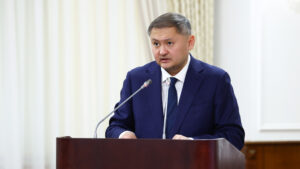
Minister of Science and Higher Education Sayasat Nurbek. Photo credit: primeminister.kz
According to Nurbek, AI-related skills were introduced across all educational programs starting in 2025. At the moment, 95 universities have included AI-related courses in their curricula, and 30 higher education institutions offer 42 AI-focused degree programs. Approximately 54% of faculty members have completed AI upskilling courses.
In cooperation with Astana Hub, the ministry is also implementing the Tomorrow School project at universities nationwide, using international teaching methodologies. Nurbek noted that equipment and facility issues have already been resolved in four regions, with preparations underway in the others.
He also announced plans to establish a specialized AI university focused on interdisciplinary training and applied research, integrated into the Alem.AI ecosystem and developed in partnership with foreign universities and technology companies.
