
ALMATY – From a snow leopard against a mountain backdrop to portraits of celebrated Kazakh artists and scenes inspired by the city’s past, Almaty’s murals have transformed residential facades into an open-air gallery, bringing art into everyday urban life.
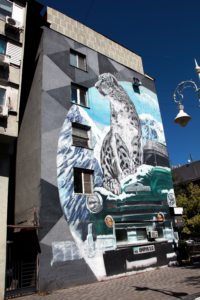
“Snow Leopard 2.0” by the Kazakh art team Neon & Shaman. Photo credit: Talgat Assanov.
The large-scale paintings, created by local and international artists, reflect the city’s cultural heritage, natural surroundings, historical memory and connection to global popular culture. Over the past decade, murals have become a recognizable part of Almaty’s urban identity, turning walls into landmarks for residents and visitors.
Unlike conventional graffiti, murals are often conceived as independent works of public art, designed to interact with their surroundings. They can tell the story of a neighbourhood, celebrate prominent figures, preserve collective memories or introduce artistic interpretations of local traditions.
In Almaty, murals gained particular visibility through international street art festivals held between 2016 and 2019. Artists from Kazakhstan, Belarus, Ukraine and the United Kingdom, among other countries, painted residential buildings, creating works that combine local themes with different artistic styles.
Murals reflecting Kazakhstan’s cultural heritage
One of the most recognizable themes in Almaty’s street art is the relationship between the city and the natural landscape surrounding it.
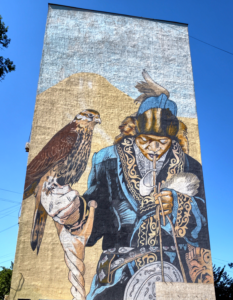
“Berkutchi” by Ukrainian artist Andrii Palval. Photo credit: Talgat Assanov.
The mural “Snow Leopard 2.0,” located at 59 Abylai Khan Avenue, was created by the Kazakh art team Neon & Shaman in 2017 for Almaty City Day. The composition depicts a snow leopard against a mountainous backdrop, bringing together two powerful symbols of the region.
The snow leopard represents the wildlife of the surrounding mountains and has become an important symbol associated with Almaty. The mural uses the animal not only as a subject but also as a visual expression of the city’s connection to its natural environment.
Another work inspired by Kazakh traditions is “Berkutchi,” painted by Ukrainian artist Andrii Palval on the facade of a building at 111 Rozybakiev Street during Mural Fest in 2017.
The mural depicts a berkutchi, a traditional eagle hunter. Golden eagle hunting has a long history among the nomadic peoples of Central Asia, making the image a reference to Kazakhstan’s cultural heritage. Palval is known for his portraits and depictions of birds, and the work demonstrates how an international artist can interpret a subject closely connected to local identity.
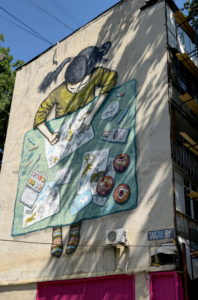
“Girl with Petroglyphs” by Belarusian artist Alexander Blagiy, known as KONTRA. Photo credit: Talgat Assanov.
Historical memory took center stage in “Girl with Petroglyphs,” created by Belarusian artist Alexander Blagiy, known as KONTRA, during Mural Fest in 2019. The composition featured a girl surrounded by imagery inspired by the ancient petroglyphs of Tamgaly, connecting a contemporary figure with the history of the Kazakh steppe.
The work also incorporated references to the Almaty aport apple, another symbol associated with the region. Through these images, the mural linked ancient rock art, local traditions and contemporary life.
However, “Girl with Petroglyphs,” formerly located at the intersection of Kurmangazy and Tulebayev streets, has been covered during facade renovation work. Blagiy expressed regret over the disappearance of the artwork in a social media comment.
“Hello! I’m Alexander KONTRA, the artist behind the mural with the girl and petroglyphs, and of course, I’m sad to say goodbye, but that’s the nature of street art,” he wrote on his Instagram page. “I recently painted two more murals in your beautiful city near the Esentai River. Greetings from Minsk! Goodbye, girl. Thank you, Almaty!”
Art celebrating Almaty’s people and everyday life
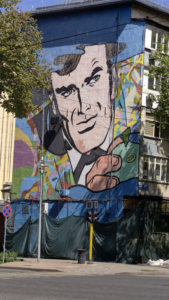
“Father of Apples” by the art group 310 Squad. Photo credit: Talgat Assanov.
“Father of Apples,” created in 2013 by the art group 310 Squad as part of Artbat Fest, was one of Almaty’s best-known murals.
The festival’s theme that year was The City as Canvas, and the work used pop-art imagery to explore the apple as one of the city’s defining natural symbols. Located at the intersection of Nazarbayev Avenue and Kurmangazy Street, the mural depicted a character associated with the origins of the apple and the region’s long-standing connection to apple cultivation. Over the years, it became a familiar part of the urban landscape.
The mural has now been covered by a new facade structure during renovation work. The Medeu District administration said the artwork would be physically preserved beneath the new facade rather than painted over or dismantled. Although it will no longer be visible from the street, officials said it would not be destroyed.
Another work rooted in the city’s collective memory is “Waiting,” created in 2019 by Kazakh artists Saule Suleimenova and Kuanysh Bazaraliyev, known as KuBa. Located at 565 Seifullin Avenue, the mural is based on a real photograph from the late 1970s or early 1980s, offering a glimpse of everyday life in Soviet-era Almaty.
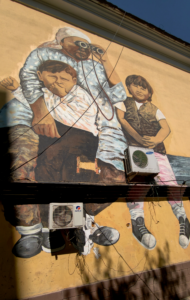
“Waiting” by Kazakh artists Saule Suleimenova and Kuanysh Bazaraliyev, known as KuBa. Photo credit: Talgat Assanov.
The work turns a historical image into a large-scale public artwork, preserving a moment from the past in a contemporary urban setting. Its significance became particularly apparent in 2022, when the mural was damaged during facade repairs and a decision was made to restore it under the artists’ supervision. Its current condition should be confirmed before publication.
Almaty’s literary and musical heritage is also represented on its walls. A portrait of poet Mukagali Makatayev adorns a residential building at 186 Makatayev Street. The location carries particular meaning because the street itself bears the poet’s name. The mural brings his image into the daily lives of residents, transforming a literary figure into a visible presence in the neighbourhood.
In May 2026, another portrait mural appeared on a residential building at 21 Samal-3, where celebrated Kazakh singer Roza Baglanova once lived. The initiative came from the building’s residents, who had previously asked the city authorities to create a tribute to the singer. Her daughter-in-law, Maral Baglanova, also took part in the project.
Everyday urban life is the focus of “Cyclists,” located at 127 Tole Bi Street. Created as part of the “Murals of Almaty” project and dedicated to City Day, the work celebrates cycling as both a recreational activity and a means of getting around the city. Its current condition should also be confirmed before publication.
From local traditions to global pop culture
While many of Almaty’s murals look to local history and nature, others connect the city with international culture. In August 2026, a mural dedicated to the British virtual band Gorillaz appeared on the facade of the Tau Samal residential complex at 72 Navoi Street, ahead of the group’s performance at the Park Live festival in Almaty.
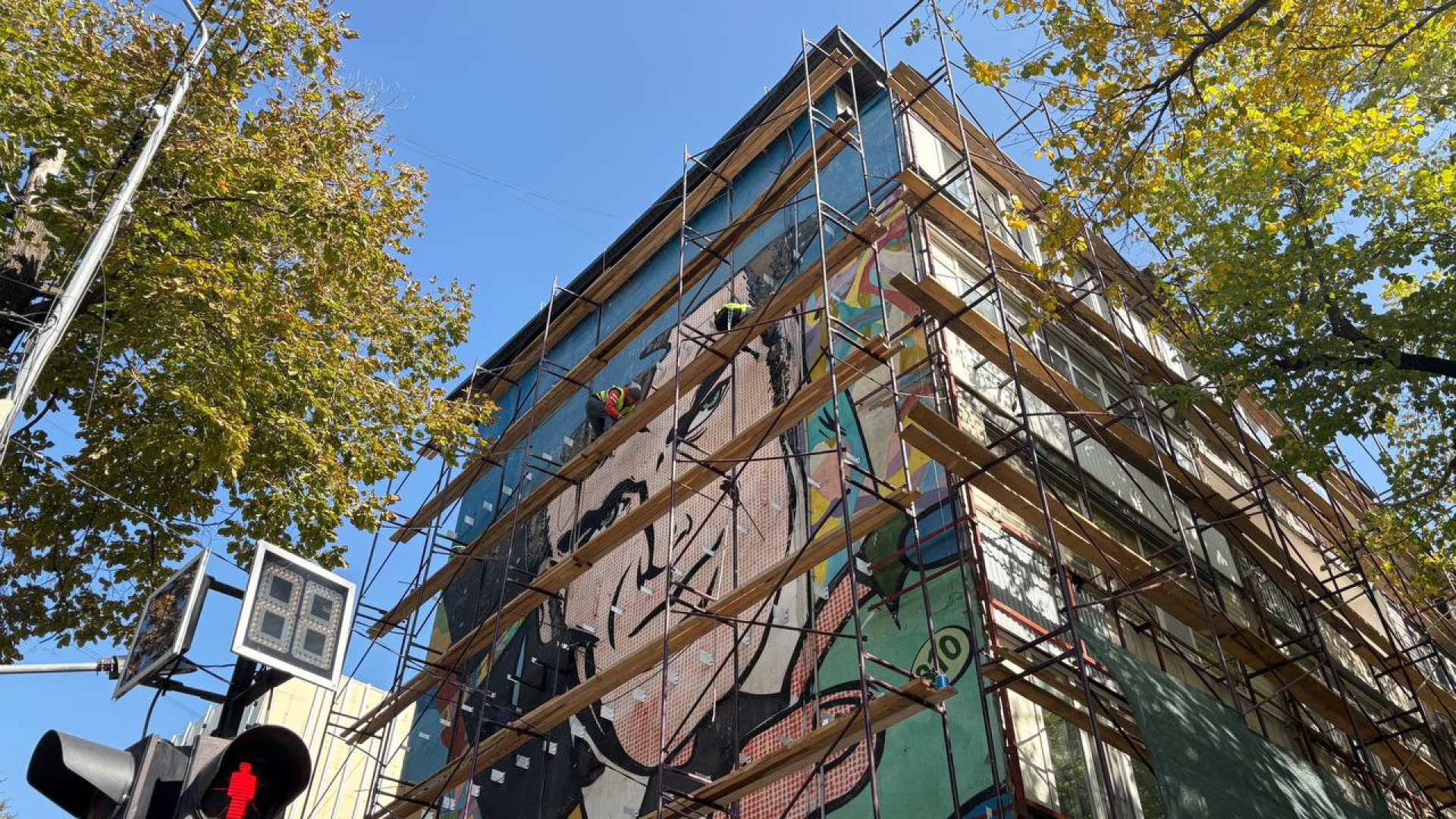
Some of Almaty’s murals have been covered during building facade renovations carried out as part of the city’s urban improvement plan. Photo credit: Tengrinews.kz / Akbota Silyam
Unlike murals celebrating Kazakhstan’s history or natural environment, the Gorillaz project brought global pop culture directly into Almaty’s streets. Its appearance also illustrated how major cultural events can leave a visual mark on the city.
Environmental themes have also found a place in Almaty’s street art. The mural “Caring Is Cool,” located near the Esentai River, focuses on water conservation and responsible consumption. Created by Almaty artist Leonid Chinaliyev, the work incorporates imagery associated with the city’s irrigation channels, a heron and a dandelion.
At Shymbulak mountain resort, artist Adil Aubekerov created a mural at an altitude of 3,200 metres to mark the 80th anniversary of the United Nations. The composition draws on the traditional Kazakh “qurak korpe” patchwork technique and incorporates petroglyphs, solar symbols and mythical imagery.
Mural removed during facade renovations
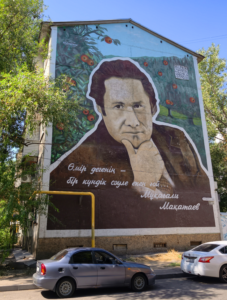
A portrait of poet Mukagali Makatayev. Photo credit: Talgat Assanov.
The Bostandyk District administration said the buildings’ facade had developed multiple defects, including cracks, peeling plaster, bulging sections and deterioration of the exterior finish. Officials said the renovation was necessary to improve safety, restore the facade and bring the building into line with Almaty’s design code.
According to the administration, residents were informed about the planned work at a meeting and gave their consent. The renovation was intended to improve the building’s safety and restore its exterior. The administration confirmed that the former mural would not be restored and no new artwork was planned for the facade.
The district administration has said artists whose works are affected by facade renovations were informed about the plans and offered opportunities to create new works elsewhere in Almaty. Authorities have also proposed installing plaques with QR codes at locations where murals have been covered, allowing passersby to view images of the original artworks and learn about their history and creators. Officials have not specified how many murals will be covered as part of the renovation programme.
Preserving the memory of Almaty’s murals
Murals have become more than decorative additions to residential buildings. They reflect the city’s relationship with its natural surroundings, celebrate cultural and literary figures, preserve memories of everyday life and connect local traditions with international art and popular culture.
As Almaty continues to modernize its buildings and streets, the fate of its murals raises broader questions about sustainability, urban renewal and the preservation of cultural identity. Architectural renovation is a natural part of a city’s evolution, as buildings must adapt to changing needs and remain functional for the people who live in them. Yet, as the city moves forward, the challenge lies in finding a balance between practical urban development and preserving the art that gives its streets character.
