
ASTANA — As the Organization of Turkic States (OTS) prepares for its Oct. 30 summit in Ankara, experts say its expanding ambitions in trade, transport, energy and security present Kazakhstan with both opportunities and challenges, particularly in turning political commitments into economic gains while preserving its independent foreign policy.
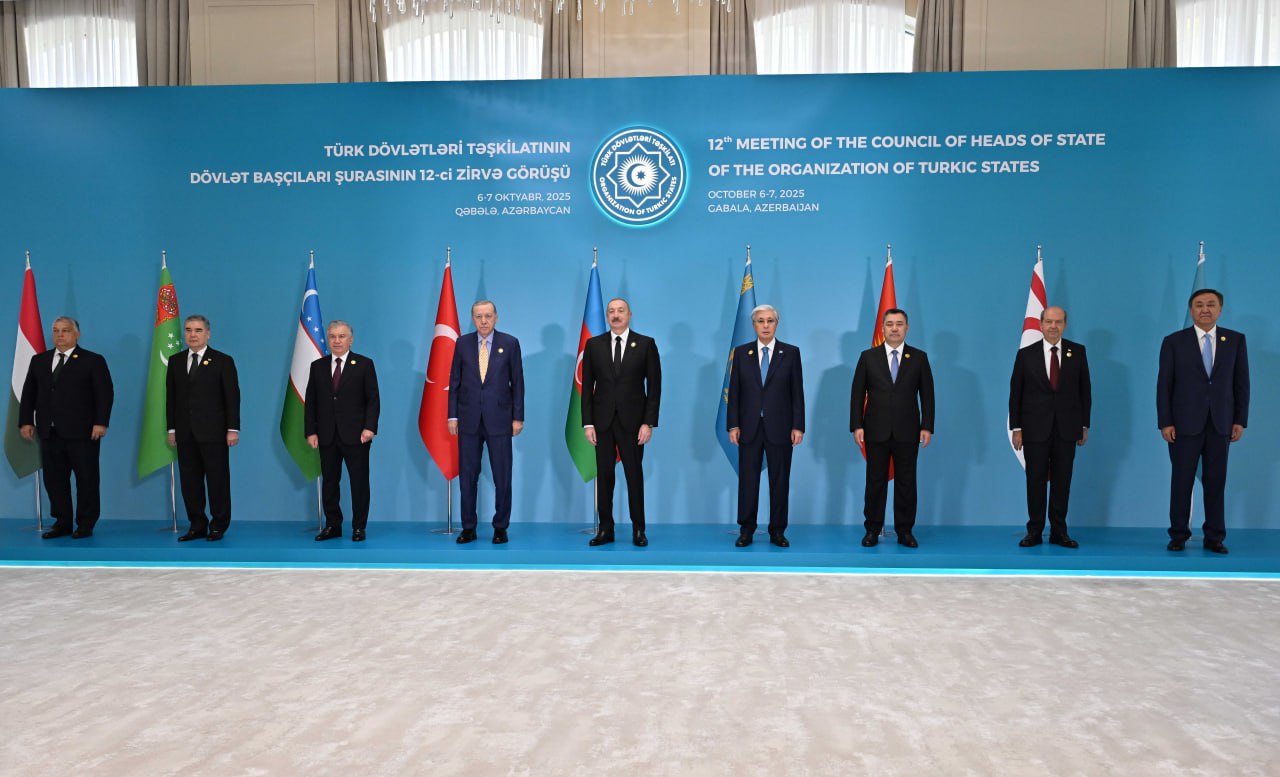
Leaders gather for the 12th Organization of Turkic States Summit in Gabala, Azerbaijan, in October 2025. Photo credit: Akorda
For Kazakhstan, translating political commitments into practical economic benefits, strengthening regional connectivity and maintaining independent foreign policy priorities will be central to the organization’s development, experts told The Astana Times.

Gabit Zhumatay, professor at the School of Law and Public Policy at Narxoz University. Photo credit: Zhumatay’s personal archives
“The OTS should not be viewed as a new geopolitical bloc or a zero-sum alternative to other regional organizations,” said Gabit Zhumatay, professor at the School of Law and Public Policy at Narxoz University.
“Its greatest potential lies in complementing existing frameworks and expanding the strategic choices available to its members. For Kazakhstan, the real opportunity is to transform Turkic solidarity into greater economic resilience, stronger regional connectivity, and greater diplomatic influence, while preserving its strategic autonomy,” he said.
The summit, hosted by Turkish President Recep Tayyip Erdoğan under the theme Turkic Century: Unity in Language, Thought and Deed, will review cooperation in political, economic and humanitarian fields.
Türkiye will assume the OTS chairmanship from Azerbaijan, with leaders expected to adopt the Ankara Declaration and discuss the organization’s institutional development, including the appointment of a new secretary general.
Institutional expansion and implementation priorities
Zhanibek Arynov, an assistant professor at Nazarbayev University, described the OTS as one of the most active regional institutions involving Kazakhstan, following an expansion of its activities over the past five to six years. Its agenda now covers trade, investment, transportation, energy, education and cultural exchanges, supported by additional agreements and dialogue mechanisms.

Zhanibek Arynov, assistant professor at Nazarbayev University. Photo credit: Arynov’s personal archives
According to Arynov, Kazakhstan’s approach remains pragmatic, with participation focused on areas that correspond to its national interests. The growing number of initiatives has provided additional opportunities for cooperation, although the organization’s limited resources and institutional capacity could affect their implementation.
“However, the resources of the OTS are very limited. When you spread these limited resources across multiple issue areas, the effectiveness and depth of cooperation might suffer. Instead of constantly widening the scope of cooperation, the OTS members should be paying more attention to the depth of those collaborations, to the implementation of those commitments,” Arynov told The Astana Times.
Zhumatay similarly highlighted the need to translate institutional development into economic outcomes. Initiatives involving the Turkic Investment Fund, innovation, digitalization and regional infrastructure could contribute to Kazakhstan’s economic diversification, although their effectiveness depends on financing, institutional coordination and the distribution of benefits among participating countries.
Different national priorities within the OTS
The organization’s members share an interest in expanding cooperation but differ in their expectations concerning its political, economic and security dimensions. These differences influence the prospects for common positions on sensitive international issues and the pace of institutional development.
Aidana Abi, a researcher focusing on the OTS and regional cooperation, highlighted findings from research on Kazakhstan, Azerbaijan and Türkiye, which identified distinct priorities within their approaches to Turkic cooperation.

Aidana Abi, a researcher focusing on the OTS and regional cooperation. Photo credit: Abi’s personal archives
“Azerbaijan places particular emphasis on security and defence cooperation; Türkiye seeks a stronger geopolitical voice for the Turkic world; and Kazakhstan prioritizes practical economic and humanitarian cooperation within its multi-vector foreign policy,” Abi told The Astana Times.
“Of course, these differences shape how far and how quickly a common agenda can develop. There is substantial common ground in transport, trade, investment, energy and education. However agreement becomes more difficult when cooperation involves sensitive foreign policy positions or deeper military commitments,” she explained.
According to her, member states have managed disagreements through compromise and accommodation, allowing cooperation to continue in areas where their interests overlap. The organization’s development will depend on its ability to consolidate these areas of agreement without requiring uniform positions on broader geopolitical issues.
Arynov emphasized that Türkiye’s active role within the OTS does not necessarily translate into influence over the foreign policy decisions of other members. He pointed to differing positions on Israel and the self-declared Turkish Republic of Northern Cyprus.
Zhumatay identified closer coordination among Central Asian members as a means of strengthening their participation in regional decision-making. According to him, Kazakhstan, Uzbekistan and the Kyrgyz Republic could develop common positions on transport connectivity, water and energy security, trade facilitation and industrial diversification, supported by joint agenda-setting and balanced representation within the organization’s institutions.
He also highlighted that cooperation within the OTS should complement Kazakhstan’s existing international partnerships rather than become an alternative to relations with Russia, China, the European Union and the United States.
“Shared Turkic identity provides an important foundation for cooperation, but Central Asia is a diverse region whose security and economic interests extend beyond linguistic and cultural boundaries,” Zhumatay said
“Tajikistan and other neighbouring states that are not OTS members remain important to regional connectivity, water management, trade, and security. The OTS should therefore complement broader Central Asian cooperation and avoid becoming an exclusive geopolitical bloc,” he said.
Transport connectivity and economic benefits
Transport and energy cooperation represent areas where OTS members have overlapping economic interests, particularly in developing the Trans-Caspian International Transport Route (TITR), also known as the Middle Corridor. Discussions increasingly focus on addressing infrastructure bottlenecks, simplifying customs procedures and improving coordination among participating countries.
“I would expect opportunities to advance the Middle Corridor through simpler customs procedures, electronic transport permits and better coordination of rail and Caspian shipping services,” said Abi.
“The Kazakhstan-Uzbekistan-Azerbaijan green energy corridor could also receive further political support. In my view, the main obstacles remain infrastructure bottlenecks, inconsistent regulations, financing and coordination. Ankara could help by securing clearer implementation commitments and timelines,” she said.
Zhumatay emphasized that the benefits of the Middle Corridor should not be assessed solely through its role as a transit link between Asia and Europe. Its contribution to export diversification, domestic manufacturing, logistics capacity and regional economic integration should also be considered when evaluating transport investments.
Abi similarly highlighted that Kazakhstan should prioritize easier market access, productive investment and stronger private-sector participation in identifying practical barriers to trade. Improved connectivity should support local businesses and regional supply chains rather than generate transit revenues alone, contributing to employment and skills development.
Security cooperation and institutional limitations
The OTS has also expanded discussions on security and defense-industry cooperation, although member states maintain different strategic interests and obligations under existing security arrangements.
Arynov noted that the organization’s security agenda has traditionally focused on nontraditional threats, including terrorism, organized crime and climate-related challenges.
Recent discussions have expanded to include defense industries and consultations among security officials, although the prospects for deeper military integration remain limited by members’ existing commitments.
“Türkiye is a member of NATO, and Kazakhstan and the Kyrgyz Republic are members of the Collective Security Treaty Organization. So those are two different institutional arrangements. I don’t think that the OTS will develop a very strong military or defense dimension,” said Arynov.
At the OTS informal summit in Turkistan in May, President Kassym-Jomart Tokayev also emphasized that the organization was not a geopolitical project or military alliance, placing greater emphasis on trade, technology, digital development and humanitarian cooperation.
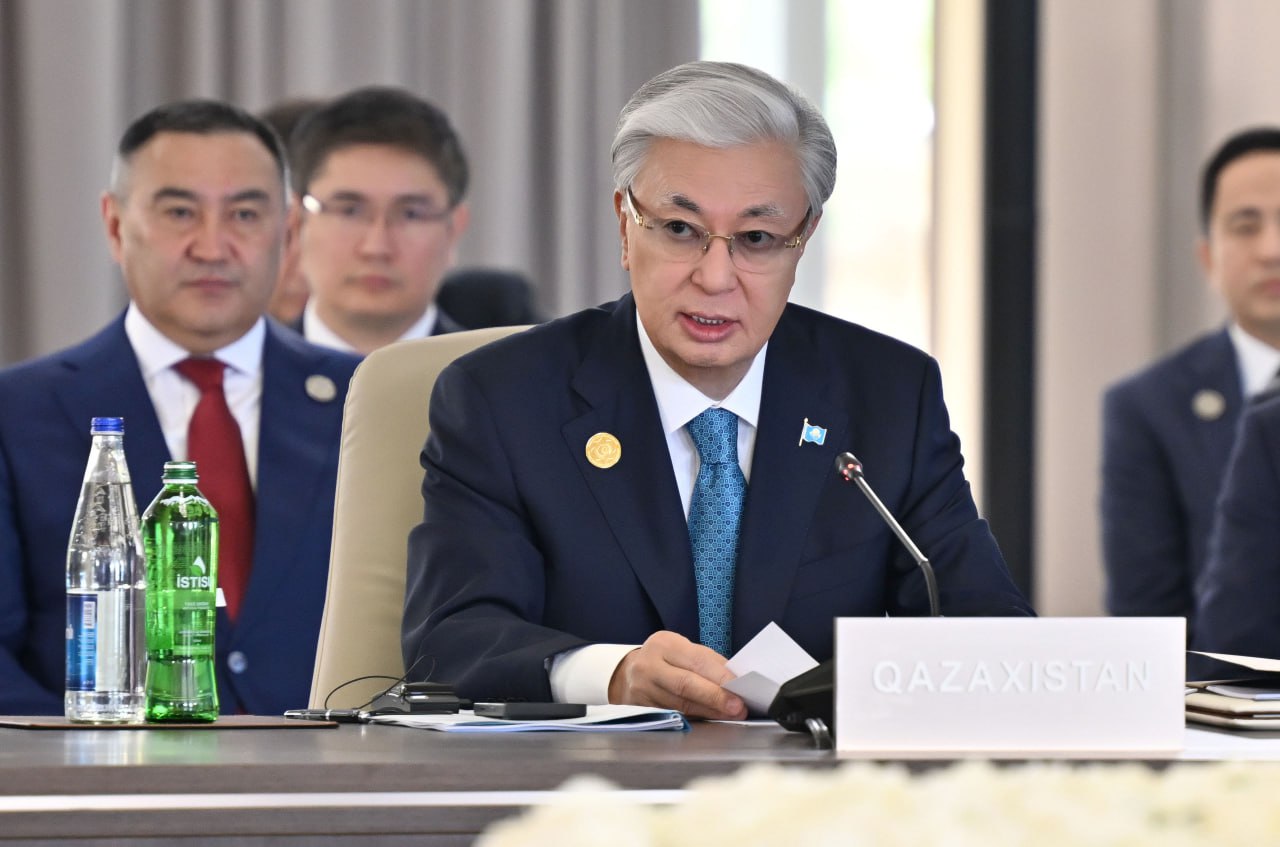
President Kassym-Jomart Tokayev addresses the 12th Organization of Turkic States Summit. Photo credit: Akorda
According to Arynov, bilateral cooperation remains the more practical format for defense-related initiatives, including existing partnerships between Kazakhstan and Türkiye and arrangements involving Uzbekistan and Azerbaijan.
Defense-industry discussions could continue within the OTS, although member states remain cautious about developing a common military framework.
Zhumatay identified functional security cooperation as a more feasible direction, including cybersecurity, counterterrorism, border security, emergency preparedness and the protection of transport and energy infrastructure. He also highlighted opportunities for joint defense production, maintenance, technology transfer and workforce development, emphasizing the development of domestic industrial capabilities rather than increased arms procurement alone.
“The OTS should avoid becoming a vehicle for geopolitical polarization. Central Asian states generally seek to diversify their external partnerships without abandoning established economic and security relationships. An explicitly anti-Russian or anti-Chinese security agenda would therefore risk undermining the very cooperation the OTS seeks to promote,” said Zhumatay.
According to him, differences in strategic orientation make a unified defense doctrine or binding mutual-defense obligations difficult to envisage. The organization could instead facilitate information-sharing, consultations among security institutions and coordination on specific challenges without requiring members to change their existing commitments.
