
ASTANA – At a time when international institutions face growing pressure and trust between major powers is weakening, Kazakhstan is making the case for a more practical approach to multilateral diplomacy, one that connects global commitments with regional cooperation and tangible results. The idea is reflected in an article in Vision for the Future edition 2026 by Kazakhstan’s Permanent Representative to the United Nations Kairat Umarov, who reiterates that diplomacy should be measured not by the number of agreements reached, but by what international cooperation changes in people’s lives.
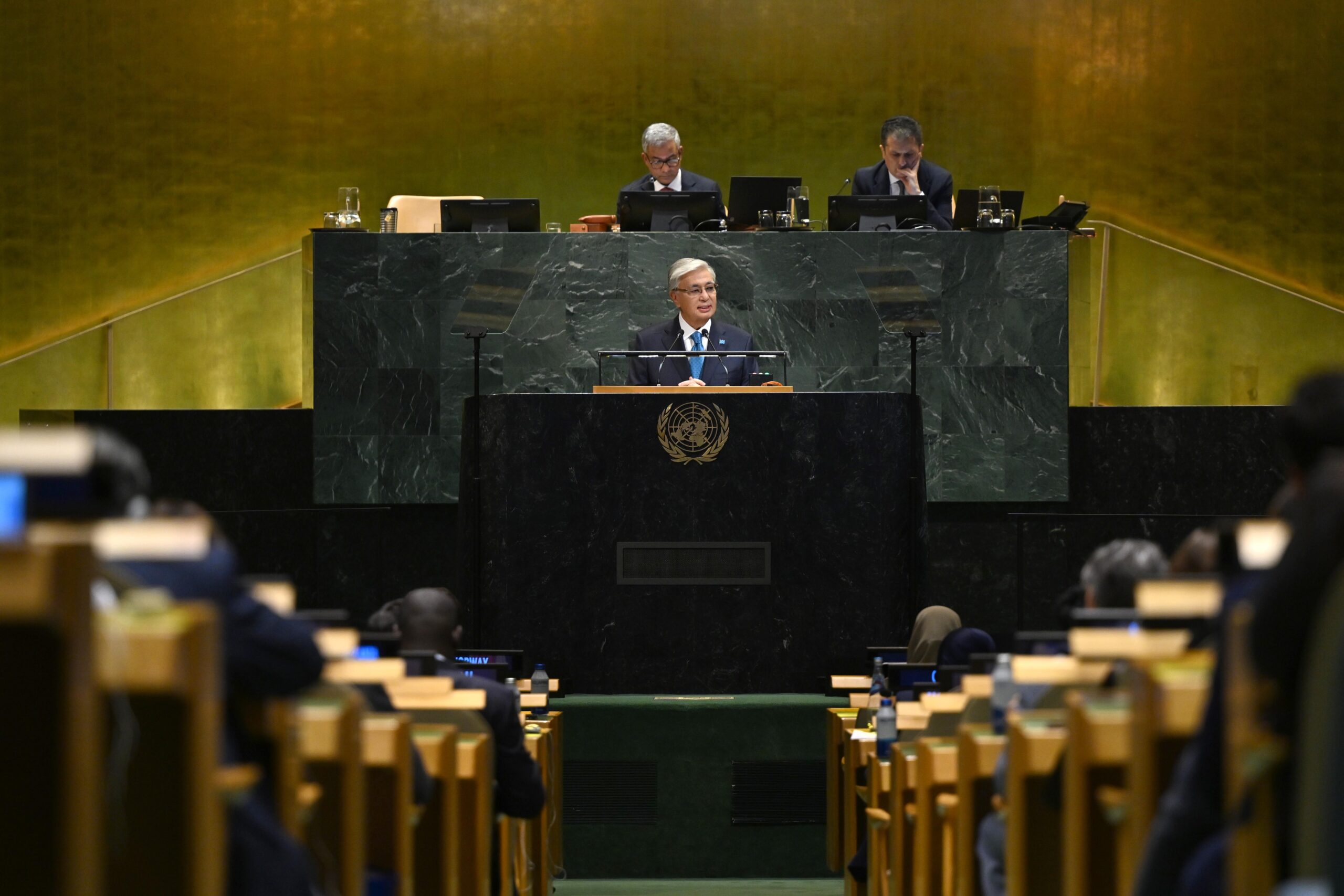
President of Kazakhstan Kassym-Jomart Tokayev delivers remarks at the General Debate of the 80th session of the UN General Assembly on Sept. 24, 2025 in New York. Photo credit: Akorda.
The argument also resonates with President Kassym-Jomart Tokayev’s October state-of-the-nation address. Assessing the international environment, Tokayev pointed to a crisis of trust among major powers, the UN’s weakening authority and the erosion of international law. Amid all these, he stressed the importance of strengthening Kazakhstan’s sovereignty while maintaining a balanced foreign policy.
Article by Kazakhstan’s Permanent Representative to the United Nations (UN) Kairat Umarov in Vision for the Future 2026. Photo credit: Vision for the Future
According to Umarov, for a country situated between major political and economic centers, these questions are closely connected to its development priorities.
“As the world’s largest landlocked developing country, our prosperity depends on open connections, peaceful relations, responsible management of shared resources and cooperation across borders. Geography has taught us a simple lesson: lasting progress cannot be built in isolation,” Umarov writes.
This perspective places regional cooperation at the center of Kazakhstan’s international engagement. Rather than treating diplomacy as a separate sphere of activity, it connects foreign policy with issues that directly affect economic development and public welfare, including transport connectivity, water security, climate resilience and digital transformation.
“We continue to pursue a balanced and constructive foreign policy, privilege dialogue and support a strong UN. For Kazakhstan, multilateralism is not an abstract preference; it is a strategic necessity,” Umarov writes.
From global commitments to regional solutions
One example is the UN Regional Center for the Sustainable Development Goals for Central Asia and Afghanistan in Almaty. According to Umarov, the center was established through General Assembly resolution 79/268, initiated by President Tokayev and co-sponsored by 152 UN Member States. Its purpose is to bring together UN expertise and coordinate assistance around regional development priorities.
The initiative reflects a broader question: how can international institutions become more responsive to regions’ specific needs rather than operate through fragmented projects and overlapping mandates?
“The true measure of multilateralism is not the number of declarations we adopt, but the difference cooperation makes in people’s lives,” Umarov writes.
This emphasis on practical results also aligns with the economic priorities outlined in Tokayev’s address. He called for Kazakhstan to strengthen its position in international transport networks, develop domestic logistics operators and expand its participation in global production chains. For a landlocked country, these ambitions depend on more than national infrastructure investment. Efficient transport corridors require coordinated border procedures, reliable regional partnerships and access to international markets. Kazakhstan’s efforts to develop the Trans-Caspian International Transport Route, also known as the Middle Corridor, illustrate how domestic economic objectives are closely tied to cooperation beyond its borders.
Water management offers another illustration of this interdependence. Central Asian countries share river systems and face growing pressure on water resources, making national policies closely dependent on cooperation with neighboring states.
Umarov identifies water security as one of Kazakhstan’s most urgent national and regional priorities. He points to the modernization of water infrastructure, water-saving technologies and digital monitoring, as well as Tokayev’s proposal to establish an International Water Organization under UN auspices.
“Water agenda remains one of our most urgent national and regional priorities.… At the international level, President Tokayev has proposed the establishment of an International Water Organization under the auspices of the UN. Such an organization could bring greater coherence to fragmented international efforts, strengthen coordination, raise water higher on the global political agenda, accelerate progress towards water-related commitments by 2030, and help shape the global water agenda beyond that timeframe,” Umarov writes.
The proposal illustrates how Kazakhstan’s domestic priorities can become part of a wider international agenda. Water infrastructure, resource efficiency and cross-border coordination are not only environmental concerns: they affect agriculture, energy security, investment and long-term economic stability.
Digital transformation beyond national borders
A similar connection can be seen in the digital sphere. Tokayev’s address placed technological modernization, AI and stronger domestic production capabilities among the country’s development priorities. Umarov, meanwhile, notes that digital transformation should be approached through regional cooperation, including shared expertise, skills development and common principles for the responsible use of artificial intelligence.
“The objective is not digitalization for its own sake, but better public services, stronger human capital and broader participation in future growth,” he writes.
The regional dimension is reflected in the Asian and Pacific Digital Solutions Center for Sustainable Development in Almaty, an initiative of the UN Economic and Social Commission for Asia and the Pacific. The center aims to help countries exchange solutions and build capabilities in the digital economy.
This approach aligns with Kazakhstan’s broader economic ambitions. In his address, Tokayev emphasized the importance of strategic partnerships with international technology leaders, deeper industrial processing and greater integration into global production chains. However, access to technology alone does not guarantee economic transformation. The challenge is to develop domestic expertise, strengthen institutions and ensure that technological advances translate into productivity gains, better services and opportunities for businesses. Regional cooperation could support these objectives by allowing countries to share expertise and address challenges that extend beyond national borders.
The role of Middle Powers in a changing global order
For Umarov, practical multilateralism requires more than establishing new institutions or expanding international dialogue. It depends on whether cooperation translates into implementation, with clear objectives, adequate resources and measurable results.
“These initiatives suggest three priorities for practical multilateralism. First, trust must come with effective architecture. New mechanisms succeed only when they respond to real demand and have the support of those they serve. Second, partnerships must lead to implementation, with clear objectives, responsible actors, adequate resources and measurable results. Third, progress must be inclusive. Women, young people, local communities, scientists, entrepreneurs and vulnerable groups must have a voice in shaping the solutions that affect them,” Umarov writes.
This distinction between political commitments and implementation is particularly relevant as the UN faces growing calls for institutional reform. The challenge is not simply to make international organizations more efficient, but to ensure that they remain capable of responding to the needs of countries with different economic capacities and development priorities.
The role of middle powers is another important part of this discussion. Kazakhstan does not seek to position itself as a global power, but its geographic location, resource base and regional ties give it an interest in maintaining open channels of cooperation.
“Kazakhstan seeks to contribute in precisely this way: not by claiming exclusive leadership, but by offering solutions and creating space for cooperation,” Umarov writes.
This approach is consistent with the emphasis on sovereignty and pragmatic international engagement in Tokayev’s October address. He linked Kazakhstan’s economic resilience to stronger transport connectivity, energy security, technological development and partnerships with major international economic players.
For Kazakhstan, maintaining a balanced foreign policy is therefore closely connected to its ability to diversify economic relationships and participate in international markets without becoming excessively dependent on any single route, partner or source of technology.
At the same time, the effectiveness of regional initiatives will depend on their implementation. Establishing new centers and cooperation mechanisms can provide a framework for joint action, but their value will ultimately be determined by the projects they deliver, the resources they mobilize and the problems they help solve.
The connection between Umarov’s diplomatic perspective and Tokayev’s domestic agenda lies in this emphasis on practical outcomes. Transport connectivity, water management, digital transformation and industrial development are national priorities, but their implementation increasingly requires regional coordination and international partnerships. For Kazakhstan, multilateralism is thus both a foreign policy principle and a practical instrument for addressing development challenges.
As the 2030 deadline for the Sustainable Development Goals approaches, the broader question is whether international cooperation can keep pace with the economic, technological and environmental challenges facing countries across the region.
“The question is not whether multilateralism should endure, but whether it can deliver,” Umarov concludes.
The article was published in Vision for the Future, the annual international publication of the Global Partnerships Forum, which brings together contributions from representatives of international organizations, diplomatic, academic and business communities on issues of global cooperation.
