
ASTANA — Cave sediments may help identify ancient human populations in Kazakhstan even where no skeletal remains survive, as new methods allow archaeologists to reconstruct how people lived and adapted to environmental change tens of thousands of years ago.
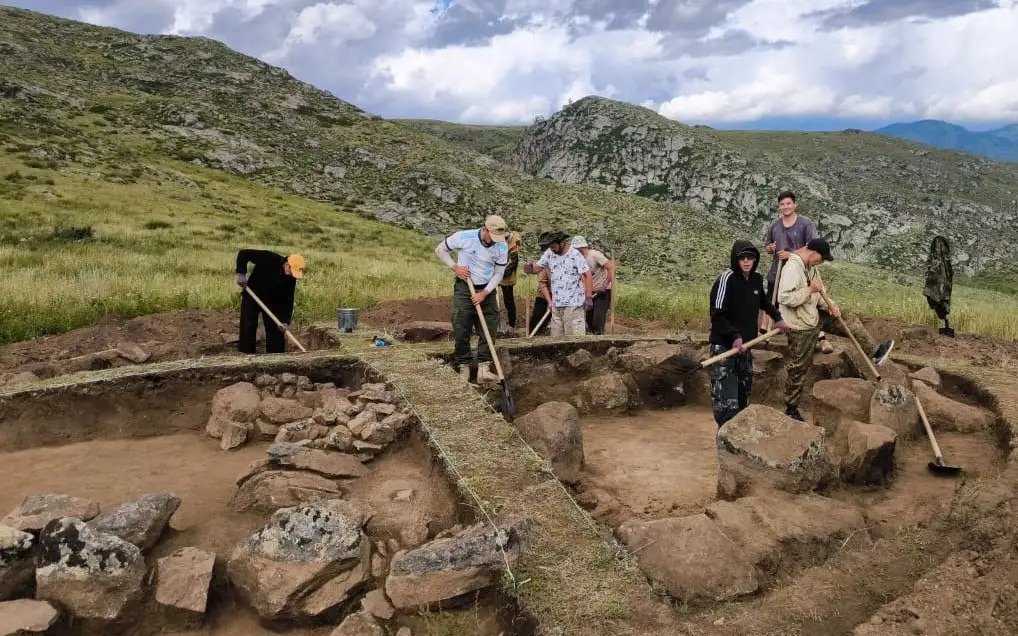
Photo credit: Ministry of Culture and Information
Researchers are turning their attention to Tuttybulaq 1 and Aqtogai, two cave sites in the Karatau range of southern Kazakhstan.

Abay Namen. Photo credit: Namen’s personal archives
“Our work will aim to expand the existing test excavations and determine the palaeoecological setting and human adaptations to the climatic instabilities,” Abay Namen, a postdoctoral researcher at Nazarbayev University’s School of Sciences and Humanities, told The Astana Times during an archaeological symposium in Astana on Sept. 24-25.
Caves can preserve evidence that is often lost at exposed archaeological sites. Organic material is more likely to survive in enclosed caves and rock shelters, while ancient DNA can remain in sediment even when human bones are absent. This can help researchers determine which hominins – modern humans or their extinct relatives – once occupied a site.
Namen’s research combines cave excavations in southern Kazakhstan with work at open-air sites in the Almaty Region in collaboration with the National Museum of Kazakhstan and New York University. The project examines human behavior and adaptation during the last glacial cycle, approximately 115,000 to 11,700 years ago.
The research was among the topics discussed at the symposium, organized by the Margulan Institute of Archaeology and Nazarbayev University to mark the institute’s 35th anniversary. More than 150 researchers from Kazakhstan and abroad participated in the event.
Tracing Kazakhstan’s earliest inhabitants
The country has accumulated substantial Stone Age material since the early 1990s, when a major Kazakh-Russian program began investigating Paleolithic sites across Kazakhstan. Over the past 10 to 15 years, new dating methods have allowed archaeologists to establish more precise timelines for many of those discoveries.
Talgat Mamirov of the Margulan Institute of Archaeology pointed to a series of stratified Upper Paleolithic sites in southern and southeastern Kazakhstan, including Rakhat, Uzynagash and Maibulak.
Talgat Mamirov. Photo credit: Mamirov’s personal archives
“It was the study of these sites that made it possible to understand the processes of settlement of the territory of Kazakhstan by modern humans within the period of 40,000-30,000 years ago,” Mamirov told The Astana Times.
“In collaboration with researchers from other countries, particularly the Institute of Archaeology of the Russian Academy of Sciences, a new archaeological culture – the Tian Shan Aurignacian – was identified in Zhetysu for the Upper Paleolithic. Over the past 10 to 15 years, there has been a qualitative leap in identifying and interpreting this material,” he said.
Elsewhere, researchers have dated six cultural layers at Shiderty-3 in northeastern Kazakhstan, providing a reference point for comparing archaeological material from neighboring areas. Mamirov also cited Kukentau as Kazakhstan’s earliest known Neolithic burial.
Caves could now fill further gaps in that record. While researchers had studied individual cave sites before, Mamirov said research has become more systematic, with dozens of larger sites identified for further investigation.
“Caves represent a localized archaeological source for obtaining information about the life, activities and everyday existence of ancient people. There, we can obtain radiocarbon dates and conduct an entire range of interdisciplinary studies, including identifying traces of DNA and studying how deposits accumulated, fauna, spores and pollen to reconstruct the climate. Human remains can also be found there,” he explained.
The symposium brought Kazakh researchers together with archaeologists studying caves in Azerbaijan, the Kyrgyz Republic, Uzbekistan, Russia and France, including specialists with experience at Denisova Cave in Russia’s Altai region and Arago Cave in France.
The exchange could also lead to new fieldwork. Mamirov said a potential Kazakh-French archaeological mission involving the Margulan Institute and France’s National Center for Scientific Research (CNRS) could search for and study cave sites in Kazakhstan dating from the Stone Age through the Bronze Age.
New tools reveal more from old evidence
Methods beyond traditional excavation increasingly support the search for early human traces. Archaeologists now combine fieldwork with ancient DNA analysis, studies of plant and animal remains, remote sensing and digital documentation.
LiDAR, for example, uses laser pulses to map terrain and can reveal archaeological features that are difficult to detect from the ground. Three-dimensional scanning creates detailed digital models of caves and artifacts, while microscopic analysis can identify traces left by stone-tool use.
Mamirov said researchers working with international specialists have found organic residues on some stone artifacts, helping identify tools that were once parts of more complex, composite implements.
These methods are being applied well beyond the Stone Age. Data presented by Margulan Institute Director General Akan Ongaruly show that approximately 800 samples have been prepared for paleogenetic analysis, while zooarchaeological collections from 123 sites are being used to study animal use and changes in ancient economies.
The institute also produced more than 150 3D scans in 2024 and has digitized approximately 3,800 archaeological reports, creating material that can be revisited as research methods develop.
From Bronze Age metal to medieval cities
Scientific analysis is also providing new details about Kazakhstan’s Bronze Age metallurgy.
According to Ongaruly, research at Taldysai, Atasu, Myrzhyk and Akmaya has helped reconstruct how ancient communities obtained raw materials, smelted ore and processed metal. At Taldysai, near Zhezkazgan in the Ulytau Region, researchers identified production of pure and arsenical copper, while Akmaya in central Kazakhstan contains a metallurgical complex with furnaces and chimneys representing a full production cycle.
“These data allow us to compare the technological traditions of individual centers and determine their place in Eurasian metallurgy,” said Ongaruly.
“The scientific significance of these results lies in the opportunity to study economic strategies and cultural differences within specific natural environments. The next step is to align regional chronologies, conduct serial dating and compare technological data,” he said.
Evidence from later periods broadens the picture further.
According to Ongaruly, finds from Berel in the East Kazakhstan Region, Shilikti in the Abai Region and Taldy-2 in the Karagandy Region have expanded knowledge of early nomadic elites, art and burial practices. At Berel, preserved organic material has revealed techniques for working with wood, felt and leather.
Settlement archaeology provides evidence of another side of Saka life. Research at Tushai and Talgar-3 in southeastern Kazakhstan has documented sedentary life, agriculture and crafts, while finds at Chirik-Rabat in the Kyzylorda Region include evidence of barley and millet cultivation, textile production and jewelry making.
The archaeological record later expands to major medieval urban centers. Ongaruly noted that long-term research at Otyrar and Sauran in the Turkistan Region, Syganak in the Kyzylorda Region, Taraz in the Zhambyl Region and Talgar in the Almaty Region has refined knowledge of city planning, irrigation, crafts, monetary circulation and urban chronology.
Connecting 35 years of discoveries
As research produces more archaeological material and new ways to analyze it, preserving and connecting that evidence has become another priority.
Ongaruly outlined plans for a national archaeological register and compatible catalogs linking archaeological sites with field reports and collections. A national archaeological service and repository are also being considered to improve the preservation, storage and future study of archaeological material.
Another long-term initiative is the multi-volume academic publication “Archaeology of Kazakhstan.” Ongaruly said its preparation would involve reviewing archaeological sources and coordinating terminology, regional chronologies and maps.
The institute is also developing fields such as archaeogenetics, landscape archaeology, bioarchaeology, paleoanthropology and experimental and virtual archaeology, alongside training specialists in archaeobotany, archaeometallurgy, traceology, conservation and other areas.
