
ASTANA – Lao President and General Secretary of the Lao People’s Revolutionary Party Thongloun Sisoulith is visiting Kazakhstan on Sept. 3-4. This marks the first presidential-level visit between the two countries since they established diplomatic relations in 1997.
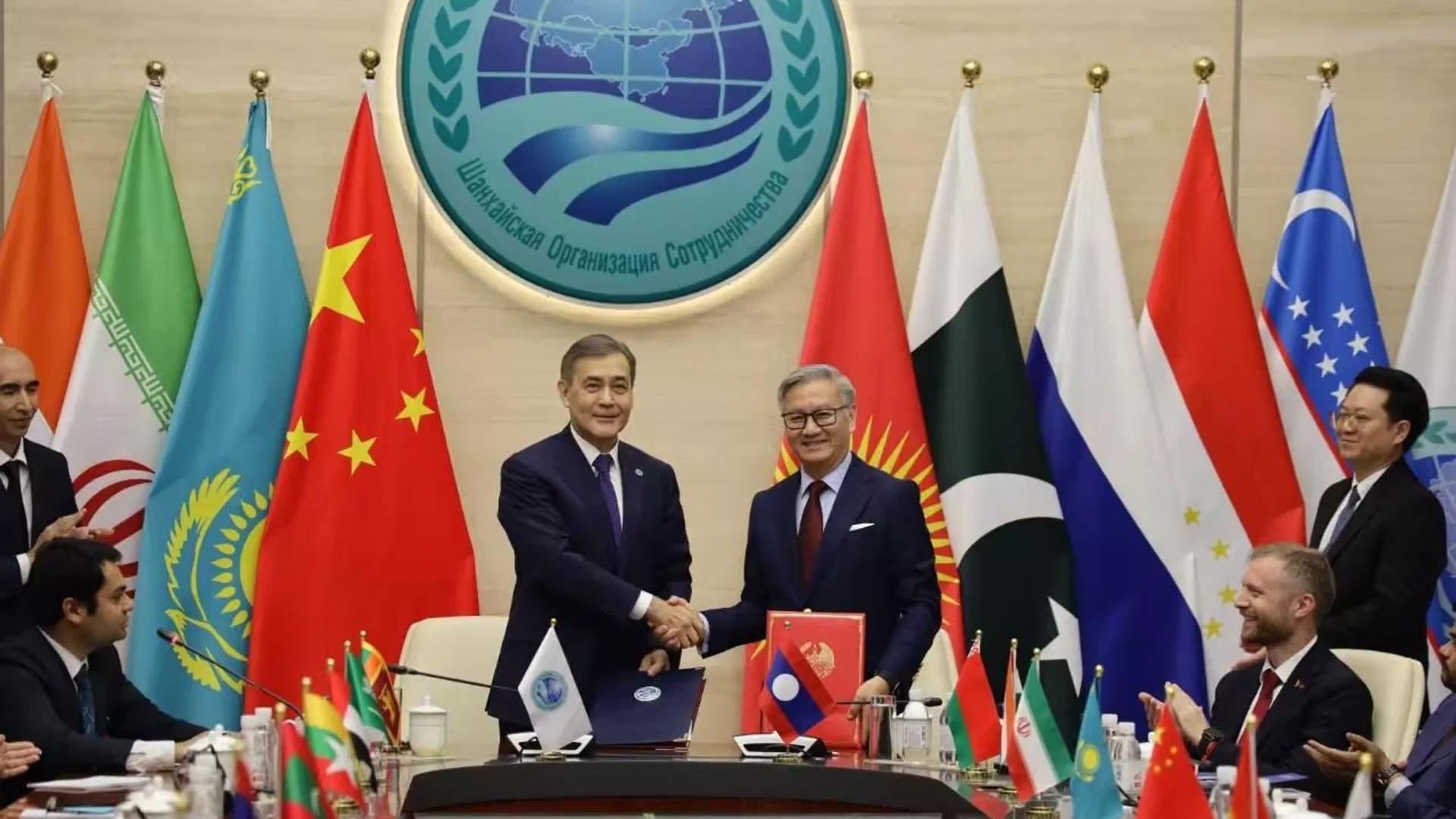
The SCO Secretary-General Nurlan Yermekbayev and Lao Deputy Prime Minister and Foreign Minister Thongsavanh Phomvihane. Photo credit: sectsco.org
The visit comes as both countries navigate a changing geopolitical and geoeconomic environment. Trade routes are shifting, energy costs are rising, and competition for access to emerging markets is intensifying.
For Kazakhstan, the visit offers an opportunity to deepen its engagement with Southeast Asia. For Laos, a landlocked country seeking to turn its geographic position into an economic advantage, Kazakhstan could be an important partner. Cooperation could help Laos expand transport connectivity and strengthen links with Central Asia and Europe.
A relationship with room to grow
Kazakhstan and Laos established diplomatic relations on Sept. 19, 1997. Despite periodic high-level contacts, bilateral relations have largely developed through diplomatic channels, international organizations and government-level exchanges rather than presidential visits.
That is set to change with Sisoulith’s visit to Astana. Preparations for the high-level contact intensified in May, when Kazakhstan’s Ambassador to Vietnam, concurrently accredited to Laos, Kanat Tumysh, visited Vientiane.
Tumysh met with Lao Deputy Prime Minister and Foreign Minister Thongsavanh Phomvihane to discuss bilateral relations. The sides placed particular emphasis on organizing and substantively preparing for upcoming high-level contacts.
The visit could therefore serve as an attempt to move Kazakhstan-Laos relations beyond diplomatic goodwill toward more practical cooperation in trade, transport, and investment.
According to the TradeReport Telegram channel, Laos is a small Southeast Asian economy with a GDP of around $18.3 billion. Its economy grew by around 4.8% in 2025, driven largely by tourism, transport, electricity exports and manufacturing. The country is rich in hydropower and mineral resources but remains vulnerable because of high public debt and its exposure to external economic conditions.
The economic relationship remains modest compared with the potential suggested by the two countries’ geographic and regional positions. In January-June 2026, Kazakhstan imported just $428,000 worth of goods from Laos, down from $472,000 a year earlier. Annual imports have never exceeded $1.4 million since records began.
According to UN Comtrade data, Kazakhstan’s exports to Laos totaled around $46,220 in 2024.
That stands in sharp contrast to Kazakhstan’s overall foreign trade, which totaled $141.4 billion in 2024, including $81.6 billion in exports and $59.8 billion in imports, according to Kazakhstan’s Bureau of National Statistics.
The two countries could therefore use the presidential visit to identify sectors where cooperation can produce tangible results.
The TradeReport Telegram channel suggested that Kazakhstan’s more promising export opportunities in Laos may lie not in wheat but in fertilizers, metal products and pipes, electrical and pumping equipment, animal feed and processed grain products. According to the channel, the Lao market for these products is valued at tens or hundreds of millions of dollars.
This indicates that Kazakhstan’s strongest trade opportunities in Laos may be in industrial and chemical products rather than traditional grain exports.
Transport could become a central pillar
Transport and logistics are among the most promising areas for cooperation. For landlocked countries, rail transport is of strategic importance. As global trade routes and logistics chains continue to change, making more efficient use of transit potential is becoming increasingly important.
Laos is the only landlocked country in Southeast Asia. Its government has promoted the concept of becoming “land-linked,” using its geographic position between China, Vietnam, Thailand, Cambodia and Myanmar to build connectivity and develop transit trade.
Kazakhstan faces a similar geographic challenge. As the world’s largest landlocked country, it has invested heavily in turning its location between China, Russia, Europe and the Caspian region into a strategic transport advantage.
The scale of Kazakhstan’s transport ambitions was highlighted by Prime Minister Olzhas Bektenov at the 40th Meeting of the Conference of General Directors of Railways of the Organization for Cooperation between Railways (OSJD) in Astana in April.
Bektenov said Kazakhstan had invested around $35 billion in its transport sector over the past 15 years and built more than 2,500 kilometers of new mainline railways. The country plans to build another 5,000 kilometers of railways over the next four years and aims to increase annual transit volumes to 100 million tons by 2035.
Bektenov also highlighted the development of the Trans-Caspian International Transport Route, alongside investments in railway and port infrastructure. Kazakhstan plans to increase container-handling capacity at the Aktau and Kuryk ports from 80,000 to 300,000 twenty-foot equivalent units (TEUs) annually by 2029.
These developments are particularly relevant as Laos seeks to strengthen its position in regional and international transport networks.
A significant development came in June, when Laos took steps to join the OSJD Railway Corridor 2, a route connecting Laos with Vietnam, China, Kazakhstan, Russia and Estonia. The development could strengthen Laos’ links with wider Eurasian rail networks and create additional opportunities for freight movement between Southeast Asia and Europe.
For Kazakhstan, deeper connectivity with Laos could provide another channel for engagement with mainland Southeast Asia and ASEAN.
A new multilateral dimension
The timing of the visit is also significant because Laos has recently expanded its engagement with Eurasian multilateral institutions.
On July 10, Laos formally became the 15th dialogue partner of the Shanghai Cooperation Organization, following the signing of a memorandum between SCO Secretary-General Nurlan Yermekbayev and Lao Deputy Prime Minister and Foreign Minister Thongsavanh Phomvihane in Beijing.
The memorandum provides a framework for cooperation in security and stability, the economy, law, infrastructure, culture, innovation and other mutually agreed areas. The sides also discussed cooperation between the SCO and ASEAN.
For Kazakhstan, one of the SCO’s founding members, Laos’ new status provides an additional platform for engagement with Southeast Asia.
For Laos, the dialogue-partner status creates a channel for closer interaction with Kazakhstan and other SCO countries without requiring membership in the organization.
