
ASTANA – Kazakhstan’s continued reliance on coal is creating challenges that extend beyond decarbonization, affecting the flexibility of the power system, public health and the way households consume energy, experts said at a panel session titled The Role of Coal in Kazakhstan’s Decarbonization during the third Regional Central Asian and European Decarbonization Forum on Sept. 16.
The IKI JET project – Innovation Regions for a Just Energy Transition organized the session, with support from Germany’s Federal Ministry for the Environment, Climate Action, Nature Conservation and Nuclear Safety (BMUKN).

Photo credit: Kairzhan Sagyndyk
Coal and the renewable-energy challenge
Tatiana Lanshina, project lead in Agora Energiewende’s Power System Transformation team, said Kazakhstan’s growing renewable-energy capacity could play a greater role in the electricity mix, but warned that a system dominated by inflexible baseload generation could constrain the integration of wind and solar power.
“The more coal-fired power plants and also nuclear power plants that operate in baseload mode, the less room there will be for large-scale deployment of solar and wind energy,” Lanshina said.
Kazakhstan is simultaneously moving ahead with new and modernized coal generation. The national project on coal-fired generation envisages around 7.8 gigawatts (GW) of new and modernized capacity, while renewable generation continues to expand. In 2025, renewable facilities generated 8.6 billion kilowatt-hours, accounting for 7% of total electricity generation, according to the Ministry of Energy.
Lanshina said the transition is particularly complicated in the heating sector, where replacing coal-fired combined heat and power plants requires finding alternative sources for both electricity and heat.
“If we want to replace an old coal-fired power plant with something else, we need to solve not one problem, but two problems. We also need to find a source of heat,” she said.
She pointed to heat pumps, geothermal energy, solar thermal technologies, biogas and electrified heating as potential alternatives.
Coal’s cost for air quality
Zhuldyz Saulebekova, Almaty Air Initiative CEO, brought the discussion to the immediate health consequences of coal combustion, arguing that climate policy and air-quality policy should not be treated as separate agendas.
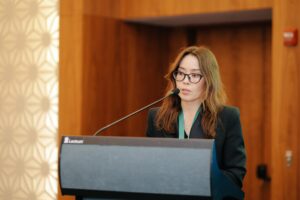
Zhuldyz Saulebekova. Photo credit: Kairzhan Sagyndyk
“Very often, when I attend different conferences, especially climate conferences, I hear a lot about efforts to address climate change and decarbonization. But very rarely do I hear about air pollution,” Saulebekova said.
She highlighted Almaty’s CHP-2 and CHP-3 plants, which together burn more than 3.5 million tons of coal annually. The coal comes from Ekibastuz and, according to figures she presented, has an ash content of around 42%.
Saulebekova said converting CHP-2 from coal to gas could reduce relevant air pollution by around 12 times.
She also presented figures from Climate TRACE showing the scale of particulate emissions from several major sources. According to the figures in her presentation, Almaty CHP-2 emits nearly 94 tonnes of PM2.5 (fine particulate matter) annually, compared with 633 tons from Ekibastuz GRES-2 and around 3,700 tons from Qarmet in Temirtau. She said Qarmet’s emissions were higher than those of 99.8% of point sources tracked by Climate TRACE, with approximately nine days of Qarmet emissions equivalent to one year of emissions from Almaty CHP-2.
Saulebekova also stressed the human-rights dimension of air pollution.
“The right to clean air is a guaranteed right in many countries around the world, including Kazakhstan. It is protected not only by our Constitution, but also by the Aarhus Convention, which Kazakhstan ratified more than 20 years ago,” she said.
She cited estimates that around 14,000 premature deaths annually in Kazakhstan are associated with air pollution, including approximately 2,000 in Almaty.
Changing the energy mindset
Mongolian Parliament member Tsenguun Saruulsaikhan highlighted another dimension of the transition: changing how people think about energy consumption.
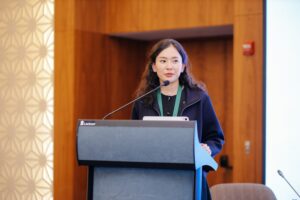
Tsenguun Saruulsaikhan. Photo credit: Kairzhan Sagyndyk
“It is not just only changing coal that is the main goal. We also have to change the people’s mindset that energy, however, from any source it comes from, we need to save it, we need to make it efficient,” she said.
She argued that artificially low heating costs can discourage households from conserving energy, making energy efficiency and insulation an important part of the transition.
“We shouldn’t be focusing on the fuels, on how to heat it. We have to actually focus on insulation, so that we do not need so much energy consumption,” Saruulsaikhan said.
Her comments point to a broader challenge shared by Kazakhstan and Mongolia: the energy transition is not simply about replacing coal with another fuel. It also requires modernizing grids and heating systems, improving efficiency, attracting investment and addressing the health and social costs of the existing energy system.
For Kazakhstan, the challenge is to reconcile growing electricity demand and energy security with a gradual reduction in coal dependence-while ensuring that the transition also delivers cleaner air and more efficient energy use.
