
HONG KONG — The term “bubble” was not a whispered fear but a baseline for discussion at the Nov. 4 Cyberport Venture and Capital Forum, where participants focused on winning the next competitive cycle in AI. As artificial intelligence valuations soar to unprecedented heights, venture capitalists are shifting their focus from the marketing noise of .ai domain names to the harder realities of monetization, scaling bottlenecks, and a shifting geopolitical landscape in which China and the United States (U.S.) are locked in a high-stakes race for dominance.
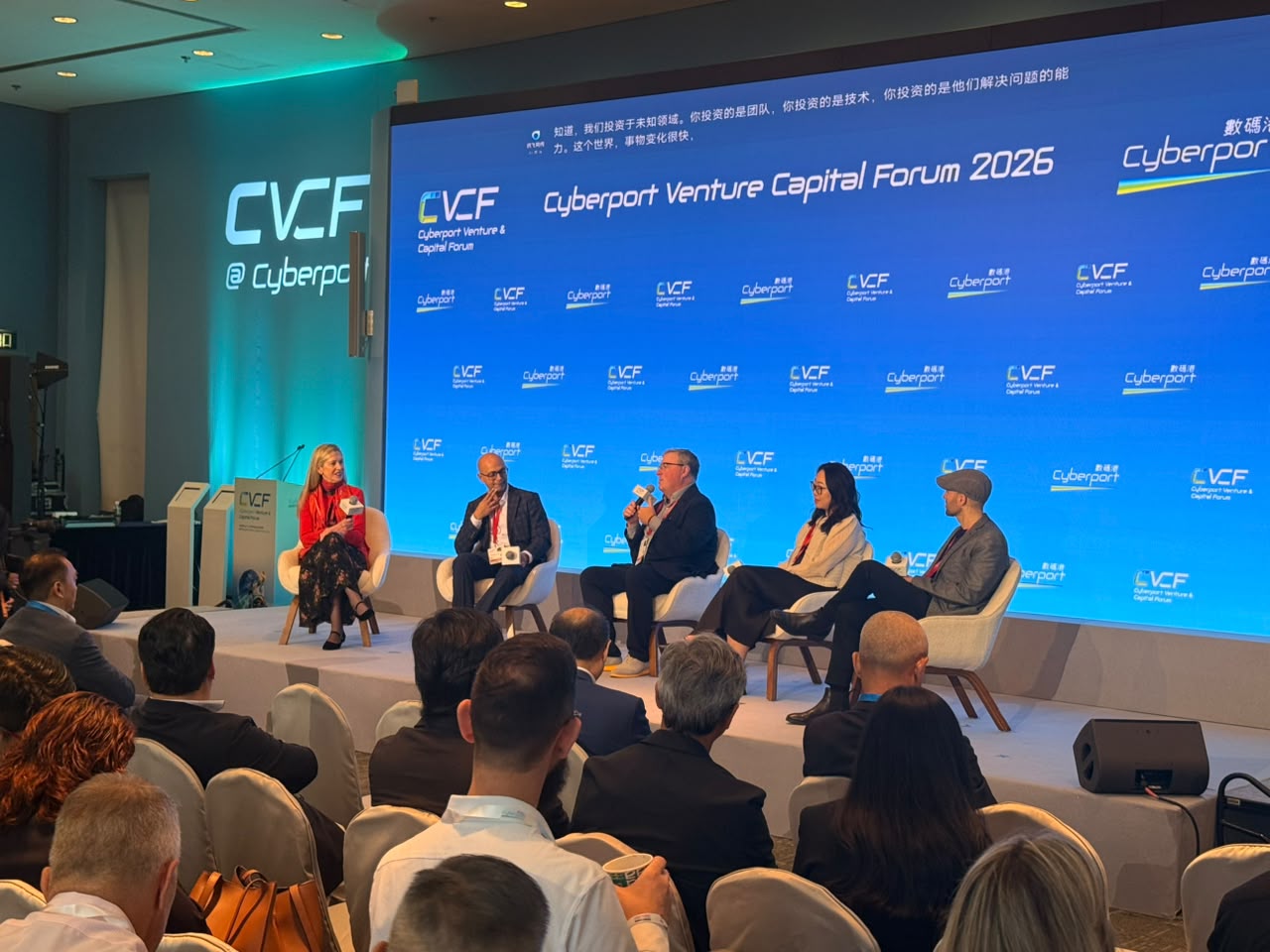
At a Nov. 4 Cyberport Venture and Capital Forum in Honk Kong, participants focused on winning the next competitive cycle in AI as its valuations soar to unprecedented heights. Photo credit: The Astana Times
For Ganesh Rengaswamy, founding managing partner at Quona Capital, the current atmosphere feels hauntingly familiar, yet fundamentally different from the dot-com era.
“Yes, of course we are in a bubble, but great transformation also comes out of the bubble,” Rengaswamy noted.
He pointed out that while modern capital deployment features “a couple of more zeros,” the foundational stack of AI: compute, cloud, models, and tooling, remains in flux. Unlike the early internet, where protocols and browsers stabilized quickly, the AI industry is still searching for its definitive architecture.
“Human beings don’t like that change; we don’t like this rapid transformation. How do we break through that and find real value? It’s tough, and I think we’re all going through that experience,” Rengaswamy added.
AI bubble: are we living it?
The sheer volume of venture capital currently in the market is historically unprecedented. Christine Keung, an advisor at Capital6 and former Bridgewater associate, suggested that the market is in a state where it remains “unclear if the public markets can withstand” the massive private valuations assigned to “hot” companies like Anthropic.
Keung highlighted a growing divide: a “Cambrian explosion” of small businesses empowered by AI, contrasted against a shrinking pool of “venture-backable” companies capable of returning the massive funds now managed by institutional investors.
“Our funds are getting bigger, which means the hurdle in which we need to return those funds increases substantially. It is only a bubble if the markets can’t absorb it… right now the bubble actually hasn’t burst yet,” she said.
Jeremy Dalton, an advisor to FOV Ventures, issued a stern warning to founders: the era of AI as a mere marketing term is over.
“Stop buying .ai domain names,” Dalton said.
He cited a recent Deloitte report showing that only a quarter of business leaders have successfully pushed even 40% of their AI pilots into production. According to Dalton, the disconnect between “hype” and “utility” is the primary driver of current turbulence.
Michael Phillips, executive managing director at Alumni Ventures, echoed the need for resilience, emphasizing that “investing through the bubbles” is the only way to catch the next generation of breakout leaders. The focus has shifted to companies that leverage existing AI layers to create tangible profit and efficiency, rather than those simply burning capital on research.
A multipolar race: China and the democratization of AI
The discussion inevitably turned to a profound geopolitical shift. For the first time in modern tech history, the U.S. faces an unchallenged rival in China. This is not just a race for better Large Language Models (LLMs), but a battle for “physical AI” — the integration of intelligence into manufacturing and robotics.
“China has always had an advantage with physical AI,” Keung noted, pointing out the country’s lead in manufacturing.
Panelists also highlighted that China is leading the charge in open-source models, which may ultimately do more to democratize AI than the proprietary ecosystems of Silicon Valley giants. The “DeepSeek moment,”a reference to recent Chinese AI breakthroughs, served as a reality check, proving that the monopoly on high-end innovation has ended.
Rengaswamy observed that the world has moved toward a bipolar reality.
“China and the U.S. are much more polarized. The world is not able to follow a linear or user-driven technology evolution in this transformation,” he said, noting that this creates significant uncertainty.
However, the rise of Chinese open-source initiatives was seen by some as a positive force for global equity.
“It opened up the market. It allowed for a view towards a path of democratization. My hope is that it will lead us on a positive path towards getting AI into the hands of every individual globally,” Keung said.
She compared the current lack of international alignment on AI safety to previous debates over human rights during peak globalization.
“What’s happening right now in our labor economies isn’t new,” she said, grounding the disruption in the historical context of the Industrial Revolution.
“It just feels scary because we’re living in it,” she added.
And they are living that reality firsthand. The panelists also discussed AI’s impact on their work and it was less about dramatic predictions of replacement but more about pragmatic, daily applications: speeding up research, testing ideas, and dealing with an expanding volume of machine-generated material.
“I have six to eight hour conversations with AI regularly… to code solutions. To do that would have cost hundreds of thousands of dollars without it,” Dalton said.
While it has enabled 24-hour research cycles, a new skepticism has emerged. Rengaswamy admitted that while AI has cut his team’s “time to do work” by two-thirds, his own “time to review” has tripled as he filters through AI-generated “slock.”
“Every single deck, every single memo I look at, it takes me probably five minutes to know if it’s done on AI or not. And that just turns me off,” Rengaswamy said.
