
ASTANA – President Kassym-Jomart Tokayev has proposed creating a Kazakhstan-Germany investment and financial platform to combine German and European capital with Kazakh co-financing, guarantees and risk-sharing mechanisms, as he outlined several priority areas for expanding economic cooperation between the two countries.
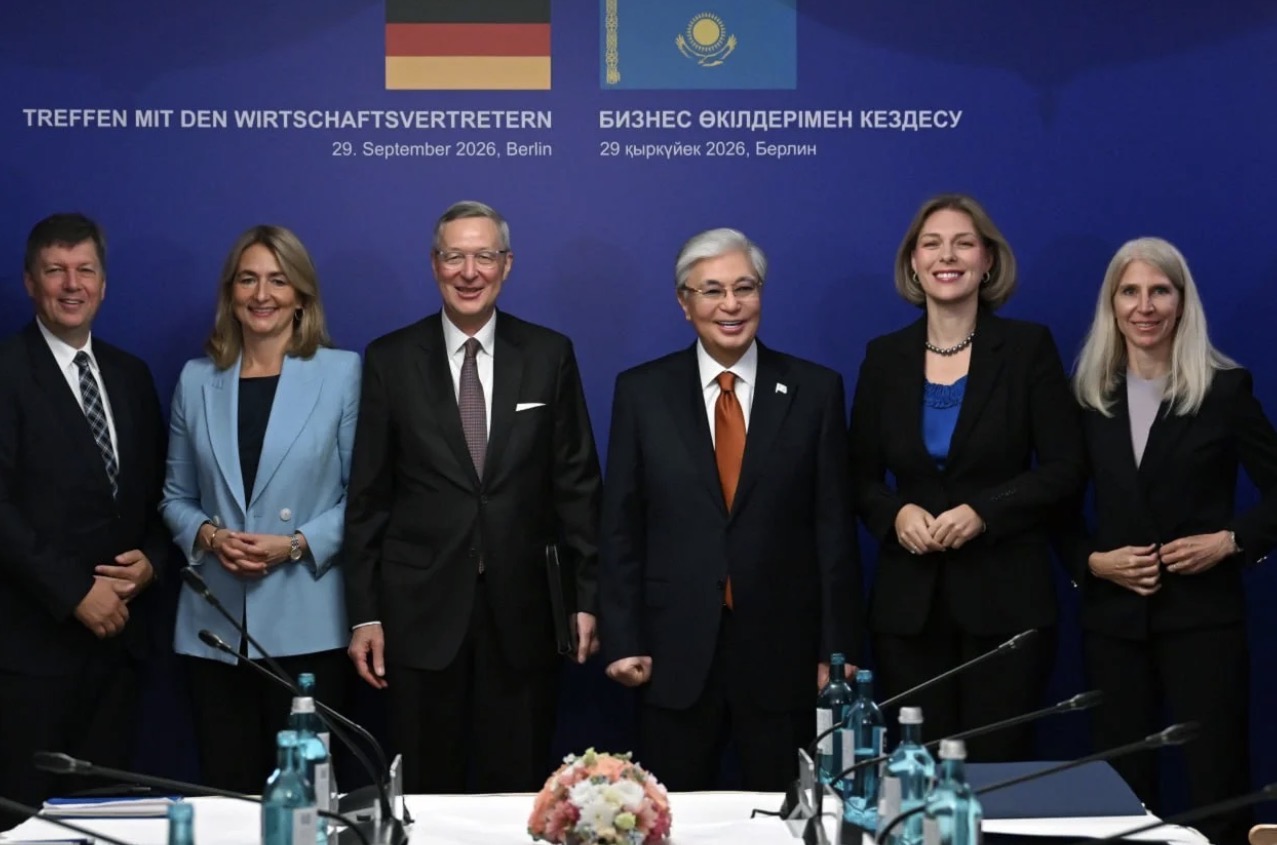
Tokayev met with heads of leading German business associations and financial institutions on Sept. 29. Photo credit: Akorda.
Tokayev made the proposal during his Sept. 29 meeting with leaders of leading German business associations and financial institutions, which opened his official visit to Germany. Addressing the participants, Tokayev emphasized the importance Kazakhstan attaches to its economic partnership with Germany, describing the country as one of Kazakhstan’s key European partners.
“Kazakh-German cooperation is an integral part of Kazakhstan’s engagement with the European Union, our largest trade and investment partner. We have come a long way together, but the potential of our economic partnership is far from exhausted. Kazakhstan is ready to take it to a qualitatively new level,” Tokayev said.
He highlighted Germany’s banking sector, engineering expertise and Mittelstand, the country’s network of small and medium-sized enterprises, as examples of strengths Kazakhstan seeks to incorporate into its own modernization and technological transformation.
Proposed investment and financial platform
Tokayev proposed establishing a Kazakhstan-Germany investment and financial platform that would bring together German and European capital with Kazakh co-financing, guarantees and risk-sharing mechanisms. According to him, the Baiterek holding would provide project structuring, while German export credit and investment insurance institutions could participate alongside international financial organizations already operating in Kazakhstan.
President Tokayev also noted that Kazakhstan’s development institutions play an active role in financing the national economy. Last year, these institutions provided $20 billion in support.
He also said the Development Bank of Kazakhstan financed major projects in industry, energy and transport infrastructure with support from German financial institutions, attracting more than $1.2 billion from Deutsche Bank, Helaba, LBBW, Commerzbank, KfW and other organizations.
Tokayev also told the German business community that S&P recently upgraded Kazakhstan’s sovereign rating to BBB with a stable outlook, while Fitch confirmed the same assessment.
Focus on critical materials and energy
Critical materials were identified as another priority area for bilateral cooperation. Kazakhstan is interested in working with Germany’s Raw Materials Fund and promoting projects eligible for UFK guarantees, Tokayev said. Such cooperation could help secure reliable supplies of raw materials for German industry.
He also highlighted opportunities to modernize Kazakhstan’s energy and industrial sectors, including through renewable energy and green hydrogen projects. He said there was significant potential for cooperation between the European Investment Bank and the Development Bank of Kazakhstan with the participation of German capital.
Kazakhstan-Germany partnership in AI and digital technologies
Digital innovation and artificial intelligence were also identified as areas for deeper cooperation. Tokayev invited German companies to apply their expertise in data center technologies, energy efficiency, cloud infrastructure and cybersecurity in Kazakhstan. Fintech was highlighted as another promising field.
“The high level of development of Kazakhstan’s digital financial ecosystem creates opportunities for the development of advanced payment solutions and tokenization technologies in the domestic market, with their subsequent scaling across the region,” Tokayev said.
He also noted that Kazakhstan has developed what he described as an advanced digital and financial ecosystem in the region over the past decade.
Alatau City as potential investment gateway
Tokayev also presented the development of Alatau City as another potential area for German investment. According to him, the project is envisioned as a smart city designed around the requirements of the digital era and could serve as a link between German institutional capital and investment opportunities in Kazakhstan.
“This project represents the first smart city in Central Asia, initially designed with all the requirements of the digital era in mind. It can become a practical bridge between German institutional capital and Kazakhstan’s investment opportunities,” Tokayev said.
Expanding Kazakhstan-Germany economic ties
The meeting also focused on combining German financial resources, expertise and risk-management instruments with Kazakhstan’s resource base and transport potential. Tokayev said Kazakhstan seeks to become a reliable partner for Germany in Central Asia and across the Eurasian space.
He stressed that closer cooperation should not be limited to increasing capital inflows but should also include the joint creation of new industries and long-term sources of economic growth.
Tokayev assured German investors that Kazakhstan would continue to provide favorable and predictable conditions, protect investors’ rights, and support strategically important projects.
