
ASTANA – While addressing London Climate Action Week on June 23, UN Secretary-General António Guterres warned that the world faces a “Tale of Two Crises” – accelerating climate change and growing energy insecurity driven by continued dependence on fossil fuels. He called for stronger climate action, regional cooperation, investment in clean energy, adaptation measures and sustainable development.
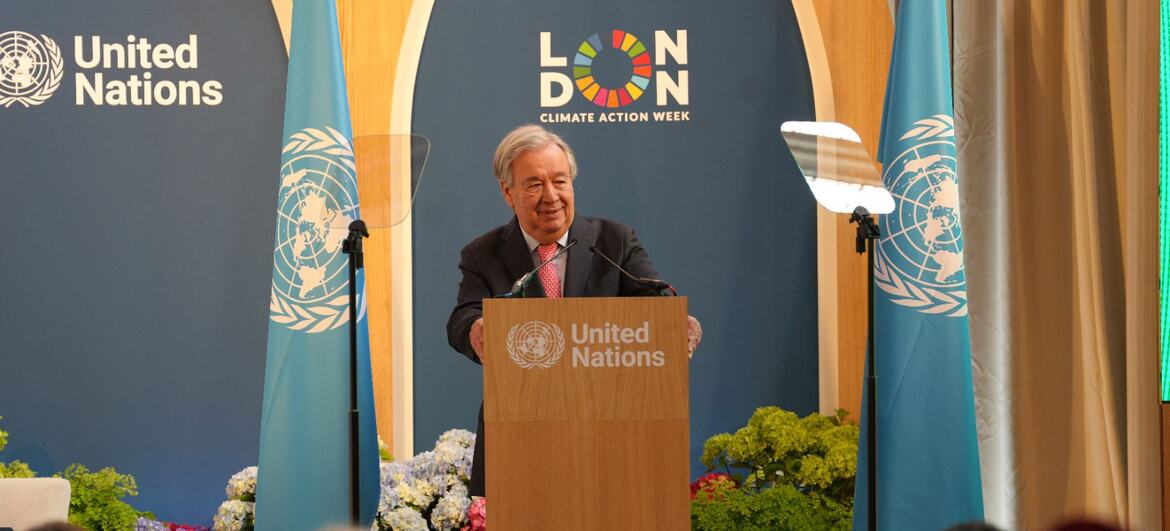
UN Secretary-General António Guterres delivered a special address at London Climate Action Week on June 23. Photo credit: United Nations/Florence Mondou
Many of these priorities are increasingly reflected in Kazakhstan’s environmental agenda and regional initiatives. A key example was the Regional Ecological Summit 2026, held in Astana on April 22-24. The summit brought together regional leaders, policymakers, experts and international partners to address Central Asia’s most pressing environmental challenges, including water scarcity, desertification, biodiversity loss, plastic pollution and the shrinking levels of the Caspian and Aral seas.
During the summit, President Kassym-Jomart Tokayev emphasized that environmental protection is both a moral obligation and a strategic necessity for peace, stability and sustainable development. Echoing themes later raised by Guterres in London, Tokayev called for fair and balanced climate cooperation based on partnership, trust and shared responsibility rather than division.
The summit demonstrated Kazakhstan’s efforts to move environmental discussions beyond declarations toward practical regional solutions. The main outcomes included a regional declaration on ecology and sustainable development, a United Nations partnership program for 2026-2030, and a package of environmental projects and investment agreements exceeding $2 billion.

Aiman Nakispekova. Photo credit: The Astana Times/Fatima Kemelova
The country has also strengthened its national climate commitments. In October 2025, Kazakhstan submitted its updated Nationally Determined Contributions (NDCs), pledging to reduce greenhouse gas emissions by 17% below 1990 levels by 2035 unconditionally and by up to 25% with international support. The country has operated an emissions trading system since 2013 and is pursuing carbon neutrality through reforms in energy, industry, agriculture and waste management.
Water security, a challenge highlighted both by Kazakhstan and the UN, has become a central element of the country’s regional diplomacy. Kazakhstan proposed the creation of an UN-affiliated water institution and promoted stronger cooperation among Central Asian and Caspian states on scientific monitoring and sustainable water management.
Speaking in London, Guterres highlighted that achieving sustainable development will require stronger political commitment.
“What we need, urgently, is the will to fully implement the Sustainable Development Goals. To align prosperity with resilience. Growth with sustainability. And opportunity with justice,” he said.
That objective is also reflected in Kazakhstan’s plans to establish the United Nations Regional Center for SDGs for Central Asia and Afghanistan in Almaty. The center is expected to serve as a platform for joint economic, social and environmental projects while strengthening regional cooperation and supporting implementation of the SDGs across Central Asia and Afghanistan.
As climate risks continue to intensify globally, Kazakhstan’s initiatives illustrate how regional cooperation and national climate action can contribute to broader international efforts.
