
ASTANA — In the Kazakh Khanate, power rarely moved in a straight line from father to son. Succession more often followed seniority within the ruling dynasty, a system shaped by the political traditions of the nomadic steppe.
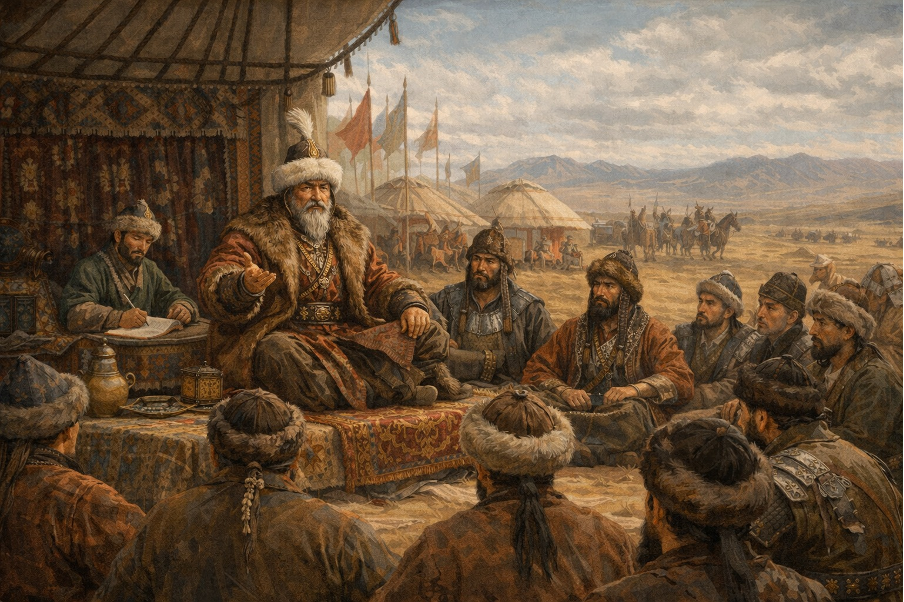
Photo credit: The Astana Times
Edil Noyanov, a candidate of historical sciences and assistant professor at Al-Farabi Kazakh National University, explained that in early Turkic states, power typically passed from an elder brother to a younger one, and only afterward to the elder brother’s son.
“The system was in place during the reign of Mukan Qaghan [553–572] and helped avert internal feuds and succession struggles within the dynasty,” said Noyanov, as quoted by Kazinform.
He noted that this approach differed from Mongol succession traditions, in which power generally passed directly from father to son. However, descendants of Genghis Khan who settled in the Dasht-i-Kipchak steppe gradually adapted to local governance norms, including Turkic principles of succession.
The Chinggisid principle and multiple claimants
At the same time, the broader political structure allowed multiple male descendants of Genghis Khan to claim authority. Historians have noted that this Chinggisid principle, rooted in the legacy of the Jochi Ulus, did not establish a rigid line of succession, which sometimes created competition among potential rulers.
“When the number of contenders grew too large, civil wars often erupted in the khanate, since any Chinggisid [direct male descendants of the four sons of Genghis Khan] could aspire to supreme authority,” said researcher Adilbek Karatayev, as quoted by Kazinform.
In addition to dynastic seniority, legitimacy often required recognition at a kurultai, a traditional assembly of sultans, biys and clan leaders. Historians note that such gatherings played a key role in confirming authority and maintaining balance among influential groups in the steppe political system.
Decisions at kurultais were reached through debate and consensus rather than formal voting, reflecting the consultative character of governance in nomadic societies.
Succession in the Kazakh Khanate
This principle also shaped the early period of the Kazakh Khanate. After the death of Kerei Khan, power did not pass to his son but to his cousin Janibek Khan, with whom he had founded the state. After Janibek’s rule, the khanate was led by Kerei’s son Burunduk Khan, and only after Burunduk did power pass to Janibek’s son Kassym Khan.
Noyanov said that age, political experience and authority within the dynasty were key factors in determining succession.
This tradition, however, was broken after Kassym Khan’s death, when the throne passed directly to his son Mamash Khan, a move that triggered a prolonged political crisis. According to historians, the period from 1521 to 1538 is characterized by political crisis and weakening.
Following Mamash, the throne passed to Tahir, the son of Adik, Kassym’s brother. Later, Adik’s sons Koja-Akhmet (1526–1535) and Togym (1526–1538) ruled, further intensifying internal divisions.
The reign of Khaknazar (1538–1580), another son of Kassym Khan, is widely regarded by historians as a period of consolidation and revival of the Kazakh Khanate. Later rulers included Shygai (1580–1582) and his son Tauyekel (1582–1598), during whose reign the consolidation of Kazakh ethnic territories was completed.
However, after the death of Tauke Khan, succession passed first to his son Kaip and then to another son, Bolat, marking the beginning of political fragmentation within the khanate.
“To preserve power, they adopted the Turkic model of rule. The transfer of the throne to another sultan rather than to one’s own son was a historical pattern,” Noyanov said.
Law of the steppe
Noyanov emphasized that this tradition is reflected not only in politics but also in everyday Kazakh life.
“For example, even if you are 30 years old, and an 18-year-old son of your father’s older brother enters the family home, the kara shanyrak, it is he who will receive honors or a gift from the grandfather first,” said Noyanov. “Kazakhs explain this through the concept of zholy ulken, seniority determined by lineage. That is the law of the steppe.”
Noyanov said that age, political experience and authority within the dynasty were key factors in determining succession.
The article was originally published by Kazinform.
