
ASTANA — Newly appointed U.S. Ambassador to Kazakhstan Julie M. Stufft, during her first press briefing on Feb. 13, sent a clear message: Washington sees Astana not as a peripheral partner, but as a country with long-term strategic weight and as a “partner of choice.”
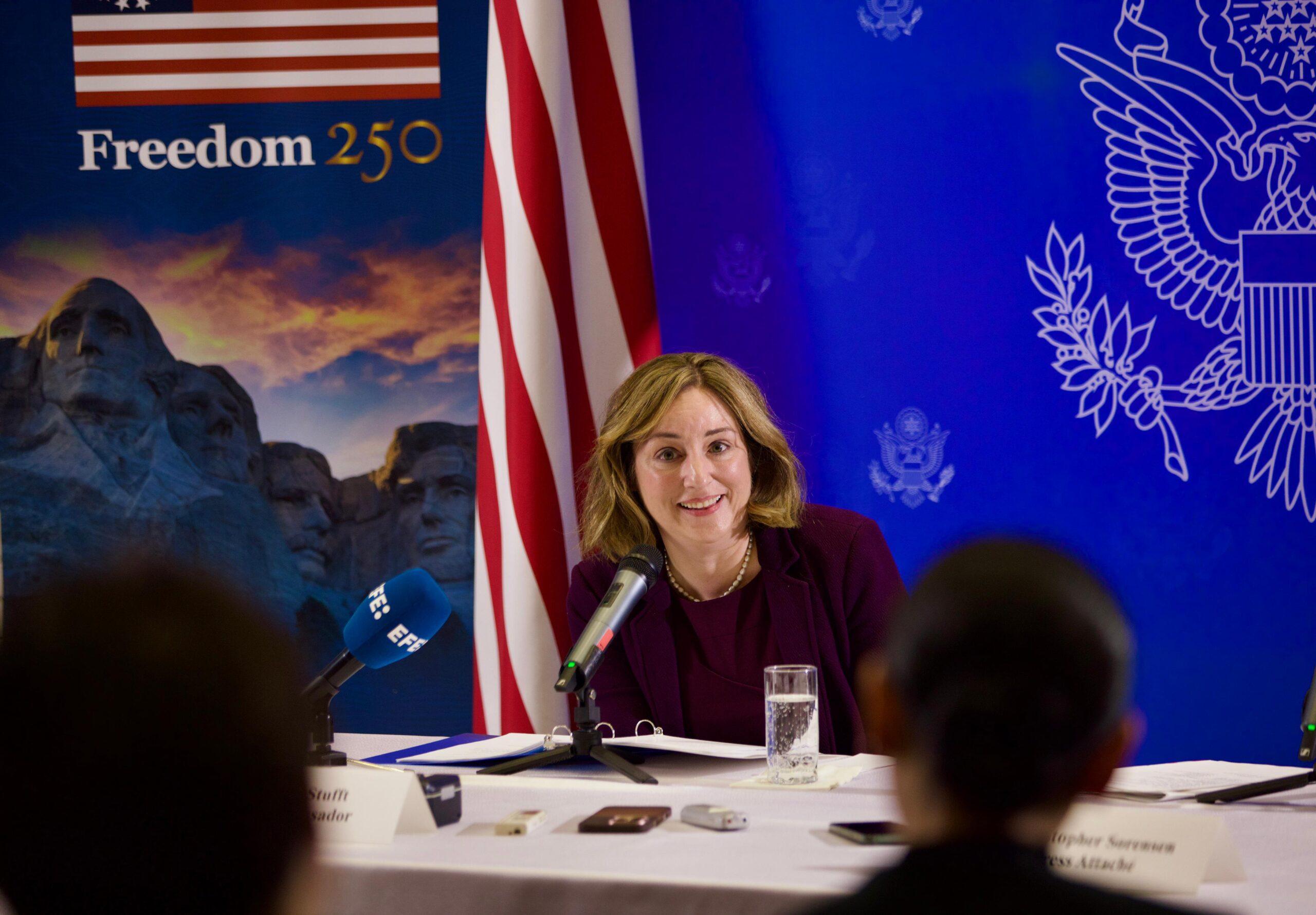
U.S. Ambassador to Kazakhstan Julie M. Stufft. Photo credit: kz.usembassy.gov
“I am glad to be here in Kazakhstan. For me, there is no country with more potential for a historic bilateral relationship with the United States than Kazakhstan,” she said in her opening remarks.
Arriving in the capital just a month ago, the ambassador joked about Astana’s winter but stressed the warmth she has experienced.
“While the weather has been cold, the welcome from the people of Kazakhstan, the government of Kazakhstan, and colleagues at the Embassy has been incredibly warm, and my family and I already feel at home,” she said.
A new phase following a 35-year foundation
The ambassador reminded journalists that Washington was the first to formalize diplomatic ties with independent Kazakhstan. Ambassador Stufft said that both countries have built a partnership based on mutual respect, shared values, and a vision for a better world. Calling the current moment the strongest point in bilateral relations, she said that the U.S. commitment to Kazakhstan’s sovereignty is unwavering.
“The bilateral relationship today is the strongest it has ever been. President Trump and President Tokayev know each other well. It really speaks to Kazakhstan’s leadership in the region and in the world,” she added.
Stufft noted that 35 years ago, the relationship began largely as a commercial relationship, with U.S. companies investing in Kazakhstan. That was only the first step, she said, reiterating that the relationship is evolving beyond its original commercial base.
“We’re in a different phase now of cooperation. And that involves security cooperation and cultural cooperation and going into other sectors of economic cooperation,” she said.
Asked what success would look like five years from now in practical terms, Stufft was optimistic but pragmatic.
“We have this amazing confluence of factors here. We have the two leaders of the countries that are very much engaged with each other on the global stage. We have unprecedented commercial collaboration with companies, investments going in both directions between our countries. We have cultural ties,” she said.
“I think that there’s a very, very bright future for both countries and for the relationship between our two countries. My job as ambassador is to capitalize on these opportunities… to make sure that we have growth and prosperity between the U.S. and Kazakhstan,” she added.
AI as “the big growth area”
Stufft, however, highlighted AI development as an area where the U.S. “can really get involved.” According to the ambassador, $3.7 billion in deals with U.S. AI companies have been completed in Kazakhstan. This is also the Year of AI Development in Kazakhstan.
Drawing from decades of diplomatic experience, Stufft expressed unusual enthusiasm.
“I’ve been a diplomat for a long time, and I’ve rarely seen a place like this already that I can see where the youth and this generation who are coming up are so good, so creative, so smart. I really think that AI is the big, big growth area here. Very excited to see what Kazakhstan does,” she said.
The remarks align with Kazakhstan’s broader ambition to position itself as a digital and innovation hub in Central Asia.
Critical minerals and strategic choice
Another pillar of cooperation is critical minerals — a sector with growing geopolitical relevance.
Another pillar of cooperation is critical minerals — a sector with growing geopolitical relevance. Photo credit: The Astana Times
“We’re very, very happy to have a memorandum of understanding, now with Kazakhstan, to talk about how we can develop in the future,” Stufft said, describing cooperation that ranges from exploratory visits to signed agreements for future development.
But she emphasized sovereignty as a guiding principle.
“Our goal is that Kazakhstan have full availability of choices in determining how to use its own mineral wealth for its own people,” she said.
The United States, she noted, brings technical capacity. According to Ambassador Stufft, the U.S. is one of the five biggest countries on Earth conducting mining operations.
“We can bring a lot of technology to Kazakhstan and to help move this along and develop these resources,” she said.
The topic is also global in scope. The ambassador referenced a high-level meeting in Washington last week, chaired by the U.S. Secretary of State Marco Rubio and attended by 54 foreign ministers.
“All of these countries agreed that we need a way forward to make sure that there is a market that’s fair and predictable for access to critical minerals,” she said.
Kazakhstan, she stressed, played a visible role.
“The foreign minister Kosherbayev gave one of the first four plenary remarks at that event. It’s a very important role showing Kazakhstan’s importance, but very much a global issue,” she said.
People-to-people ties: “Maybe more important than all of this”
Beyond geopolitics and trade, Stufft framed human connections as her most personal priority.
“You asked what my priorities are as ambassador. (…) But there’s actually one other goal that I have that’s maybe more important than all of this. So my real goal as U.S. ambassador is to have more Kazakhs visit the United States and more Americans visit Kazakhstan. And why I say that is that our two countries are actually very similar, and we need our citizens to see that,” she said.
Ambassador Stufft noted that distance does not determine partnership, saying that just because some countries share a border does not mean they are the best partners or allies.
“Sometimes partners and allies are far away, and that’s where we are for Kazakhstan. We want to be the partner of choice and the ally. We aren’t geographically close. We’re on the other side of the world, but we need Kazakhstan to understand America and America to understand Kazakhstan,” she said.
Educational exchange figures underscore that trend. In the 2024–2025 academic year, more than 3,000 Kazakh citizens studied in the U.S., the highest number on record. In 2023–2024, more than 100 Americans studied in Kazakhstan — another historic peak. Ambassador Stufft said that part of her tenure will include work on increasing those numbers.
Constitutional reform: “We are watching it very closely”
Asked about Kazakhstan’s ongoing constitutional reform process, the ambassador struck a careful diplomatic tone, saying that the U.S. embassy is watching it very closely.
“It’s a very ambitious reform package, and it’s something that’s moving quickly. I was meeting with President Tokayev. He had some time today, and we did discuss it,” she said.
While emphasizing respect for Kazakhstan’s sovereign process, Stufft underscored a fundamental principle.
“I think it’s critical to understand that a constitution has to protect the natural rights of the citizens of a country. That’s the whole purpose of a constitution. So yes, we’ll continue to watch this process,” she said.
Freedom 250 and a symbolic year
The ambassador also announced the launch of the U.S. Freedom 250 campaign, marking America’s 250th anniversary of independence alongside the 35th anniversary of U.S.–Kazakhstan diplomatic relations.
“Throughout 2026, we will shine a spotlight on American excellence and innovation, but also on the enduring friendship between our nations. I invite you, the storytellers of Kazakhstan, to join us in sharing the story of the U.S.-Kazakhstan relationship,” she said.
