
ASTANA – Foreign capital inflows to Kazakhstan surpassed $58 billion in 2025, said Prime Minister Olzhas Bektenov while briefing President Kassym-Jomart Tokayev on the latest economic figures at an expanded government meeting in Astana on Feb. 10.
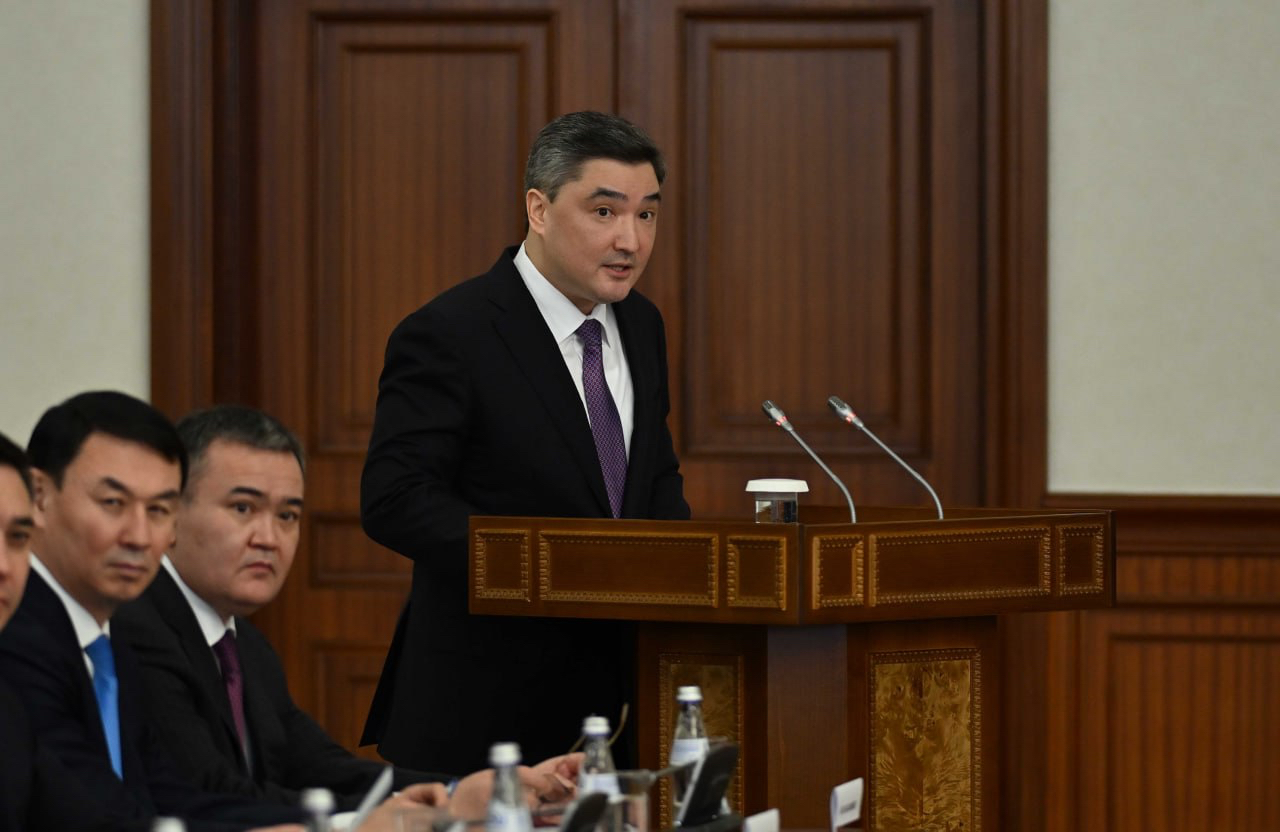
Prime Minister Olzhas Bektenov delivers report at an expanded government meeting. Photo credit: Akorda press office
“Foreign direct investment increased by $1.5 billion, or 10.9%, over nine months to reach $14.9 billion. Including portfolio investment and borrowed funds, total foreign capital inflows exceeded $58 billion,” said Bektenov.
Fixed capital investment rose by 13%, hitting 22.7 trillion tenge (US$46.1 billion).
“Of that amount, public investment increased by 800 billion tenge [US$1.6 billion], while private investment rose by 2.4 trillion tenge [US$4.9 billion],” he added.
Bektenov highlighted the role of an investment task force, which helped regulate issues related to 212 projects with a combined value of $115 billion in 2025. He also said Kazakh Invest national company will open additional branches in countries with high investment potential to strengthen outreach abroad.
The prime minister reiterated that the functions of the investment ombudsperson were assigned to the prosecutor general, strengthening legal protection for investors through enhanced prosecutorial oversight. Baiterek Holding has also begun proactively seeking major investors interested in implementing priority projects in Kazakhstan.
Speaking about economic figures, Bektenov stressed the steady growth, with GDP rising by 6.5%. Transport expanded by 17.8%, construction by 14.6%, mining by 17.4%, manufacturing by 12.2%, trade by 26% and agriculture by 5.9%, the Prime Minister said.
Bektenov said current manufacturing growth rates are insufficient to achieve full economic diversification. To accelerate momentum, the government is implementing projects to boost the development of processing industries.
Projects involving higher value-added production in metallurgy, mechanical engineering and the agro-industrial sector are currently underway through financing mechanisms operated by Baiterek Holding, he said.
“Despite economic growth, a number of pressing issues remain that require prompt action. Priority is being given to modernizing the country’s infrastructure and implementing large government-led industrial projects, while at the same time paying particular attention to supporting small and medium-sized businesses, which employ about 4.5 million people, roughly half of the country’s economically active population,” he told the government meeting.
Bektenov said existing tools to support micro and small businesses are insufficient to fully unlock their potential. As a result, the government and the business community are developing additional financial and regulatory support measures.
One of the key initiatives will be a program to re-equip small and medium-sized enterprises with modern equipment. Under a special scheme operated by Baiterek Holding, entrepreneurs will be able to obtain concessional loans within 10 days to purchase modern machinery without additional collateral. The measure is intended to boost competitiveness and address the sector’s worn-out production base.
As of the end of 2025, the number of active SMEs in Kazakhstan increased by 5% to more than 2.2 million enterprises. Employment in the sector rose by 3.9% to 4.5 million people, accounting for nearly 46% of total employment and nearly half of the economically active population.
SMEs accounted for 40.5% of GDP, with total output estimated at around 73 trillion tenge (US$148.3 billion).
The transport sector also posted steady growth. Bektenov said the government plans to modernize 11,000 kilometers of roads and expand airport throughput capacity to handle up to 40 million passengers.
“This year, we will complete the construction of two railway lines totaling 475 kilometers and modernize 2,900 kilometers of track. This will increase transit freight volumes by 60%, while the average speed of transit container trains will reach 50 kilometers per hour. For example, by the end of this year, cargo delivery time from the Chinese border to the Caspian Sea will be reduced from 84 hours to 55 hours,” he said.
