
ASTANA — An international expert discussion titled Central Asia 2030: Strategic Horizons and Regional Choices was held at Astana International University (AIU) on Feb. 2, bringing together regional and international policymakers and analysts to assess Central Asia’s strategic trajectory through the end of the decade. The forum marked the first public discussion and official launch of CFive, a new intellectual platform established at AIU in partnership with leading analytical centers, including the Atlantic Council and the Caspian Policy Center.
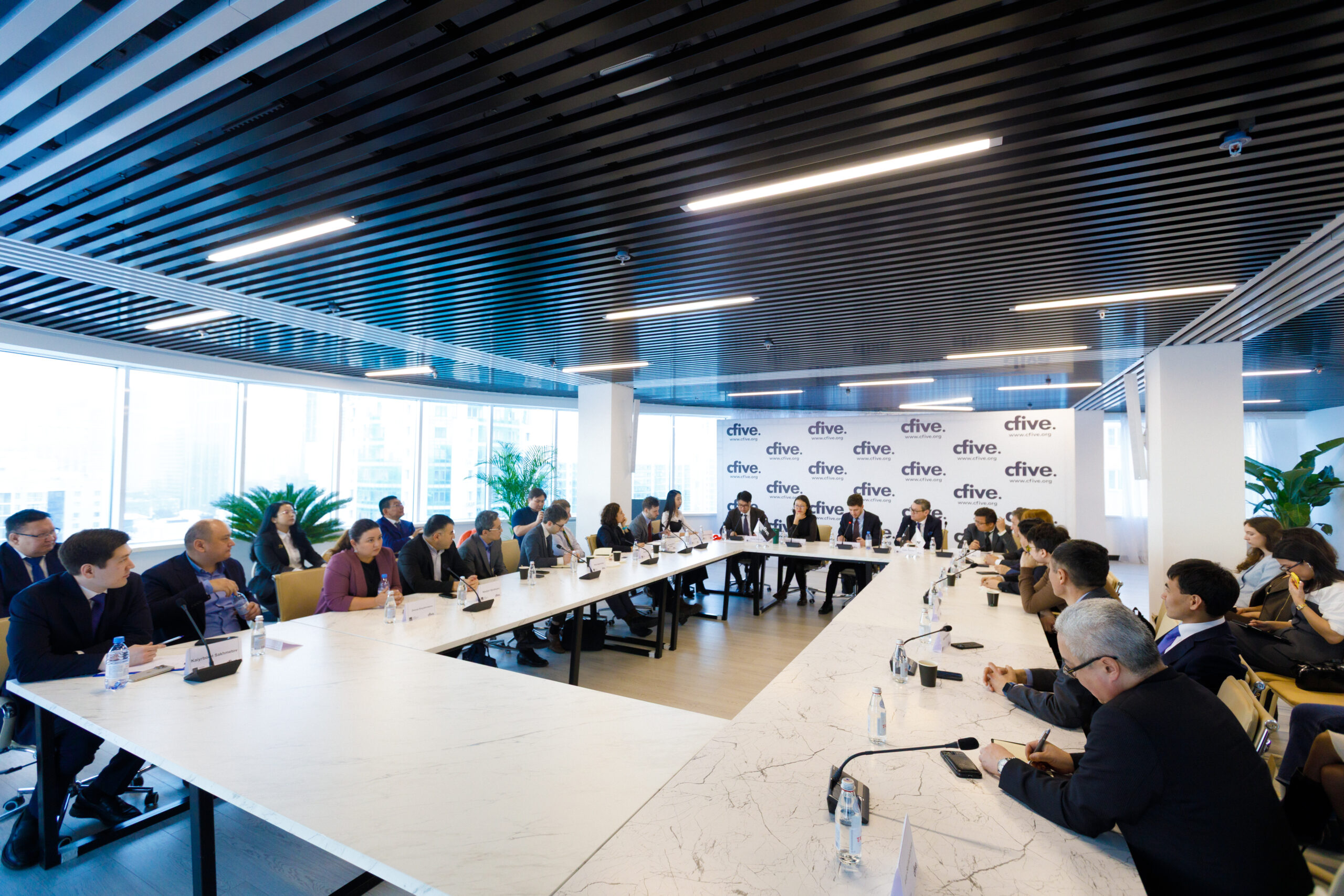
Astana International University hosts Central Asia 2030: Strategic Horizons and Regional Choices with global experts on Feb. 2. Photo credit: AIU
The discussion was moderated by Iskander Akylbayev, Chair of CFive. Participants included Andrew D’Anieri of the Atlantic Council’s Eurasia Center; Efgan Nifti, Chief Executive Officer of the Caspian Policy Center (joining online); Zulfiya Suleimenova, Ambassador-at-Large at Kazakhstan’s Ministry of Foreign Affairs; Dauren Aben, Deputy Director of the Kazakhstan Institute for Strategic Studies; and Yerkin Tukumov, Special Representative of the President of Kazakhstan for Afghanistan.
A central theme of the discussion was the rethinking of regional connectivity not as an alternative transit route, but as strategic infrastructure essential for economic sovereignty, sustainable growth, and long-term stability. Participants noted that over the past year, countries across Central Asia and the Trans-Caspian region have made tangible progress in coordinating transport, logistics, customs, and digital systems: developments that until recently had seemed difficult to achieve.
The United States approach to Central Asia
Experts highlighted that the United States (U.S.) is increasingly advancing a regional approach to engagement with Central Asia, viewing it as an autonomous strategic actor with its own agency and significance, rather than as a passive object of external policy. From Washington’s perspective, long-term commercial and investment projects are closely linked to regional stability, deeper cooperation among neighboring states, and the strengthening of multilateral regional formats.
In this context, the C5+1 framework was underscored as the cornerstone of U.S.–Central Asia engagement. The recent C5+1 summit at the level of heads of state in Washington was described as a notable milestone, particularly given the traditionally bilateral orientation of U.S. foreign policy under President Donald Trump. It was also emphasized that Trump’s potential visit to the region would likely hinge on the presence of a so-called “big deal,” a large-scale commercial or strategic project offering clear, mutual benefits. Areas cited as potential anchors for such engagement included critical minerals extraction, transport and logistics connectivity, and major investment initiatives that go beyond symbolic cooperation.
From debt to equity
Western and U.S. investors currently view Central Asia as a reliable region due to its macroeconomic stability and growing appeal of sovereign debt instruments. At the same time, participants stressed the need to move to the next stage: creating conditions for substantial equity investments capable of delivering sustainable economic returns for both regional economies and international partners.
Regional institutionalization and new priorities
The discussion also focused on deepening regional institutionalization, including the potential development of a C6 format (C5 plus Azerbaijan). Such an expansion would extend Central Asia’s strategic perimeter westward and strengthen the region’s collective bargaining position in engagements with external actors.
Energy and critical minerals were identified as emerging strategic priorities. Participants highlighted the importance of transitioning from a raw-materials model toward processing, value creation, and integration into global production chains linked to green energy, electrification, and digital infrastructure. In this context, the Middle Corridor was viewed as a key instrument for enabling this transformation.
Summing up, participants agreed that if 2025 marked a year of strategic alignment, 2026 will be a test of implementation and delivery. Key priorities include expanding the capacity of the Middle Corridor, addressing infrastructure bottlenecks, moving from political declarations to practical outcomes, and embedding regional cooperation into the everyday practices of governance and trade.
The event underscored the growing relevance of CFive as a new independent analytical platform and a long-term venue for expert dialogue and international cooperation on Central Asia’s strategic future.
The launch of CFive reflects the broader evolution of Central Asia’s external engagement architecture, which has expanded steadily since the introduction of the first “Central Asia Plus” dialogue format in 2004. Today, more than ten C5+1 and Central Asia Plus tracks connect the five regional states with major global partners, underscoring the region’s growing strategic confidence and role as a connector between multiple centers of political and economic influence.
