
ABU DHABI — Despite renewable energy installations reaching a new peak, employment in the sector grew by just 2.3% year on year, totaling 16.6 million jobs in 2024, according to Renewable Energy and Jobs – Annual Review 2025 by the International Renewable Energy Agency and the International Labour Organization.
Photo credit: Shutterstock
The report was released on Jan. 11, on the eve of Abu Dhabi Sustainability Week 2026, held in the UAE capital under the patronage of Masdar, Abu Dhabi’s state-backed clean energy champion.
As in previous years, uneven development persists worldwide. According to the report, China remains at the forefront in both generating capacity deployment and equipment manufacturing, mainly due to its integrated, large-scale supply chains that deliver equipment at unmatched prices. In 2024, China created an estimated 7.3 million renewable energy jobs, or 44% of the global total.
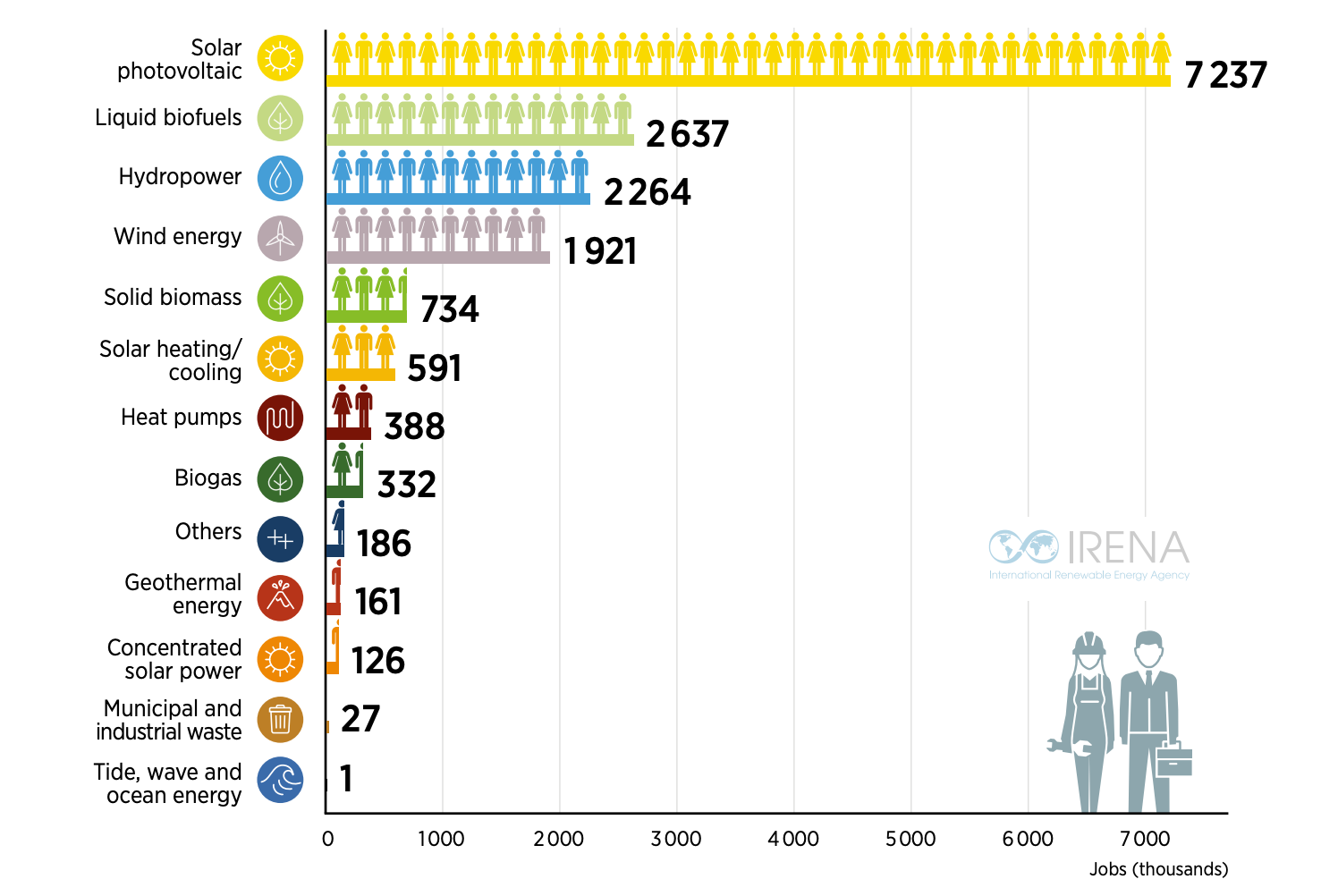
Global renewable energy employment, by technology, 2024 by IRENA
According to the report, the EU followed suit, with employment remaining unchanged from 2023 at 1.8 million jobs. Brazil’s renewable energy employment reached 1.4 million, whereas India’s and the United States’ figures increased modestly, from around 1 million to 1.3 million and 1.1 million, respectively.
In Non-EU Europe and Eurasia, Türkiye stands out as a regional outlier, recording rapid growth in both solar and wind power alongside a fast-expanding domestic manufacturing base, which IRENA estimates supported more than 120,000 renewable energy jobs in 2024. In the Caucasus, Armenia and Azerbaijan report smaller but measurable employment, mainly in solar, hydropower, and waste-to-energy, while Georgia’s renewable workforce remains anchored in hydropower, underscoring uneven visibility and development across the region. No data were available for Kazakhstan or Central Asia.

IRENA Director-General La Camera said it is important governments to put people at the centre of their energy and climate objectives. Photo credit: IRENA press service
Commenting on the trend, IRENA Director-General Francesco La Camera said it is important for governments to put people at the centre of energy and climate objectives that drive investment, build domestic capacity, and develop a skilled workforce along the supply chain. He also pointed to uneven geographical progress, which he said calls for stronger international collaboration.
“Countries that are lagging behind in the energy transition must be supported by the international community. This is essential not only to meet the goal of tripling renewable power capacity by 2030, but also to ensure that socio-economic benefits become lived realities for all, helping to shore up popular support for the transition,” he said.
According to the report, solar photovoltaics (PV) retained the lead in employment by technology, driven by the continued rapid expansion of installations and panel manufacturing. The industry employed 7.3 million people in 2024. Asian countries accounted for 75% of global PV jobs, with China alone accounting for 4.2 million jobs.
ILO Director-General Houngbo reiterated that accessibility for persons with disabilities must be built into every stage of policy design and implementation. Photo credit: Flickr.com
Liquid biofuels ranked second to solar PV, generating 2.6 million jobs in 2024, with 46.5% of those positions in Asia. Hydropower ranked third with 2.3 million jobs, followed by wind energy with 1.9 million.
Beyond the headline numbers, the report underscored the need for greater inclusion and equity in the renewable energy workforce. It found that women continue to face barriers to hiring and career advancement, while people with disabilities are only beginning to gain broader access to employment opportunities.
ILO Director-General Gilbert F. Houngbo reiterated that accessibility for persons with disabilities, who often face barriers despite their skills, experience, and talent, must be built into every stage of policy design and implementation.
“This requires accessible training systems, inclusive hiring practices, and workplaces that accommodate, welcome and respond to diverse needs and respect every worker’s rights. Disability inclusion is not only a matter of justice; it is essential for resilient labour markets and sustainable development,” he said.
