
ALMATY — The Rhenus Group has strengthened its presence in Central Asia with the acquisition of its first rail-connected intermodal terminal in Kazakhstan, marking a strategic step in the company’s long-term development of integrated logistics infrastructure along the Trans-Caspian International Transport Route (TITR).
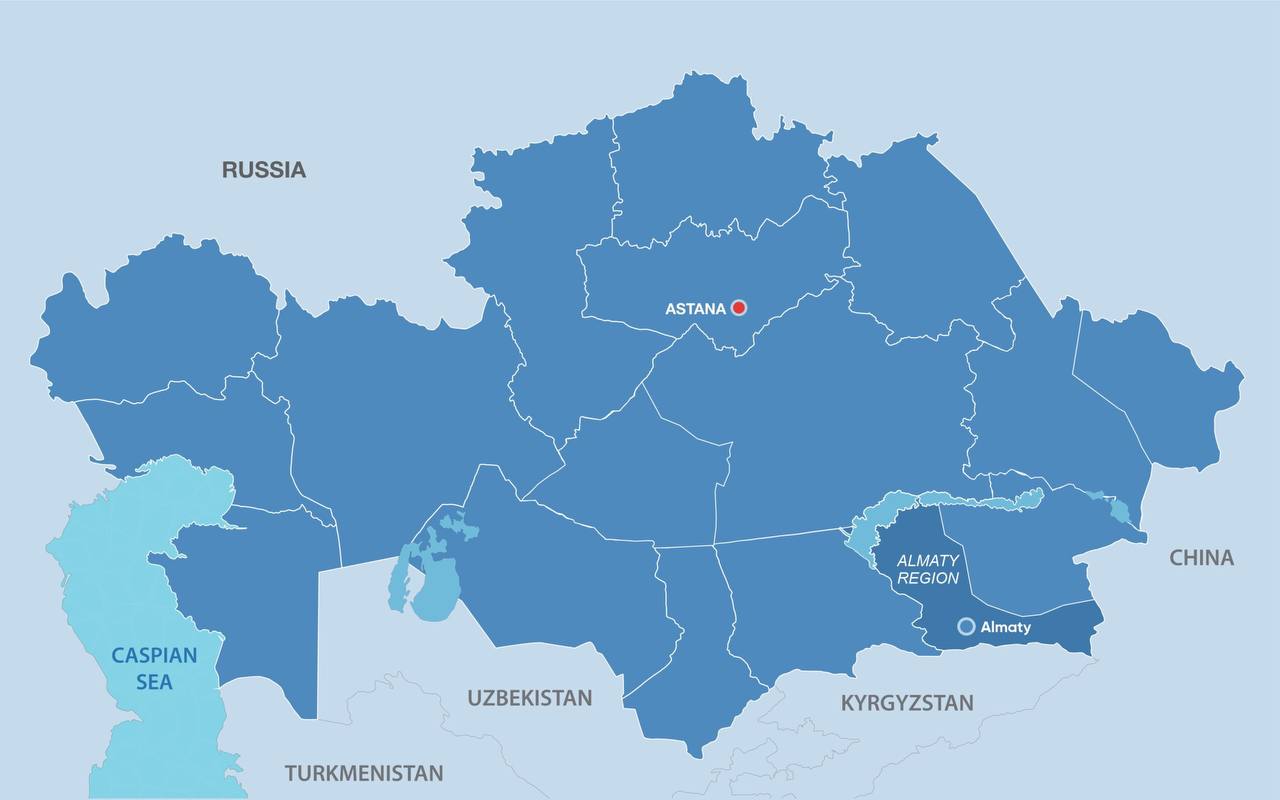
The terminal provides direct access to national and international rail networks, supporting growing import, export, and transit flows between China, Europe, and Central Asia. Photo credit: Rhenus Group. Click to see the map in full size. The map is designed by The Astana Times.
Located at the Bayserke railway station in the Almaty region, the new facility, operating under the name QAZContargo Almaty, significantly expands container-handling capacity in southern Kazakhstan.
The terminal provides direct access to national and international rail networks, supporting growing import, export, and transit flows between China, Europe, and Central Asia, reported the company’s press service on Jan. 19.
Operations at the terminal will be carried out by the Contargo Group, a long-standing partner of Rhenus with extensive expertise in international container logistics.
Enhancing multimodal connectivity
The QAZContargo terminal focuses on container depot services and block train handling. It offers bonded storage facilities for import cargo, an open bonded yard for container operations, and rail-based transshipment solutions. The site is also equipped to transfer bulk cargo from rail wagons into containers, enabling more efficient multimodal transport along the TITR.
Rhenus has been operating in Kazakhstan since 1996, providing freight forwarding and logistics services through offices in Almaty, Astana, and Karagandy. The integration of its first own rail-connected terminal enhances these operations by linking forwarding services with dedicated terminal infrastructure, improving efficiency and reliability across regional supply chains.
Growing role of Kazakhstan as a logistics hub
With the launch of the Almaty terminal, Rhenus now operates its second container terminal in Central Asia, following the establishment of a joint rail-connected terminal with Uzbek Railways in Andijon, Uzbekistan, in 2025.
The expansion reinforces Kazakhstan’s role as a key logistics gateway for Eurasian trade and strengthens inland connectivity along strategic east-west transport routes.
As global supply chains continue to regionalize, demand for flexible routing and reliable inland rail solutions is rising. Andreas Stöckli, a member of the Rhenus Group management board, said the investment reflects changing market dynamics along the Trans-Caspian Corridor.
“With the addition of the QAZContargo terminal, we are responding directly to these developments and strengthening our ability to offer resilient, intermodal solutions. This investment supports the next phase of supply chain transformation from 2026 onwards and demonstrates our long-term commitment to Central Asia and the sustainable development of logistics infrastructure in the region,” Stöckli said.
In a recent interview with Eurasian Development Bank’s Chief Economist Evgeny Vinokurov, warehousing was described as one of the most underestimated drivers of growth in Eurasia. Often dismissed as low-value real estate, modern warehousing is a capital-intensive, technology-heavy infrastructure that directly shapes supply-chain efficiency and costs, with logistics accounting for up to a quarter of the final retail price.
In Central Asia, where per-capita warehouse capacity remains far below global benchmarks, this deficit has become a structural bottleneck, one increasingly addressed through rail-connected intermodal terminals that combine storage, customs, and transshipment, and are now emerging as critical nodes along the Trans-Caspian route.
