
ASTANA — Kazakhstan and Iran not only maintain a constructive political dialogue but are also seeing growing trade and economic ties, with trade up 40% in just ten months. President Kassym-Jomart Tokayev said the momentum must continue during a Dec. 11 meeting with the President of the Islamic Republic of Iran Masoud Pezeshkian, who arrived in Kazakhstan on an official visit for the first time, according to Akorda.
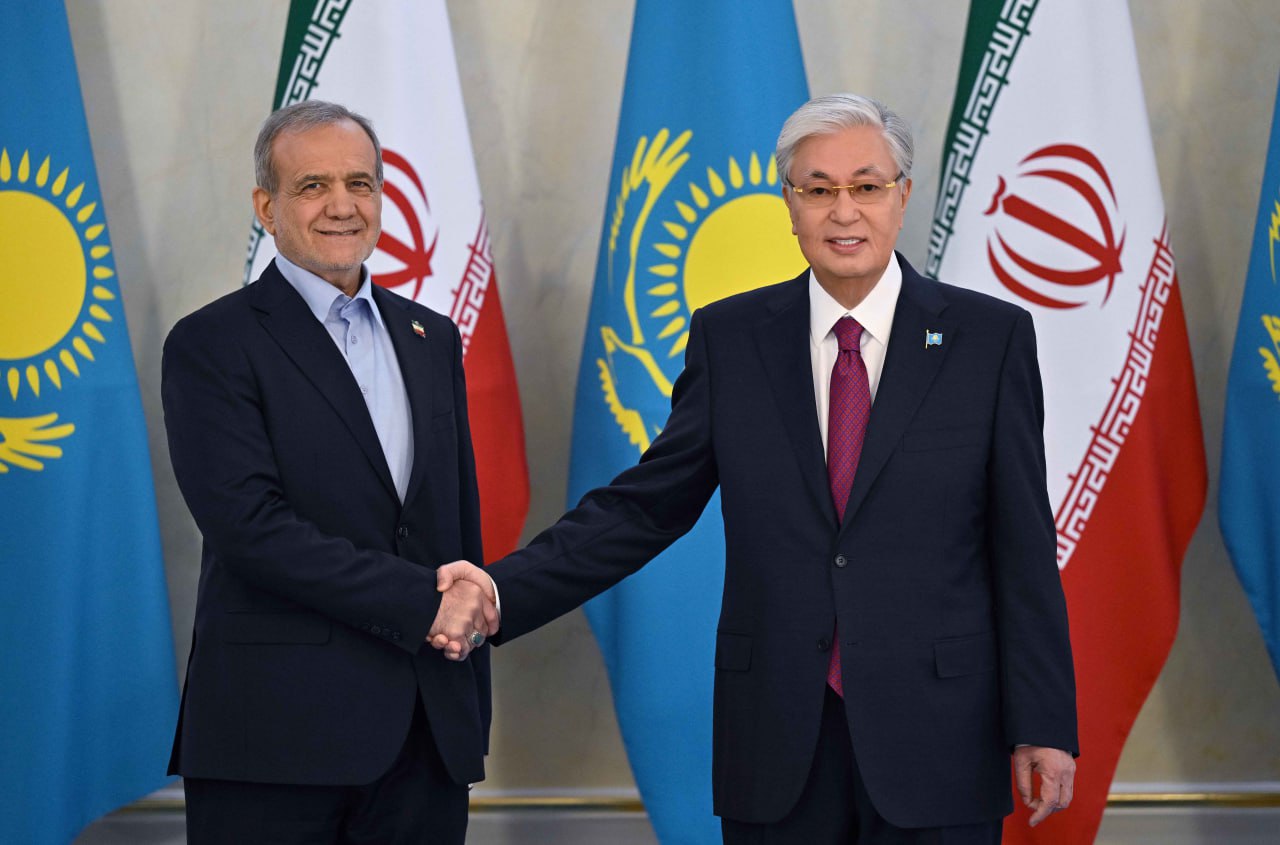
President of the Islamic Republic of Iran Masoud Pezeshkian and President Kassym-Jomart Tokayev. Photo credit: Akorda
Tokayev reiterated that for Kazakhstan, Iran is both a close neighbor and a reliable partner in the Middle East.
“We have enduring respect for the Iranian people. Despite all challenges, we continue to develop our ties. Our relationship has deep roots, with shared customs, traditions, and culture, and we have engaged with one another for centuries. Kazakhstan has always supported Iran; there are no unresolved issues between our countries. I believe there is significant potential for further cooperation,” he said.
Tokayev also conveyed his best wishes to Iran’s Supreme Leader, Ayatollah Ali Khamenei.
Pezeshkian thanked President Tokayev for the warm welcome and expressed confidence that his visit would inject new momentum into bilateral relations. Echoing Tokayev, he said there is enormous potential to deepen cooperation in politics, economics, culture, humanitarian affairs, and security.
Trade and political dialogue on the rise
In a meeting with delegations from both countries, President Tokayev emphasized Kazakhstan’s interest in deepening cooperation with Iran, an important and reliable partner in the Caspian region. He noted the progress achieved over the past 33 years, including constructive political dialogue, effective work of the Intergovernmental Economic Commission, and active inter-parliamentary ties.
“A broad legal and contractual framework has been created, with more than fifty agreements concluded. Cooperation within international organizations is expanding. All of this is a vivid testament to the traditional friendship and partnership between our nations,” Tokayev said.
The Kazakh President also noted Iran’s high international standing, emphasizing its achievements through hard work and prudent leadership, and wished the Iranian people prosperity and well-being.
Pezeshkian underscored the deep historical roots of Kazakh-Iranian relations, dating back to the Great Silk Road and even before Kazakhstan’s independence.
“Cooperation with your country is of great importance to us. Effective intergovernmental and interagency collaboration has been established. Our positions on many international and regional issues align, as well as our cooperation within the Eurasian Economic Union, the Shanghai Cooperation Organization, and the Organization of Islamic Cooperation. Our joint task is to strengthen work in these areas. Currently, bilateral trade has increased by 40%, which is an excellent indicator,” Pezeshkian said.
He noted that the two countries had previously agreed to raise trade volumes to $3 billion and that every effort would be made to achieve this. He added that the Free Trade Agreement between the Islamic Republic of Iran and the Eurasian Economic Union provides a solid foundation for expanding trade and economic ties.
Prospects for expanding trade, economic, and investment cooperation being a cornerstone of the talks, Tokayev stressed the need to diversify mutual trade, especially in agriculture, transport and logistics, mining, healthcare, and advanced technologies. He added that Kazakhstan is ready to supply Iran with goods valued at at least $200 million and supports the initiative to establish a Kazakhstan Trade House in Tehran, stressing the importance of activating the Business Council and fully leveraging the potential of the Kazakhstan-Iran Chamber of Commerce and Industry.
According to Akorda, since the beginning of the year, Iran has invested $17.8 million in Kazakhstan through direct investment. Iranian entrepreneurs are involved in projects such as a cheese production plant in the Almaty region and a leather processing complex in the West Kazakhstan region. In turn, Kazakh businesses are implementing projects in the Iranian market.
Both sides confirmed their mutual interest in further developing the North–South transport corridor and the Kazakhstan–Turkmenistan–Iran railway route. Over the first ten months of this year, transport volumes along these routes increased by 53% compared to last year. The presidents also discussed prospects for further diversifying transport and transit routes to strengthen interregional ties, including the joint development of port infrastructure in the Caspian Sea.
Culture, heritage, and innovation
Special attention was given to enhancing cultural and humanitarian ties. Tokayev noted that Iranian archives hold a significant number of Kazakh historical artifacts, and Kazakh scholars have begun joint studies on Al-Farabi’s legacy. Plans are underway to create a historical and cultural complex in Kazakhstan dedicated to the great thinker.
“Today, the Iranian delegation presented us with copies of valuable ancient manuscripts related to Kazakhstan’s history, for which I am sincerely grateful. This gesture highlights the depth of historical ties between our peoples,” Tokayev said.
To promote mutual understanding of their spiritual and cultural values, both sides agreed to hold Culture Days in the coming years, expand student exchanges between higher education institutions, and develop cooperation between medical organizations and pharmaceutical manufacturers.
