
ASTANA – The courage of Kazakh warriors, known as batyrs, and the people’s unity were decisive in ensuring the Kazakhs’ survival during the centuries-long Kazakh–Dzungar wars, a conflict that reshaped Central Asia’s geopolitical map and posed one of the greatest tests to Kazakh statehood, said Bereket Karibayev, professor at Al-Farabi Kazakh National University and doctor of historical sciences.
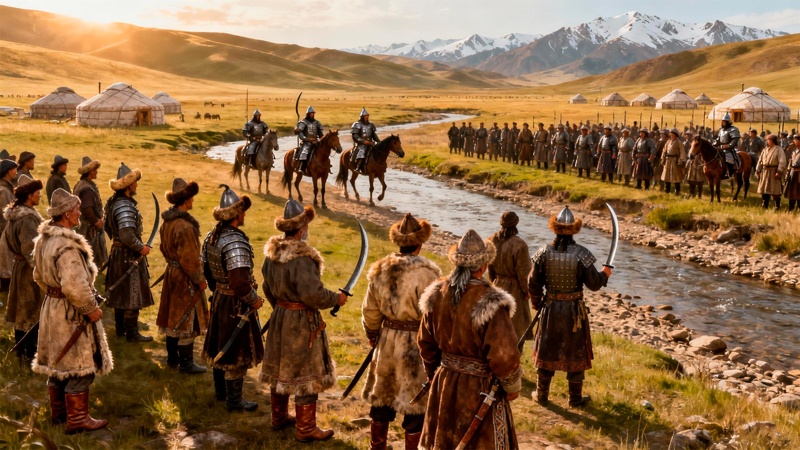
Photo credit: Midjourney
According to Karibayev, tensions between the Kazakhs and the Oirats, western Mongolian tribes, emerged long before the Dzungar Khanate was founded.
“If the Kazakh Khanate was established in 1465, the Dzungar Khanate appeared almost two centuries later, in 1635. However, clashes between the Oirats and Kazakh tribes began much earlier. The Oirats frequently raided Moghulistan, the tribes of Zhetisu, and the state of Abulkhair Khan,” he said.
He noted that the Oirats lacked many necessary goods; they obtained them through trade or warfare.
The rise of the Dzungar threat

Bereket Karibayev, professor at Al-Farabi Kazakh National University and doctor of historical sciences. Photo credit: abai.kz
In 1635, the year the Dzungar Khanate was founded, the Dzungars immediately launched a campaign against Kazakh lands, capturing Sultan Zhangir, the future Kazakh khan. Karibayev described this episode as one of the most unusual in Kazakh-Dzungar relations.
“Executive power among the Dzungars belonged to the khongtaiji, while the legislative body was the chulgan or chuulgan. Its chairman, Kundulen Taishi, was known for his wisdom and strategic thinking,” he said.
Kundulen kept Zhangir in his horde, later married him to his daughter, and sent him back with honor. Their son became the future Tauke Khan.
Karibayev outlined several major stages of the war. Between 1635 and 1652, clashes were frequent but had not yet led to catastrophic losses. Zhangir Khan was killed in 1652, and Batur Khongtaiji died the following year.
From 1653 to 1677, Dzungaria was weakened by internal conflict after Sengge took power, though his authority was not recognized by his brothers.
“Dzungaria was engulfed in internal strife and temporarily halted major campaigns against the Kazakhs,” said Karibayev.
Intensifying the struggle for the steppe
A new phase began between 1677 and 1697, marked by Galdan’s expansion. After Sengge was killed by his brothers, Galdan seized power.
“Researchers describe Galdan as a ruler who sought to emulate Genghis Khan. He aimed to dominate all of Mongolia and then subjugate East Turkistan,” Karibayev said.
Galdan also turned toward Zhetisu and the Kazakh steppe. He died in 1697 during a war with the Qing Empire.
Between 1697 and 1727, shortages of pastureland intensified the Dzungars’ pressure on Kazakh territories.
Under Tauke Khan, the wars grew more brutal. After his death, the Kazakh Khanate split into six smaller khanates, weakening central authority.
“During this weakened period, from 1723 to 1725, the Dzungars intensified their campaigns. Tsevan Rabdan sought to create a great Dzungar Empire. It was Khan Abulkhair’s retaliatory campaign that saved the Kazakh people from destruction,” Karibayev said.
From 1740 to 1757, Galdan-Tseren, the new ruler of the Dzungar Khanate, launched several major campaigns on Kazakh territory, during which Abylai was taken prisoner.
After 1745, another internal crisis erupted in Dzungaria, allowing Kazakh forces to gradually reclaim their lands.
The Dzungar Khanate was destroyed in 1757. After its collapse, official border relations were established between the Kazakh Khanate and the Qing Empire.
The heroes of the Kazakh steppe
Karibayev noted that a key difference between the two states was their military structure.
“The Dzungars had a permanent, regular army, which required vast resources. The Kazakhs had no standing army. They relied on militia forces, or zhasaq, which had to be organized by the central authority. That authority weakened after Tauke Khan’s death,” he said.
As a result, the defense of Kazakh lands depended largely on the heroism of tribal batyrs such as Karasai, Bogenbai, Raiymbek, Nauryzbai, Malaysery, and Kozhabergen, among others.
The article was originally published in Kazinform.
