
ASTANA — While global foreign direct investment (FDI) fell 11% in 2024, Chinese investment in Eurasia continued to rise, reaching record levels in Central Asia, according to the Eurasian Development Bank’s report under its flagship Monitoring of Mutual Investments project released on Dec. 25. Kazakhstan remains the top recipient in Central Asia, with China’s total FDI stock in the region now standing at $36 billion.
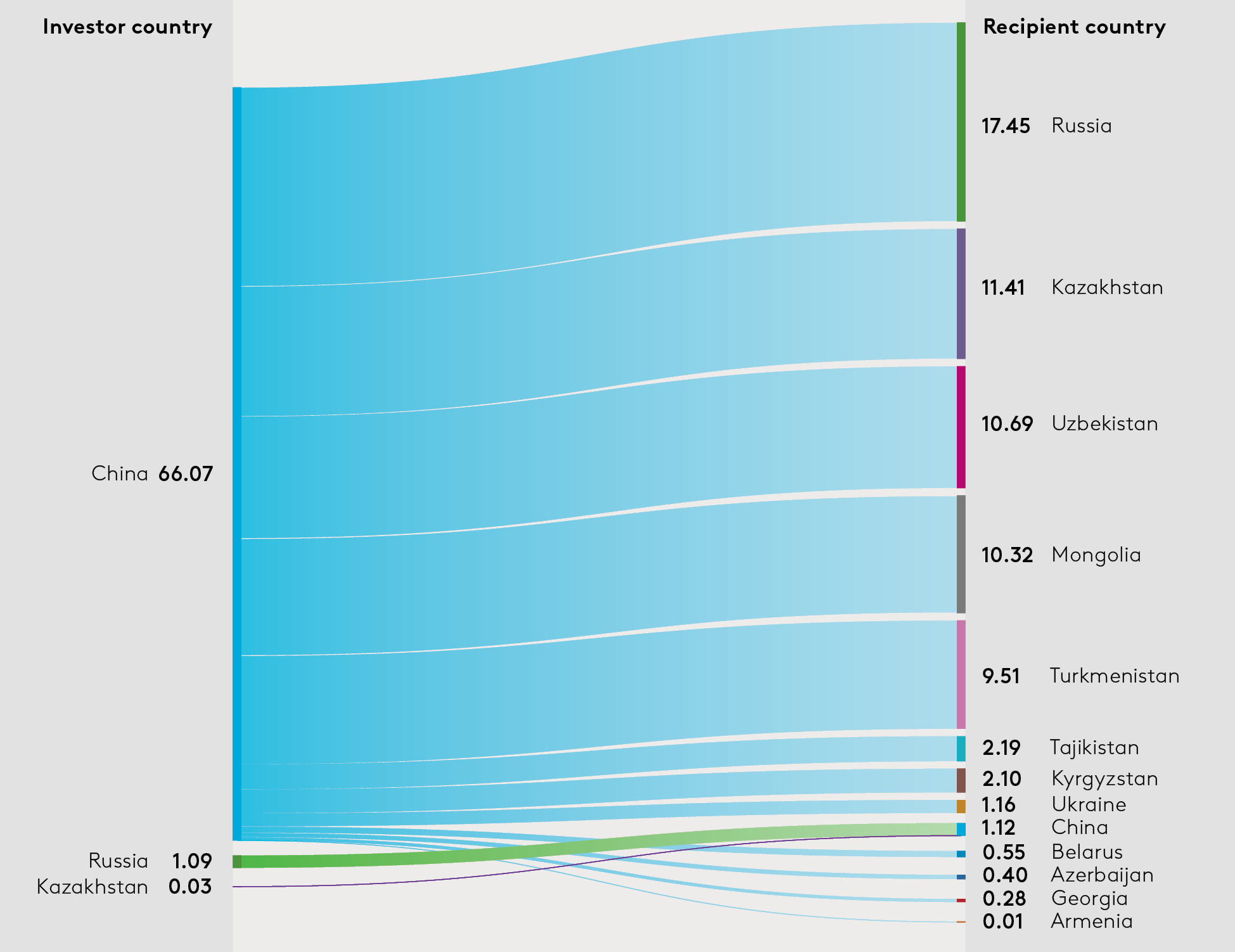
Mutual investment flows between China and Eurasian countries, US $ billions Photo credit: EDB MMI database.
According to EDB Chief Economist Evgeny Vinokurov, China has emerged as a key investment partner for Eurasian countries, with a growing focus on new manufacturing facilities.
“In recent years, Chinese companies have focused on creating new manufacturing and energy facilities. Most of these projects are private investments, demonstrating both the technological maturity of Chinese investors and the improving investment climate in Central Asia,” said Vinokurov.
Over the past 18 months, Chinese investment in the Eurasian region rose by $7.4 billion, up 13% compared to 2023. Kazakhstan leads in total investment volume, attracting $11.4 billion, while Uzbekistan’s FDI growth over the past decade reached $10.4 billion, reflecting its emergence as a key growth driver in the region.
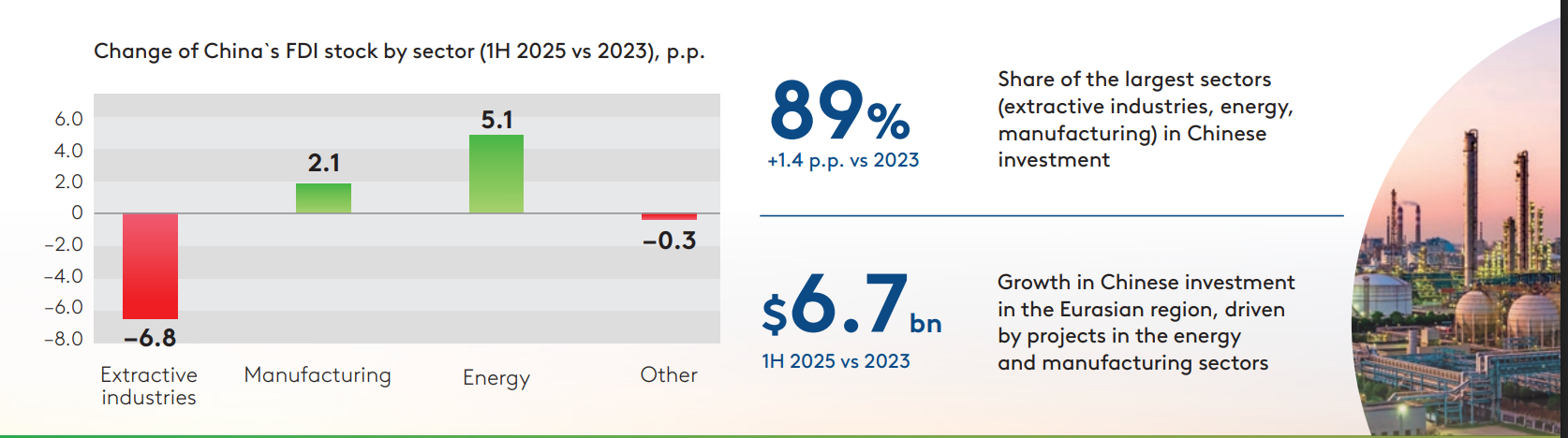
Photo credit: EDB MMI database.
The report highlights a structural shift in Chinese investment across Eurasia. While extractive industries have historically dominated, manufacturing and energy are now driving growth. Over the past decade, China’s total investment in the region increased by 80%, reaching $66 billion by mid-2025.
In Central Asia, Kazakhstan, Uzbekistan, and Turkmenistan together account for nearly 90% of Chinese FDI, with manufacturing and energy projects now comprising more than one-third of the regional portfolio. The share of extractive industries has fallen from 68% to 54%, while greenfield projects, reflecting technological sophistication, have risen from 43% to 60%.
Russia remains the largest recipient of Chinese FDI within the Eurasian Economic Union (EAEU), with an investment stock of $17.5 billion by mid-2025, including Sinopec’s $3.2 billion stake in the Amur Gas Chemical Complex.
In the South Caucasus, Chinese FDI has grown 2.5 times over the past decade, reaching $0.69 billion, primarily split between Azerbaijan (60%) and Georgia (40%), with manufacturing and energy as priority sectors. Across the EAEU, China’s investment reached $31.5 billion across 160 projects, with Russia and Kazakhstan accounting for 91% of the total.
Mongolia has also attracted significant Chinese investment worth $10.3 billion by mid-2025, largely concentrated in mining, including iron ore and oil projects.
