
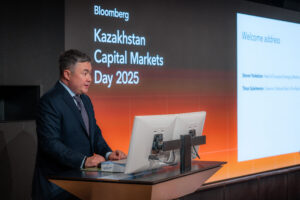
LONDON – Bloomberg European Headquarters hosted Kazakhstan Capital Markets Day in London on Nov. 5. Kazakh officials outlined the country’s economic growth, the stability of its banking system, and an ambitious modernization agenda driven by technology and advanced e-government solutions.

The opening session of the forum. Photo credit: Aigerim Qali.
The forum, organized by Bloomberg, the National Bank of Kazakhstan (NBK) and the Kazakhstan Stock Exchange (KASE), presented plans for Kazakhstan’s shift to a fully digital economy within three years.
In his opening remarks, NBK Governor Timur Suleimenov called fintech a major force behind Kazakhstan’s economic growth.
“We are deploying next-generation financial infrastructure from the digital tenge and open-banking systems to application programming interface (API)-based payments and remote onboarding. These innovations are making our banking system the most resilient in the region,” he said.
NBK Governor Timur Suleimenov. Photo credit: Aigerim Qali.
Suleimenov noted that nearly 90% of payments in Kazakhstan are now cashless and 98% of public services are available online. He added that the country also ranks eighth globally in the United Nations e-Government Development Index (EGDI), a benchmark recognizing nations that excel in digital governance and innovation.
Meanwhile, rising tariffs and prolonged monetary tightening are reshaping the global outlook. According to Jamie Rush, director of global economics at Bloomberg, Kazakhstan remains largely shielded from these pressures, benefiting from its position as a major commodity exporter and its prudent macroeconomic management.
“It now costs about 15% more for U.S. importers to buy the same goods as last year. This is the biggest tariff shock since the 1930s. Interest rates are likely to stay high, testing smaller emerging markets. Strong institutions and credible policy will be key, and Kazakhstan is moving in that direction,” he said.
Kazakhstan’s banks today embody both financial stability and digital innovation, moving in step with global trends reshaping the modern banking industry.
Halyk Bank Chairwoman Umut Shayakhmetova highlighted that banks have evolved beyond traditional lending to become “ecosystem and lifestyle platforms,” offering integrated digital services across everyday life.
“Over the past five years, we have proved our ability to withstand shocks from the pandemic to regional turbulence while continuing to support clients and the real economy,” she said.
“Today, more than 85% of state services can be accessed through banking apps, from payments and loans to ticket purchases or even marriage registration. We are not only lenders but also one of the largest taxpayers, employers, and innovators,” said Shayakhmetova.
Halyk Bank, listed in London since 2006, serves 86% of Kazakhstan’s largest taxpayers and has a market capitalization of more than $7 billion.
KASE Chairman Adil Mukhamejanov said that the country has become one of the most liquid markets in the region, with trading volumes reaching $602 billion in the first 10 months of 2025 and expected to surpass $830 billion by year-end.
“Over three decades, KASE has evolved from a small foreign exchange platform into a full-fledged investment infrastructure,” he said. “The exchange currently operates four markets: foreign exchange, money, securities and derivatives, with sovereign and corporate bonds forming the backbone of the securities segment.”
The equity market is entering a new phase driven by the government’s privatization program through 2028. The capitalization, according to Mukhamejanov, has grown 19% this year to $75 billion, supported by initial public offerings (IPOs) of major national companies such as KazMunayGas, Kazatomprom, and Air Astana.
Speaking to The Astana Times, Vice Minister of National Economy Assan Darbayev described the event as an important platform to showcase Kazakhstan’s economic strengths to the global investment community.
“Such factors as steady gross domestic product growth, strategic transit potential, advances in digitalization, and positive evaluations from international rating agencies reflect sustained progress. They confirm that Kazakhstan offers transparency, openness, and strong long-term potential for investors,” he said.
Amid a global risk revaluation, Kazakhstan’s trajectory continues to illustrate how rapid digitalization, consistent reforms and a commitment to transparency can turn an emerging market into a trusted destination for long-term investment.
