
ALMATY — Kazakh government expects the national economy to expand by 5.4% in 2026, according to projections presented in the Senate, an upper chamber of Parliament, on Nov. 20, as Deputy Prime Minister – Minister of National Economy Serik Zhumangarin outlined key macroeconomic indicators.
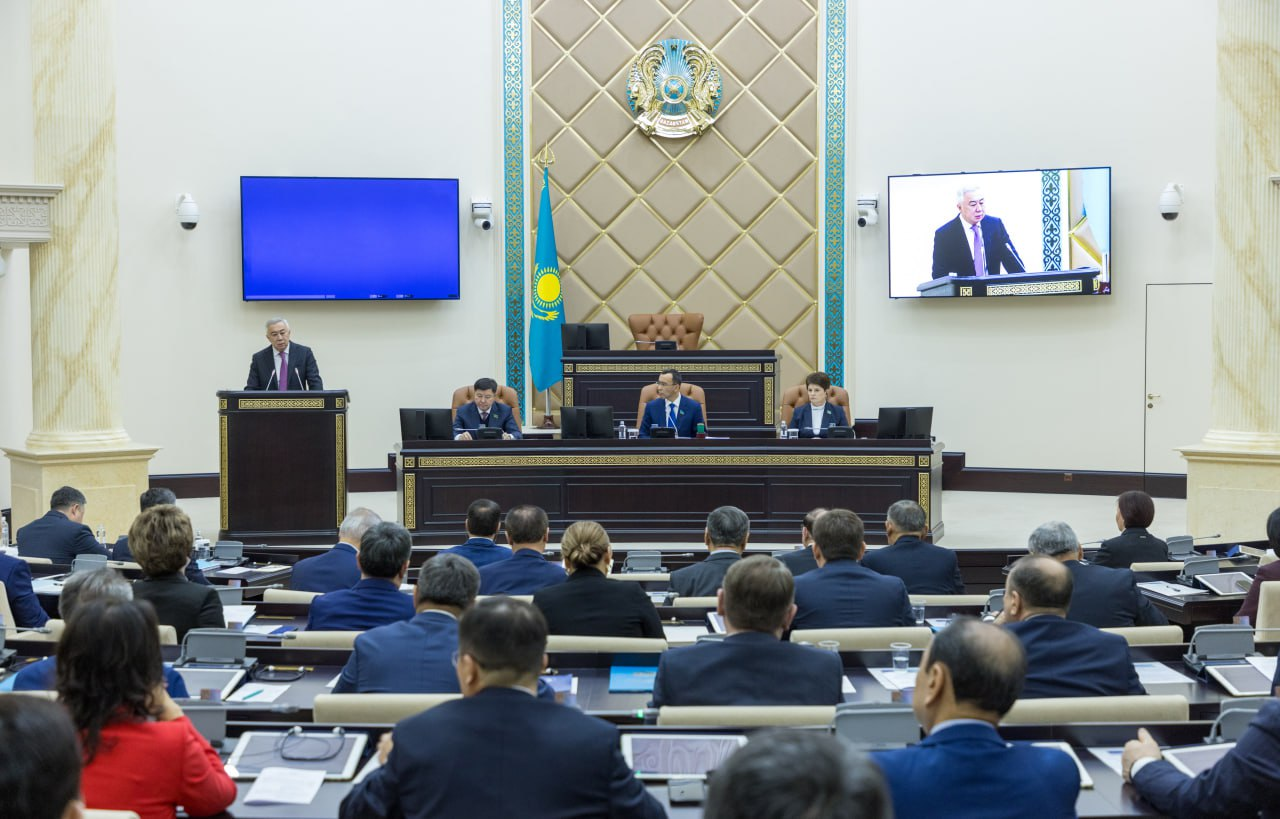
Photo credit: Prime Minister’s press service
Speaking during the session, Zhumangarin emphasized that local budgets remain fully balanced, and the country will continue a stable growth trajectory over the next three years, reported the Prime Minister’s press service.
Economic growth and GDP outlook
Presenting the baseline scenario, Zhumangarin said real GDP growth is projected at 5.4% in 2026, with an average annual rate of 5.3% through 2028.
“Nominal GDP will increase from 183.8 trillion tenge [US$386 billion] in 2026 to 229.8 trillion tenge [US$443.3 billion] in 2028,” he said.
According to him, economic expansion will be driven by the real sector and services. Growth in the manufacturing industry is expected to accelerate gradually, rising from 6.2% in 2026 to 6.6% in 2028, supported by the implementation of major investment projects.
The mining sector is projected to grow by an average of 2.8%, agriculture by 3.9%, construction by 11%, transport services by 10.1%, and trade by 6.7% during the same period.
Trade forecasts and budget revenues
Zhumangarin emphasized that external trade projections remain positive. Exports are expected to grow from $77.1 billion in 2026 to $83.7 billion by 2028, while imports will expand from $67.7 billion to $75.2 billion.
Inflation is forecast to slow steadily, with estimates set at 9–11% in 2026, 5.5–7.5% in 2027, and 5–7% in 2028.
“Budget revenues excluding transfers are forecast at 19.2 trillion tenge [US$35.6 billion] in 2026. In the planning period, revenues are expected to rise to 23.2 trillion tenge [US$43 billion] by 2028. Generally, the budget’s self-sufficiency ratio will rise from 63.7% in 2025 to 83.5% in 2028,” Zhumangarin said.
National Fund transfers and inflation
According to him, the budget expenditures will amount to 27.7 trillion tenge (US$51.3 billion) in 2026, increasing to 28.8 trillion tenge (US$53.3 billion) in 2027, and reaching 29.8 trillion tenge (US$55.2 billion) in 2028.
“At these levels of revenues and expenditures, the budget ensures financial independence without the need to attract additional targeted transfers from the National Fund,” he said.
Fiscal and non-oil deficits are set to decline from 2.5% and 4.9% of GDP in 2026 to 0.9% and 2.7% respectively by 2028.
Government debt is projected to decrease from 21.4% of GDP in 2026 to 19.6% in 2028.
Kazakhstan’s public debt level
Prime Minister Olzhas Bektenov stressed that Kazakhstan’s public debt remains at a safe and internationally recognized low level. He highlighted that public debt currently stands at 23.6% of GDP, comparing this to levels exceeding 50%, 80% and even 100% of GDP in many developed economies.
“Kazakhstan’s investment-grade rating, the only one in the region, reflects strong financial resilience,” he said, pointing out that the country recently placed Eurobonds at 4.4%, which he described as a clear signal of investor confidence.
High-return infrastructure
Bektenov emphasized that borrowing must be directed primarily toward commercially viable infrastructure projects capable of generating long-term returns. He cited toll road performance as an example.
According to him, last year, toll revenues reached 48 billion tenge (US$88.9 million), with 10 billion tenge (US$18.5 million) generated by foreign vehicles. Over the January-October 2025 period, revenues reached 72 billion tenge (US$133.3 million), including 17 billion tenge (US$31.5 million) from international traffic.
“Where a modern highway is built, economic activity transforms completely as dozens of fueling stations and services emerge, jobs are created, and taxes are generated,” Bektenov said.
Targeting social spending
Bektenov said that during the budget formulation process, baseline expenditures were reduced from 15% to 12%, though social spending continues to account for about 60% of the national budget.
“Social support must reach those who genuinely cannot work due to objective circumstances. The state will not provide long-term support to those who are capable of self-sufficiency,” he said.
