
ASTANA — Artificial intelligence is scaling at a pace no economic model can match, and it’s already outpacing human control. When I spoke with futurist and bestselling author Brett King for The Astana Times YouTube channel, he warned that AI’s capabilities are growing tenfold every two years, while our policies and institutions are barely keeping up. His vision of the future is both thrilling and unsettling: a world where central banks are led by technologists instead of economists, and where data privacy becomes a relic of the past.
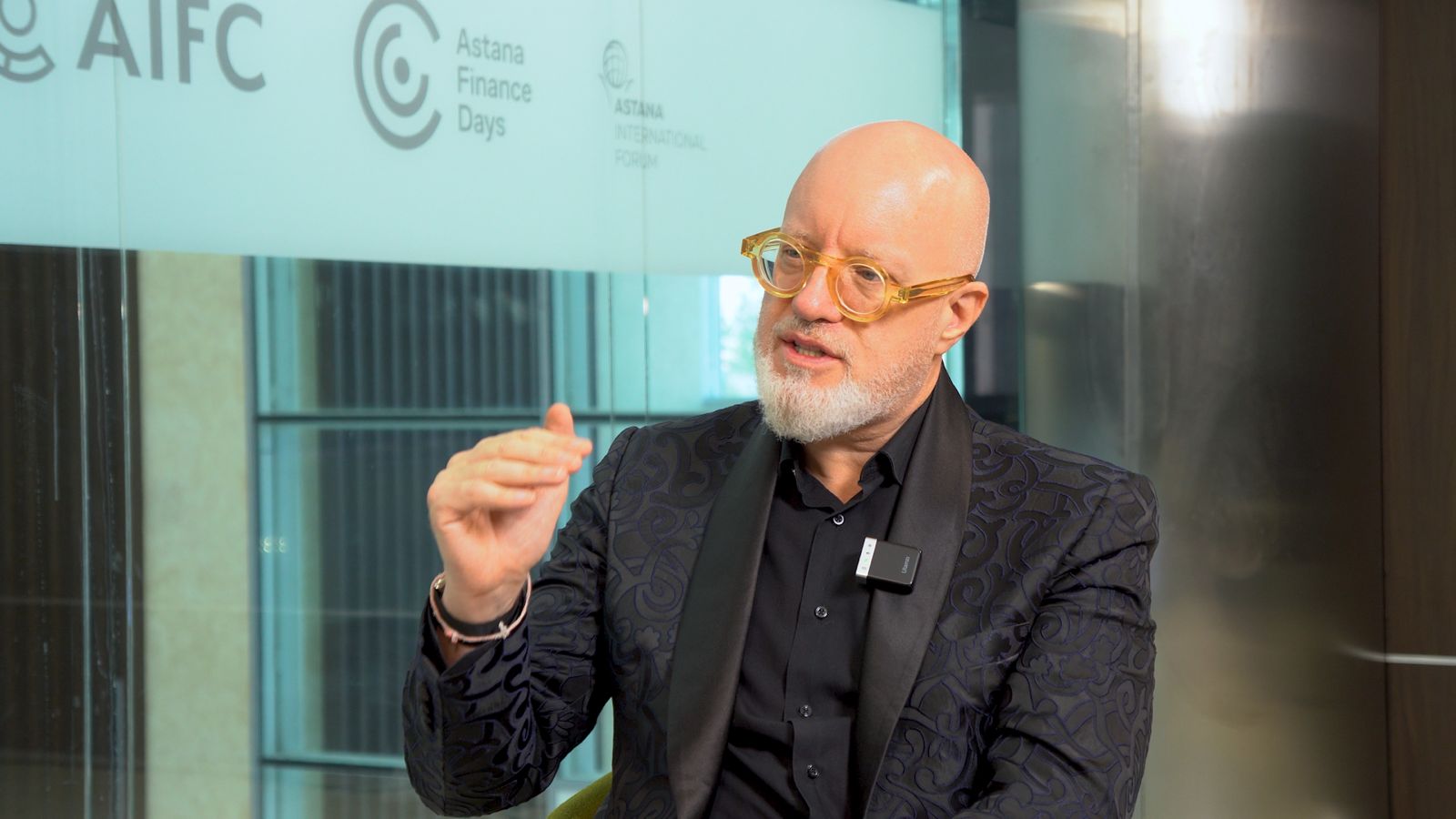
Futurist and bestselling author Brett King. Photo credit: The Astana Times
“We are seeing a tenfold increase in the capabilities of AI every two years right now. This is faster than any technological curve we’ve ever seen. It means we’re witnessing exponential growth in intelligence and technology, while policy struggles to adapt at the same rate,” he said.
King noted that the biggest risk to humanity and financial systems is the growing gap between policy and technological possibility. Technology can quickly bypass existing regulations and rules because policymakers have not adapted fast enough.
“Ultimately, if you want to create policy that protects your markets and citizens from the risks of AI, you must develop policy infrastructure that is based on AI as well. It’s the only way you’re going to be able to adapt,” he said.
He explained that central banks and regulators must begin thinking about AI as technology infrastructure rather than just a set of rules, policies, or laws.
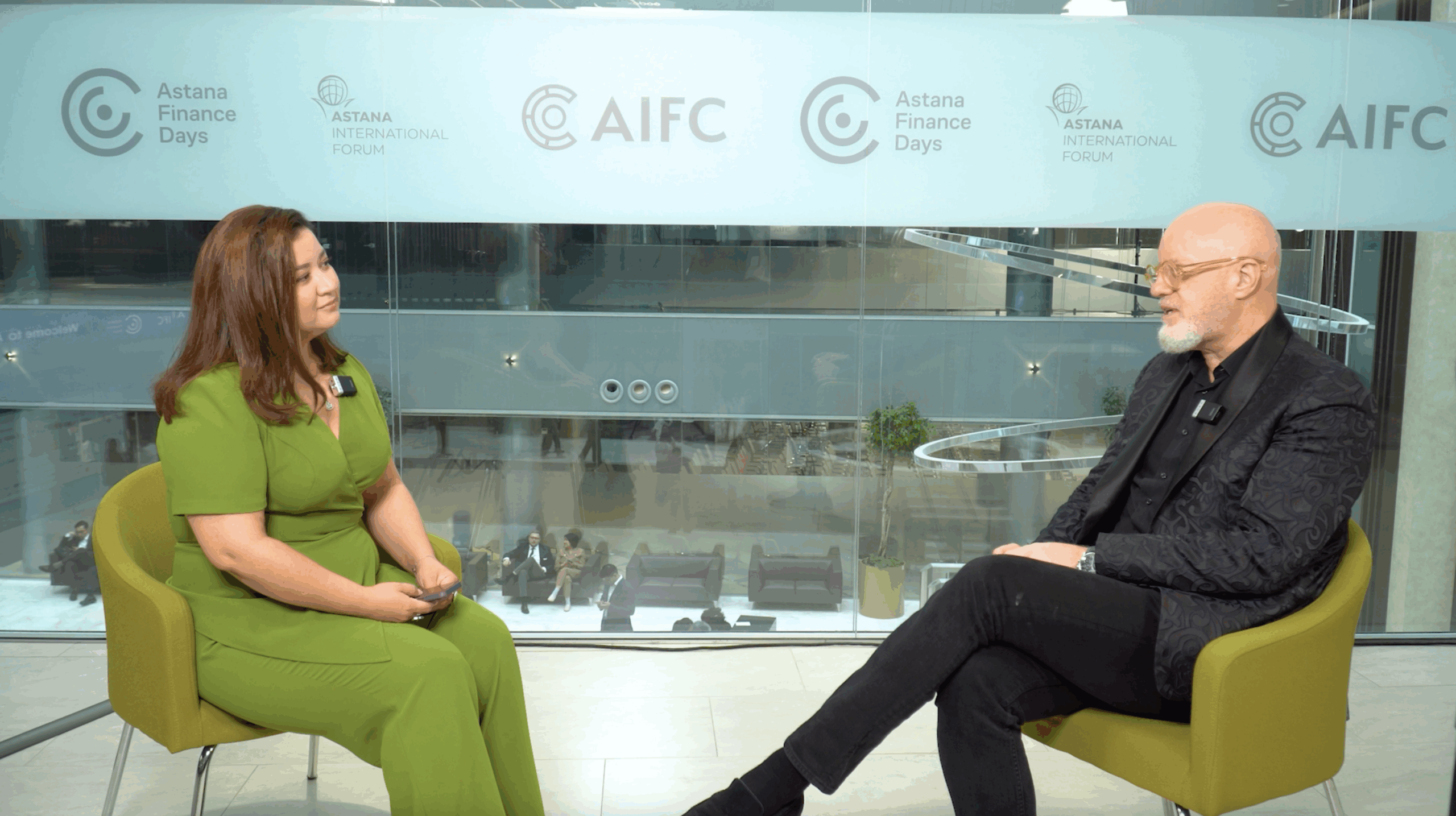
Brett King spoke to The Astana Times correspondent Aida Haidar. Photo credit: The Astana Times
“One key point to understand here is that it won’t be the job of central banks to regulate artificial intelligence, because AI is going to be infused in all parts of society. The most advanced economies in this respect, China and the United Arab Emirates, have already created AI or AI regulation bodies. This is what you need at the market level to start building safety mechanisms. It’s not going to be the job of the healthcare ministry to regulate AI in healthcare, or the banking sector to regulate AI there,” he said.
I asked King about Kazakhstan’s strong focus on digital services, noting that many foreigners, especially from the European Union (EU), often wonder whether Kazakh citizens are not afraid to share their personal data with the government or banks so easily. Are we choosing convenience over privacy?
King turned the question completely around, saying that data privacy will not survive the AI revolution. According to him, if one wants access to things like longevity treatments, which may become available over the next five to ten years to extend lifespan, one will have to share data to do that. The same applies to personalized financial services or personal AI that can plan shopping or travel.
“It means we have to shift to a different view of data, which is data ownership as a trade. You will give your data in return for some sort of value exchange from these AI systems. But it requires digital identity and open data architecture for things like healthcare to be effective. If you don’t want to share your data, you’re going to find yourself with very limited options in the autonomous world of the future,” he said.
King also explained why China, the UAE, and Kazakhstan are moving ahead with digital IDs, blockchain-based services, and massive renewable energy investments while the United States (US) risks falling behind. According to him, if a country fails to make these core technological changes, it will lack the economic growth capacity that others might have. He explained that the world’s most advanced economies in the next 20 or 30 years will be smart economies.
“We call them smart economies because they integrate autonomous operations and AI at the economy level for maximum efficiency and scalability. Economies like the US and many in the EU are still industrial economies, focused on resources and models that were built during the industrial revolution. That’s where the gap is going to open up. Right now, it’s fairly clear that the US is not going to make this transition in time,” he said.
King added that leadership in the world’s smart economies will likely be overtaken by China because of its massive investment in autonomous infrastructure.
“To illustrate, 80% of China’s ports today are fully automated. The U.S. had a strike, just before Biden’s administration ended in November last year, where they banned the implementation of AI in shipping ports for the next 20 years. So the U.S. cannot compete with China when it comes to autonomous supply chains, and that’s going to create a massive gap in economic growth,” he said.
I suggested that perhaps the previous and current U.S. administrations are doing this to save jobs. But at the same time, China, with its enormous workforce, is moving toward a future with minimal human labor. China also has millions of people who need jobs like the rest of us. So what’s really going on? King warned of a coming era of techno-feudalism, where a handful of AI owners accumulate enormous wealth, leaving the rest of society dependent on basic income.
But he also offered hope: the emergence of a “passion economy,” where work is no longer about survival but about meaning. Will AI collapse capitalism or set humanity free? King shared what he called “the worst-kept secret in AI.”
“Let’s be clear, the intent of AI has always been to destroy human capital, because the most efficient form of a company is a humanless corporation. The most efficient form of a transportation company like Uber or Grab is where you have robot drivers and no human drivers. And we see a rush toward this type of autonomous operation. Then you hear Elon [Musk] and Zuckerberg talk about universal basic income as the solution that we’ll tax robots and algorithms to pay people a basic income for survival. But let’s be clear, the intent of AI has always been to remove human labor and human capital from the workforce, because that’s what will produce the most profits,” he said.
King added that all one has to do is listen to Sam Altman OpenAI CEO talking about his bets with Musk and others on the emergence of the first single-person unicorn, a billion-dollar company run by one person using AI technologies. He explained his position on this point.
“Many economists will disagree with me on this, but my position is that the more automation you put into the system, the more likely our system of capitalism will fail. At the heart of capitalism, Adam Smith’s Wealth of Nations, is the concept that as demand for a product or service increases, you increase supply by adding more human capital to the workforce. AI fundamentally breaks that part of the model of capitalism,” he said.
“That doesn’t mean we’ll move to socialism or communism. It means we need new economic thinking about what comes next. Otherwise, AI will produce this sort of techno-feudalist world where those who own the AI technologies accumulate massive wealth, and we are all left on basic income just to survive. That’s going to be unsustainable politically and economically. So AI must produce a philosophical shift in terms of what the purpose of the economy is,” he added.
King concluded by saying that the world will not be focused on economic growth in the 2040s as it is today. Instead, the goal will be to use AI, quantum technologies, and next-generation energy to raise living standards and improve the quality of life.
“We’ll be asking how to use these technologies to raise the standard and quality of life for everyone, so that the struggle of human existence disappears. That’s the promise of AI. But we have to go through that period of disruption where we see the collapse of capitalism and the concept of work as it exists today,” he said.
“Here’s the really interesting part, Aida, when I meet you in 15 or 20 years, and I ask, ‘What do you do?’ your answer won’t be about a job that puts food on the table or helps you survive. Thanks to these tools, your work will be what you’re truly passionate about, what brings real meaning to the world, instead of being just an economic unit of value,” he added.
Well, I thought, if that’s the future, count me in.
