
ASTANA – The Astana Times has selected articles from global media outlets covering Kazakhstan. This week’s foreign media digest features reports on the country’s growing adventure tourism scene, Dimash Qudaibergen’s historic concert at Madison Square Garden, Kazakhstan’s expanding artificial intelligence ecosystem, and more.
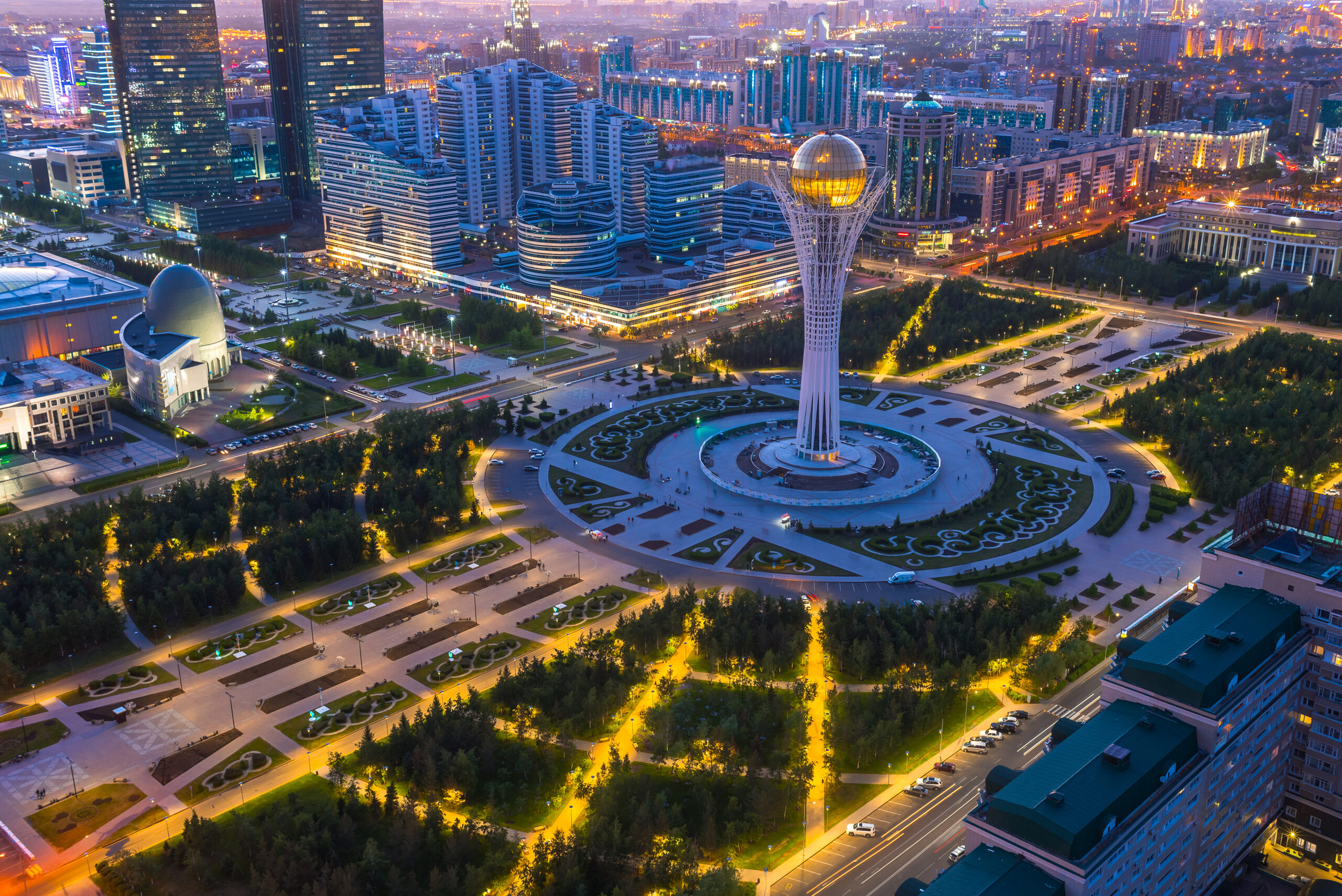
Astana. Photo credit: Shutterstock
First tracks in the forests of Kazakhstan
The Financial Times published an article on Oct. 8 describing a two-week skiing trip in eastern and southern Kazakhstan, from the Altai Mountains near Ridder to the Tien Shan peaks around Almaty. It highlights the exceptional snow conditions, remote terrain accessible only by snowcats or skis, and the growing appeal of areas such as Shymbulak and Alatau for international skiers.
The piece celebrates Kazakhstan’s “white gold” — its extraordinarily light and abundant snow — and contrasts the wild, untouched terrain of the Altai, accessible only by snowcat or touring skis, with the more developed slopes of Shymbulak near Almaty. Through vivid descriptions of frozen forests, rustic cabins, and yurt camps, the article portrays Kazakhstan as an undiscovered winter-sports destination, offering adventure and authenticity far from the crowded European resorts.
“The real reason to bring your skis to Kazakhstan, though, is everything other than the resorts, and for every piste within range of the city, there are hundreds of acres of untracked snow to explore by climbing under our own steam,” reads the article.
Dimash makes history at Madison Square Garden with triumphant STRANGER tour performance
Kazakh superstar Dimash Qudaibergen made history on Oct. 5, becoming the first artist from Kazakhstan to headline a solo concert at Madison Square Garden, reported NYS music on Oct. 8.
The sold-out show marked a defining moment in global music as fans from across continents gathered to witness one of the world’s most extraordinary vocalists launch the international leg of his STRANGER World Tour.
Dimash’s Madison Square Garden debut was as much a celebration of identity as it was a showcase of unmatched vocal artistry. The evening opened with a powerful performance of the Kazakh national anthem, the first ever at MSG, uniting the audience in a rare and emotional moment.
Astana Hub pushes Kazakhstan’s national AI ambitions
Kazakhstan has an ambitious agenda to promote artificial intelligence innovation and use across its public and private sectors, pitching itself as Central Asia’s main ecosystem for the fast-evolving technology, reported fDI Intelligence on Oct. 2.
Countries have rushed worldwide to develop their own sovereign AI capabilities, investing in talent, computing clusters, local large language models and initiatives to make domestic data sets available to AI start-ups.
Kazakhstan has a plan for all of the above. A national ‘concept for AI development’, launched in 2024, is being upgraded into a strategy by an AI council under the aegis of a newly formed AI and digital development ministry. A supercomputer, developed by UAE firm G42 using Nvidia H200 chips, was officially launched in July in Kazakhstan’s capital Astana.
“AI and high technologies are central to Kazakhstan’s long-term development strategy,” Zhaslan Madiyev, Kazakhstan’s Minister of AI and Digital Development, tells fDi via email.
Kazakhstan prioritizes development of technological innovation
The Jamestown Foundation released an article on Oct. 2 about Kazakhstan’s ambitious digital transformation agenda announced by President Kassym-Jomart Tokayev in his annual address on Sept. 8. It focuses on the creation of a new Ministry of Artificial Intelligence, the launch of a unified Digital Kazakhstan strategy, and the development of Alatau City – a futuristic tech and crypto hub designed to position Kazakhstan as a regional leader in digital innovation and to diversify its economy beyond dependence on Russia and China.
Tokayev’s announcement of a new AI ministry and a new fund for digital assets is part of a broader plan to boost the importance of the recently established Alatau city, a futuristic Singapore-style city in northeastern Kazakhstan. The new city concept is designed to attract more foreign investment in digital projects and infrastructure, aiming to transform Kazakhstan into a future hub for cryptocurrency investments and AI, reads the article.
Kazakhstan emerges as a key player in multipolar geopolitics
This article by Derya Soysal, published in The Gulf Observer on Sept. 22 focuses on Kazakhstan’s emergence as a dynamic middle power — a country that has successfully combined economic modernization, proactive diplomacy, and democratic reform to position itself as a bridge between Europe and Asia. Soysal highlights how Kazakhstan’s multi-vector foreign policy, digital transformation, and strategic role in global trade and energy corridors are turning it into a key regional and international actor in a rapidly changing multipolar world.
The article also emphasizes President Kassym-Jomart Tokayev’s political and institutional reforms, which aim to modernize governance, promote transparency, and strengthen Kazakhstan’s democratic foundations, alongside its growing global influence.
“The multi-vector foreign policy is based on the concept of developing ‘friendly and predictable relations with all states’ while playing an ‘important role in world affairs’ in order to protect Kazakhstan’s interests. Today, the largest of the five Central Asian republics maintains friendly relations with Europe, China, Central Asian countries, the United States, the Middle East, Pakistan, Turkiye… while diversifying its international influence networks.
Kazakhstan is emerging as a dynamic middle power at the crossroads of Europe and Asia. With its multi-vector foreign policy, proactive diplomacy, and commitment to modernization, the country has become both a strategic partner for global powers and a bridge between continents and cultures. Its rapid economic growth, rich natural resources, and central role in new transport corridors reinforce its importance in the evolving multipolar order,” the article reads.
Derya Soysal is a historian and environmental management expert on Central Asia and researcher on Central Asia post-Soviet period. Journalist for EuReporter and EuReflect and Special Director of The Gulf Observer for Europe and Central Asia.
The Caspian, the world’s largest inland sea, is fast shrinking due to the climate emergency
The Conversation published an article on Sept. 22 about the rapid decline of the Caspian Sea due to climate change and its far-reaching ecological, economic, and geopolitical consequences. It explains how global warming is accelerating water loss through increased evaporation, causing vast areas of seabed to dry out and threatening the livelihoods of millions of people as well as unique species like the endangered Caspian seal. The author warns that while regional governments are trying to adapt through dredging and infrastructure relocation, the pace of environmental decline may outstrip political cooperation, making urgent, coordinated action essential.
“The level of the Caspian Sea has always fluctuated, but the scale of recent change is unprecedented. Since the turn of the current century, water levels have declined by around 6cm per year, with drops of up to 30 centimeters per year since 2020. … Now global warming is the main driver of decline. It might seem inconceivable that a body of water as large as the Caspian could be at risk, but in the hotter climate the rate of water entering the sea from rivers and rainfall is reducing, and is now being outstripped by increased evaporation from the sea surface,” reads the article.
Senate confirms Ohio native Julie Stufft as Kazakhstan ambassador
The U.S. Senate on Tuesday confirmed Julie Stufft, who grew up on a small farm in Wayne County, Ohio, as the next U.S. Ambassador to Kazakhstan by a vote of 51 to 47, reported Cleveland on Oct. 7.
Stufft, a career Foreign Service officer, previously served as deputy chief of mission in Moldova and Djibouti, and in missions in Russia, Ethiopia, and Poland.
Stufft holds degrees from Case Western Reserve University and Duke University, and speaks Russian, Romanian, French, and Polish. In 2023, she received the Distinguished Executive Presidential Rank Award, the highest award granted to a civilian federal employee. Her other honors include seven Superior Honor Awards and the American Foreign Service Association’s Award for Constructive Dissent by a Senior Officer.
