
ASTANA — Kazakhstan to remain Central Asia’s fastest-growing economy in 2025, expanding by 5.9%, well above the global average of 3.2%, according to the International Monetary Fund’s (IMF) Regional Economic Outlook, released on Oct. 21.
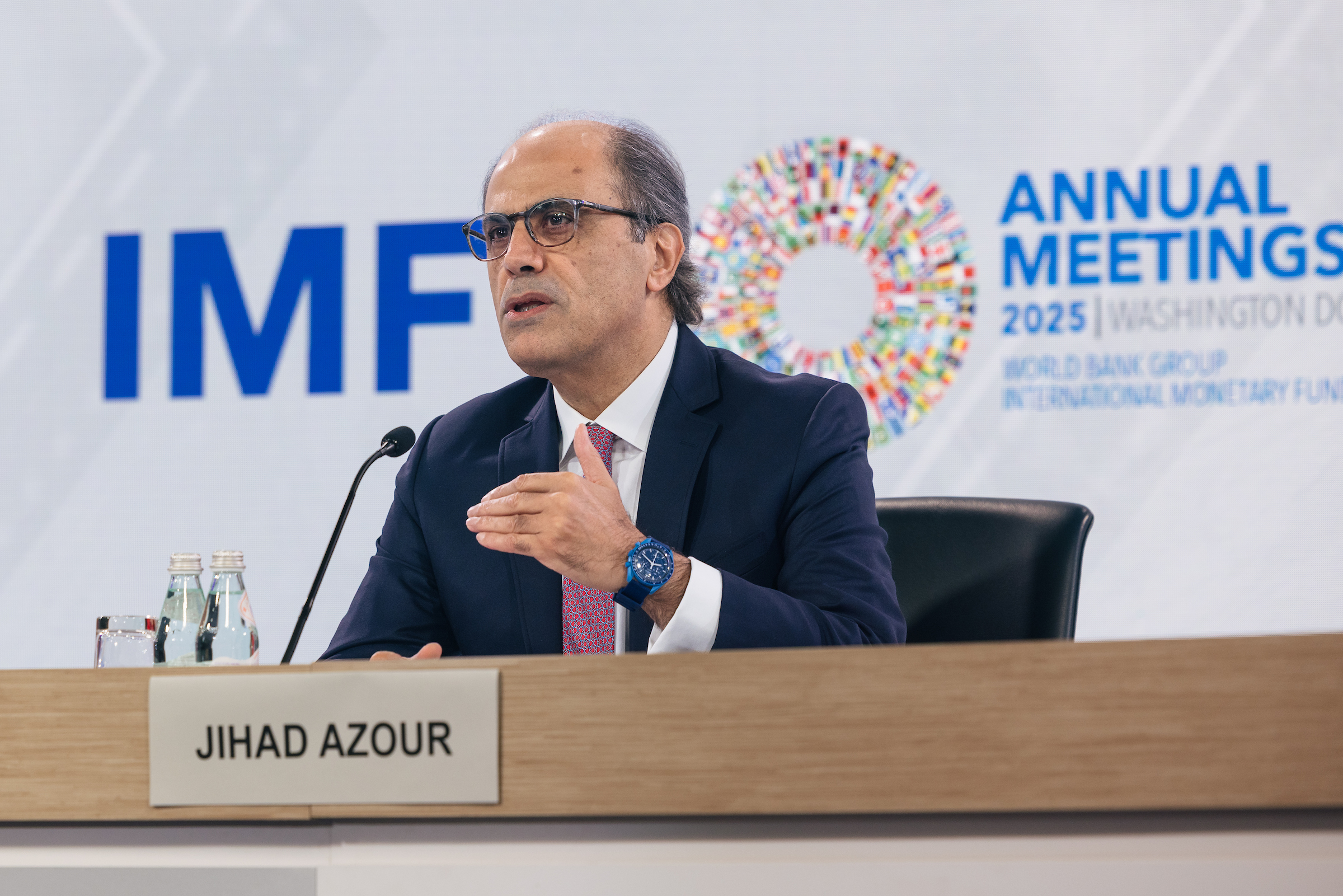
IMF Middle East and Central Asia Department Director Jihad Azour briefs the press on the findings in the latest Middle East and Central Asia Department’s Regional Economic Outlook on Oct. 17. IMF Photo/Alyssa Schukar
The IMF revised its forecast for the broader Caucasus and Central Asia (CCA) region upward to 5.6%, citing Kazakhstan’s strong hydrocarbon output, robust domestic demand, and expanding credit as the main growth drivers.
During the IMF 2025 Annual Meeting on Oct. 17, Jihad Azour, Director of the Middle East and Central Asia Department, said the outlook, while still clouded by global uncertainty, reflects a region that has weathered external shocks better than anticipated.
“Output growth has held steady and inflation remained moderate or eased in most regions. Some of the global economy strength reflects temporary factors, such as firm frontloading activity ahead of the tariff increases and adjusting inventories and supply chain, as well as significant investment in new AI technologies. As these factors fade, global demand may soften, which could affect our regions through trade, finance and commodity channels,” said Azour.
Across the region, economic activity remains resilient, supported by consumption, investment, and steady hydrocarbon exports. Inflation trends, however, are uneven, easing in some economies while accelerating in others due to imported price pressures and strong domestic demand.

IMF’s Georgieva said global trade must remain “a driver of growth, not division” on Oct. 16 during IMF/World Bank Annual Meeting in Washington, D.C. Photocredit: Reuters
“In the CCA, growth will moderate to a more sustainable pace, while inflation gradually declines. However, downside risks remain significant. Recent shocks and still-elevated global uncertainty could undermine demand and induce global economic slowdown or tightening global financial conditions,” Azour noted.
Beyond short-term resilience, the IMF points to a “new growth model” emerging across Central Asia as economies like Kazakhstan diversify away from resource dependence. Labor and capital inflows, particularly linked to post-war migration from Russia, are helping fuel productivity gains in IT, services, and capital-intensive industries, lifting the region’s potential growth from 4.2% before 2022 to nearly 4.8% today.
The fund urged regional policymakers to seize the moment while macroeconomic conditions remain stable. The regional outlook focused on three priorities for sustaining resilience: strengthening fiscal frameworks to ensure long-term sustainability, enhancing monetary policy credibility to anchor inflation expectations, and accelerating structural reforms to diversify economies and attract investment.
For Kazakhstan, these recommendations align closely with the government’s national strategy: from industrial modernization and green energy to innovation and digital transformation.
Broader Global Context
The IMF upgraded the forecast for the world economy despite persistent uncertainty. IMF Chief Economist Pierre-Olivier Gourinchas warned that escalating trade tensions, particularly between the United States and China, could shave up to 0.6 percentage points off global GDP by 2028, with potential knock-on effects on inflation and financial markets.
IMF Chief Economist Gourinchas warned that escalating trade tensions between the US and China, could shave up to 0.6 percentage points off global GDP by 2028 on Oct. 16 during IMF/World Bank Annual Spring Meetings in Washington, D.C. Photo credit: IMF
“If new trade or export restrictions on critical materials are introduced, global economic activity could slow significantly,” Gourinchas cautioned.
The U.S. economy is expected to expand by 2% in 2025, buoyed by tax incentives and AI-driven investment, while the euro area and Japan show modest but steady growth. China’s outlook remains fragile at 4.8%, weighed down by real estate vulnerabilities and rising debt concerns.
IMF Managing Director Kristalina Georgieva emphasized that global trade must remain “a driver of growth, not division,” urging governments to resist protectionism and give space for the private sector to adapt and innovate.
“The private sector handles uncertainty better, so unlock private sector growth for economies to deliver more jobs and better livelihoods. For the private sector to thrive, countries must push ahead with broad and ambitious domestic reforms. I have encouraged our members to keep trade as an engine of growth,” Georgieva said.
Regional Engagement
During the IMF 2025 Annual Meeting on Oct. 17, Azour expressed that the IMF reaffirmed its commitment to supporting the Middle East and Central Asia through policy advice, financing, and capacity-building. He said since 2020, the fund has approved nearly $56 billion in financing and implemented over 385 development projects across 31 countries.
He also announced that these discussions will continue at two upcoming regional events: the IMF Regional Economic Outlook launch in Almaty on Oct. 30, where Kazakhstan will once again take center stage as one of Central Asia’s most dynamic and reform-oriented economies.
