
ALMATY – Kazakhstan has all the potential to become a key crypto destination of Eurasia, said Binur Zhalenov, the chief digital officer at the National Bank of Kazakhstan, at the World Forum of Central Securities Depositories (WFC 2025) on Sept. 25 in Almaty. He expressed hope that the efforts of the NBK as a regulator will help the country make this goal a reality.

Photo credit: Kazakhstan Central Securities Depository (KCSD).
Zhalenov outlined Kazakhstan’s blockchain and digital asset initiatives. He also emphasized that while only 5% of digital assets are currently regulated, the country is moving to maximize the potential of its digital finance infrastructure.
One of the latest developments is the establishment of a state cryptocurrency reserve, based at the National Investment Corporation. This crypto reserve will become part of Kazakhstan’s overall sovereign reserves managed by the National Bank.
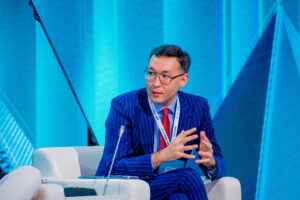
Binur Zhalenov, the chief digital officer at the National Bank of Kazakhstan. Photo credit: Kazakhstan Central Securities Depository (KCSD).
When asked about the future impact of digital assets in two years’ time, Zhalenov turned the conversation to the convergence of programmable money, programmable assets, and AI agents.
“There is an idea of a debt increment theory. I think we will see a similar concept first in the retail payment space, where all payment operations for e-commerce will be handled by AI agents connected to your chatbots or other interfaces. And at the end of the day, I think we will see a similar pattern in post-payment infrastructure,” he said.
The challenge is not theoretical. He explained that in 2024, the total circulation of stablecoins reached $27.6 trillion, surpassing the combined volume of Visa and Mastercard transactions for that year. 98% of activity is driven by bots, which Zhalenov describes as speculative algorithms, not humans.
“That’s going to be a huge problem for us as regulators, because we have to first recognize what an AI agent is. We should be able to verify that this AI agent has proper rights from the end consumer. And how it all will coordinate, because everything will speed up,” he said.
During the session, the participants also debated innovations transforming traditional post-trade services.
Alexandre Kech, CEO of the Global Legal Entity Identifier Foundation (GLEIF), reflected on his experience with digital assets since 2017, noting how skepticism has shifted to a focus on proof of value. Kech said it has progressed from denial to acceptance and is now in the implementation phase.
“When I started [working with digital assets] in 2017, let’s be honest with ourselves, there was a lot of denial in the community of banking and central securities depositories (CSDs) around the potential of this technology. I am glad to see that now it is part of the agenda of everybody, because I personally believe it has been proven over the last years that it will revolutionize how CSDs operate markets in every country,” said Kech.
To fully benefit from blockchain asset access, it is essential to ensure that all receiving wallets are properly verified and compliant with relevant rules and accredited-investor requirements.
“All that process requires identity,” explained Kech. “But we need first to solve a critical issue, which is verification of identity, and that’s what GLEIF is now doing. It has established a protocol called a verifiable legal entity identifier, or VLEI, which enables exactly that – not only on a digital asset platform, but on any platform.”
For the first time, the WFC 2025 convened in Kazakhstan on Sept. 23-26, bringing together more than 200 participants from 80 countries to address challenges and opportunities in the post-trade market. Hosted by the Kazakhstan Central Securities Depository (KCSD), the forum united the regional associations representing nearly 135 organizations worldwide.
