
My mom used to tell me about the feeling of internal coherence she experienced whenever she stepped onto the land of her ancestors – the vast steppes of the village where she was born. The corners of her lips would lift into a soft, almost unnoticeable smile, while her soul seemed to recover, reconnecting with the roots it belongs to.
I’ve felt this feeling too – though not only in my own city, but in thousands of places where I’ve had the
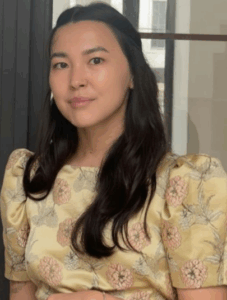
Ayana Birbayeva
chance to wander, stay and leave a part of myself behind.
I felt it in the narrow streets of Riga’s Old Town, where history was left in every stone I stepped on. I found it balancing the rhythm of life aboard a small red boat hotel anchored in the bay of Stockholm. It spread through my entire body with the sounds of the Saturday market on Córdoba’s main square, where cheerful voices of local women and the clinking of handmade goods filled the air with warmth and color.
I experienced it standing on a hill next to Monte Vulture, gazing at hundreds of wind turbines whose quiet grandeur made my body tremble. I felt it in those fleeting details: waking up in a new place, tasting a piece of warm local pastry and having balcony conversations with strangers who felt like neighbors, if only for a day.
Each time I arrive somewhere new, I feel a sense of home within the unfamiliar. I find pieces of myself scattered in these places as fragments that had been buried, waiting for the right setting to emerge.
It’s as though every new destination offers me a mirror, reflecting a version of myself I hadn’t known existed. Perhaps it’s the thrill of adventure that awakens something deep inside. Or maybe it’s the way a city’s pulse syncs with my own, revealing desires, fears and dreams I didn’t know were there.
And yet, the more I travel, the more I wrestle with one simple, persistent question: Where is my home?
The paradox of belonging
I feel at home everywhere. My soul connects with the energy of each place, but when it comes to defining home, I can’t help but feel adrift. There’s, certainly, beauty in the idea that I belong wherever I am, that I am adaptable and capable of forging deep connections with people, places and cultures all over the globe. But in this constant state of movement, where does one truly belong?
I’m not alone in this feeling. Many of us today are global citizens, living lives that don’t fit into the traditional idea of home. The deeper question arises – is home a place or is it a feeling? Сan it ever truly be found?
Language: many faces of me
What I’ve come to realize is that my sense of self is deeply tied to the languages I speak. I am Kazakh by birth, yet my first language was Russian. I studied in an English-speaking school, later attended university in Latvia, and spent time living in Spain. And in every place, in every language, I become a slightly different version of myself.
In Kazakh, I feel deeply connected to my roots – the traditions passed down from generation to generation and the modesty. Russian, the language I was raised with, holds a pragmatic, precise, perhaps even a little more confident part of my identity. In English, I find myself able to express ideas with a clarity and freedom that feels almost liberating, while Latvian and Spanish bring out more curious and spontaneous parts of my character.
It is as though every language unlocks a new personality. Each language doesn’t just help me communicate – it shapes how I see the world and, in turn, how I see myself. And this has made me question: do I have one true self? Or am I simply a patchwork of different versions of me, stitched together by the languages I speak and the places I’ve been?
It is also something psychologists and linguists have been exploring for years. There’s a concept known as “linguistic relativity,” which suggests that language shapes how we perceive reality. It’s fascinating to think that each language I speak could be guiding me toward a different self.
The legacy of our generation: rootlessness or freedom?
As I grapple with this question, I have realized that perhaps this experience of having homes everywhere but nowhere is not an anomaly. It is the legacy of our generation, shaped by constant movement, globalization and digital connectivity. We are the first to grow up in a world that allows us to be everywhere at once. We can interact with people across continents in real time, work remotely from anywhere and form deep bonds without ever setting foot in the same place.
This is both a gift and a curse. We are free in a way that past generations could hardly imagine, but in this freedom, we often lose a sense of stability. The traditional notion of home as a physical location no longer resonates for many of us. We can carry our homes with us in our hearts, but the question remains: does this constant adaptation and mobility bring us closer to who we really are, or does it disperse us, making us feel fragmented?
National identity
As a Kazakh, my national identity is a constant thread throughout all of this. But even here, I feel torn between multiple identities. While I’m proud of my heritage, the place where my family’s roots run deep, the modern world has made me question what it means to be truly Kazakh.
There is an idea in sociology called glocalization – the blending of global and local influences. In many ways, this has shaped who I am today. Being Kazakh in a globalized world isn’t as simple as it once seemed. I am no longer just shaped by my birthplace. I am shaped by everything I have experienced across the globe. The more I travel, the more I realize that I am not confined to one national narrative. I am a product of all the places I have called home.
The psychological explanation: the search for identity
Psychologists often talk about the concept of identity development in relation to place and language. According to studies, identity is deeply tied to the places we inhabit, the culture we embrace, and the roles we play within those spaces. But in our interconnected world, identity is not static – it is an evolving process. This is particularly true for people like us, who move between places and experiences.
There’s a term called “global nomadism,” which refers to people who live without a permanent home, often adapting to new places and cultures, finding themselves in different versions of their identity depending on the location. For many of us who travel frequently, this becomes a defining feature of our lives.
Finding home within ourselves
As I continue to wander, I realize that maybe the quest for home is not about finding one place, one identity. Perhaps it is about learning to carry a little piece of every place within us. We are constantly evolving, and each journey adds a new layer to the person we are.
In the end, home is not a destination – it is a process. It is the way we weave together our experiences, our memories, and the versions of ourselves we discover along the way. It is knowing that we are not bound by geography, that our sense of belonging comes from within. Home is in the feeling of peace we carry with us, wherever we go.
And perhaps that is the legacy of our generation: not to find ourselves in a single place, but to find ourselves everywhere.
