
ASTANA — The Eurasian Development Bank (EDB) has unveiled its strategic vision for advancing warehousing infrastructure across Central Asia and initiated the creation of the Central Asia Warehousing Association with IBC Global, during the Central Asia Warehouse Summit (CAWS) held on Oct. 16 in Almaty, the EDB’s press service reported on Oct. 21.
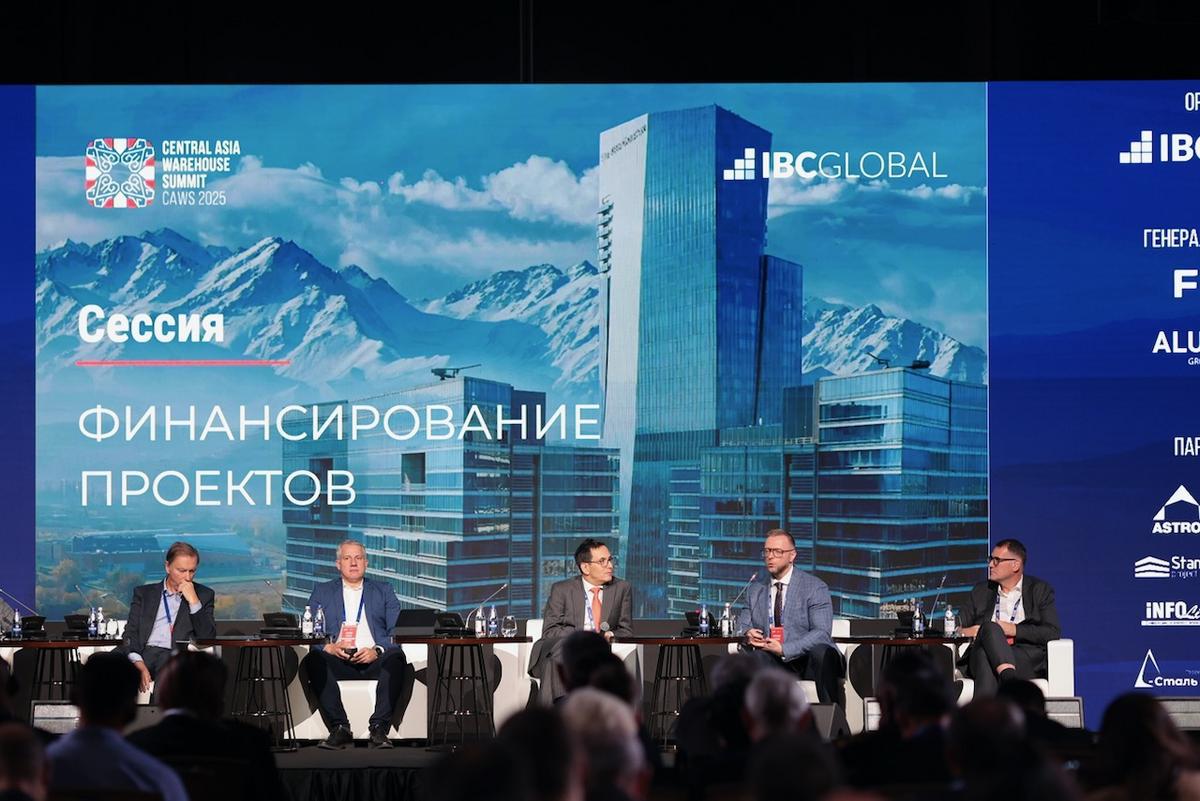
EDB with IBC Global initiated the creation of the Central Asia Warehousing Association during the CAWS on Oct. 16 in Almaty. Photo credit: EDB’s press service
During the event, the EDB outlined key investment priorities and the region’s growing infrastructure challenges. According to IBC Global and NF Group, Central Asia’s warehousing market faces a persistent shortage of high-quality facilities. This structural gap is creating significant opportunities for investors, offering returns of 17–20% per year and payback periods of five to eight years, making the sector one of the most promising for business growth in Eurasia.
Overall demand for modern warehouses in Central Asia is estimated at nearly 2 million square meters, with total investment needs of up to $1.5 billion. EDB data show that the region’s countries have already announced projects totaling 1.6 million square meters of warehouse space, reflecting strong market activity and investor confidence from both domestic and international players.
According to the EDB, modern warehouses play a crucial role in the development of logistics and e-commerce across Central Asia, which is rapidly emerging as a key hub in global supply chains. The region’s expanding e-commerce and industrial sectors are fueling demand for advanced warehousing solutions, including automation, temperature-controlled zones, and rapid order processing.
“Class A warehouses — high-quality facilities with low vacancy rates and stable profitability — are in particularly high demand. These facilities drive the growth of third-party logistics (3PL) operators, attract new investment, and support the region’s deeper integration into international logistics networks,” the EDB’s press statement reads.
Long-term projections point to a significant expansion of warehouse capacity across Eurasia. The EDB’s scenario modeling suggests that total warehouse stock in the region could nearly double by 2040. Under the baseline scenario, demand is projected to rise from around 58 million square meters in early 2025 to 101 million square meters by 2040 — a 74% increase.
A step ahead: creating a regional warehousing association

Skatin, head of the EDB Directorate for Strategic Projects, said the bank’s goal is to unite the professional community to develop a regional market with access to long-term financing and common industry standards. Photo credit: EDB’s press service
To stay ahead of the curve, the EDB and IBC Global have launched an initiative to establish the Central Asia Warehousing Association, an industry platform intended to unite market participants, support the development of the Eurasian Agricultural Goods Distribution System, and attract global investment to the logistics sector.
Alexey Skatin, head of the EDB Directorate for Strategic Projects, said the bank’s goal is to unite the professional community to develop a regional market with access to long-term financing and common industry standards.
“We plan to establish the Central Asia Warehousing Association as a platform for dialogue and cooperation among all market participants — from investors to technology providers. We invite developers, tenants, financial institutions, and general contractors to join this initiative to help lay the foundation for the systematic development of warehousing infrastructure and create favorable conditions for both international and regional investment,” he said.
Why it matters
Central Asia currently has one of the lowest levels of modern warehousing availability in Eurasia. The surge in e-commerce, agricultural exports, and cross-border trade underscores the urgent need to modernize logistics systems and construct high-quality storage facilities. However, the market remains fragmented, lacking unified standards and sufficient access to finance.
The newly established association aims to bridge these gaps and become a cornerstone of the Eurasian Agricultural Goods Distribution System. Its work will focus on attracting financial institutions and investors, facilitating access to financing, forming financial consortia, promoting industry standards, and supporting certification and standardization processes. It also plans to conduct research and training programs, foster dialogue with governments, and contribute to improving the legal framework.
Through this initiative, the EDB seeks to make warehousing projects in the region more accessible, transparent, and efficient, benefiting all stakeholders, including investors and developers, public institutions, and technology providers.
