
ASTANA – This year will mark the opening of the Bukhara contemporary art exhibition on Sept. 5 in Bukhara, a UNESCO Creative City of Crafts and Folk Art. The event boasts to become the largest and diverse art initiative in Central Asia and will run through Nov. 20.
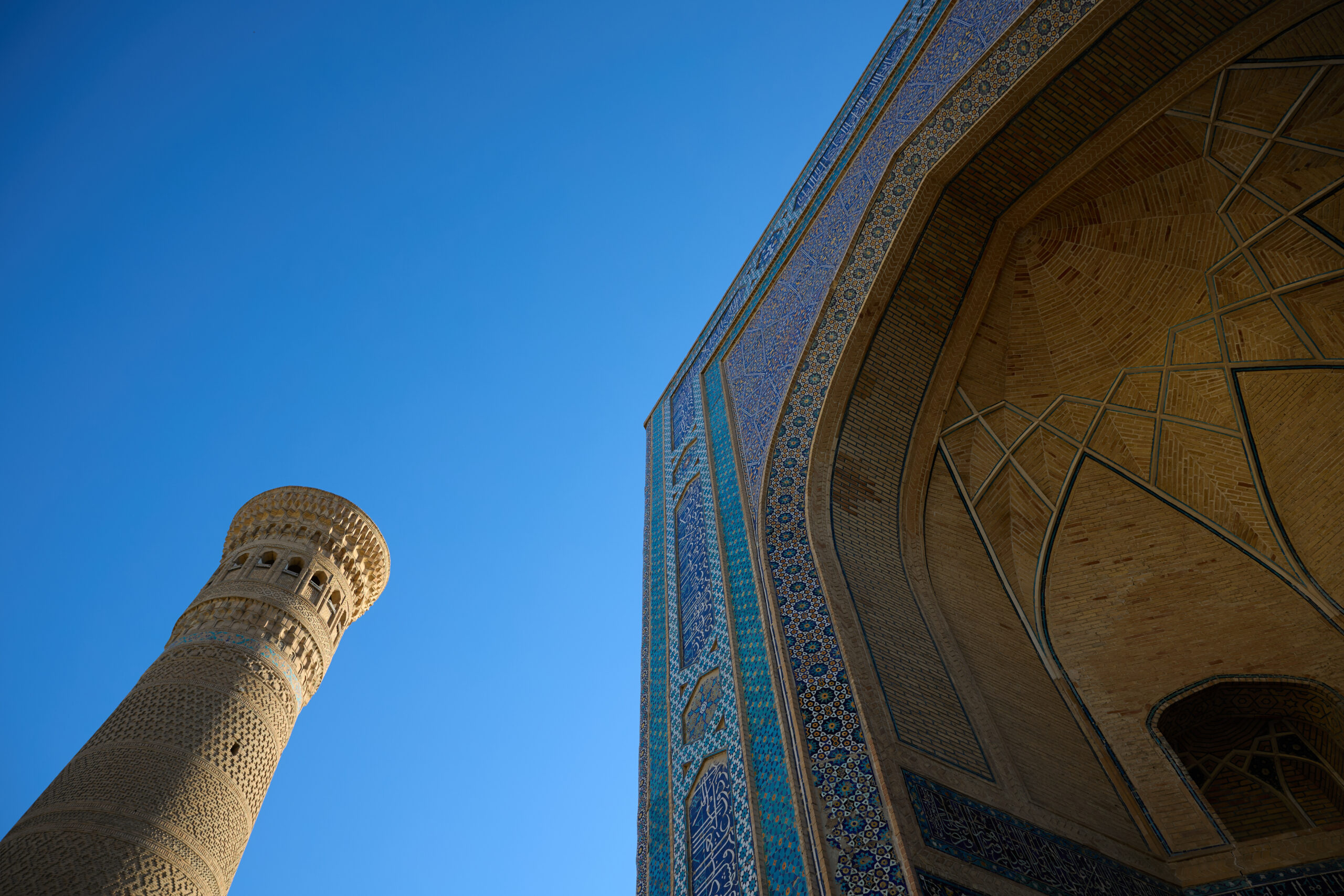
Entrance portal of Khoja Kalon and Kalon Minaret__Courtesy of Uzbekistan Art and Culture Development Foundation. Photo credit: Uzbekistan Art and Culture Development Foundation (ACDF)
We spoke with Gayane Umerova, the commissioner of the Bukhara Biennial and Chair of the Uzbekistan Art and Culture Development Foundation (ACDF) to learn more about the exhibition and creative industry development in the region.
Beating heart of the cultural event
Dubbed as the “Recipe for Broken Hearts,” the display will feature more than 70 art projects all of which are being made in Uzbekistan and are site-specific, with several closely connected with the exhibition’s architecture and the local conditions at that time of the year.

Gayane
Umerova. Bukhara Biennial Commissioner and Chairperson Uzbekistan Art and Culture Development Foundation Courtesy of
ACDF. Photo credit: Uzbekistan Art and Culture Development Foundation (ACDF)
Approximately half of the participants are from Uzbekistan, including photographer Bekzod Boltaev, ceramic artist Abdulvahid Bukhoriy, multidisciplinary artist Daria Kim, ethnographic and cultural documentary photographer Zilola Saidova and London-based artist Aziza Kadyri. The line of participants include artists Saule Suleimenova, sculptor Gulnur Mukazhanova and film director Aisultan Seit from Kazakhstan and Almaty-based artists Nazira Karimi from Tajikistan and U.K-based multidisciplinary artist and musician, who was born in Uzbekistan and raised in Kyrgyzstan, Aziza Shadenova.
Umerova said the exhibition has been several years in the making and a natural evolution of they have been working at the foundation – “supporting Uzbek artists, designers, and craftspeople – not just locally, but on a regional and global scale.”
“Central Asia is reasserting its voice on the global stage, not as a periphery but as a serious nexus for global art discourse,” Umerova explained. “The event will create a significant moment on the 2025 art world calendar, inviting an international audience to witness the thriving Uzbek art scene firsthand, and present opportunities for younger generations. The event, together with other efforts, seeks to revitalize and grow the creative industries in Uzbekistan, preserve the city’s architecture and to revive Bukhara’s historic roots as a center for intellectual exchange and production.”
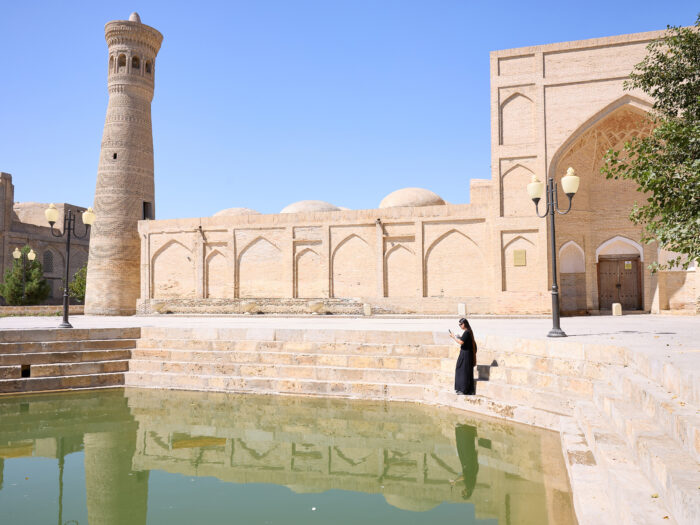
Artist Nomin Zezegmaa at the façade of the Khoja Kalon Courtesy of Uzbekistan Art and Culture Development Foundation. Photo credit: Uzbekistan Art and Culture Development Foundation (ACDF)
Specifically for the first edition, the curatorial theme breaks down hierarchies with equal treatment across every participant, regardless of their social status, nationality, specialism, age or career trajectory. There is an intentional substantial representation of Central Asian artists and the gathering will serve as inspiration for future exchange and collaboration with a long-term impact across the region.
The city along the Silk Road
Bukhara is chosen as the host city because the city has historically been a centre for intellectual exchange and the prolific production on the Silk Road inspired the idea to reconnect the city with the rest of the world.
Umerova emphasized the event is part of a long-term masterplan for the city and will mark the start of a revitalization and conservation plan. It includes an expansion of the Cultural District consisting of restored landmarks, new infrastructure, cultural spaces, events and community-driven initiatives designed to open up opportunities within the creative industries in Uzbekistan – for those living in Bukhara as well as those in Tashkent and beyond.
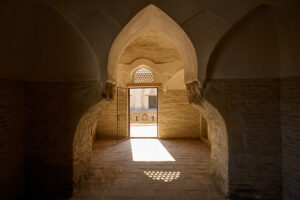
The interiors of the Ayozjon Caravanserai Courtesy of Uzbekistan Art and Culture Development Foundation. Photo credit: Uzbekistan Art and Culture Development Foundation (ACDF)
Artistic director of the Bukhara Biennial Diana Campbell’s curatorial vision of “Recipes for Broken Hearts” is inspired by a popular legend which tells the story of a broken heart claimed to have been restored by a dish invented by the preeminent philosopher and physician Ibn Sina.
“The city’s distinct identity as a place for invention, scholarship, creativity and trade, as well as religious tolerance, will be reinterpreted throughout the event, such as visual and performance projects as well as spaces for learning, including The House of Softness, where symposiums, workshops and performances will be held. There will also be a large food focus within this year’s biennial, which builds on Bukhara’s history and global influence in the context of the spice trade,” said Umerova.
Cultural ties between brotherly nations
This year, Uzbekistan presented two major exhibitions in Almaty and Astana featuring archaeology as well as artefacts from the finest craftsmanship of Uzbekistan. Both of these exhibitions, including “Heritage in Stitches: A Journey through the embroidery and sewing traditions of Uzbekistan” which was held at the National Museum until June, will soon be shown in Tashkent. Kazakhstan also hosted a series of Uzbek Lazgi performances.
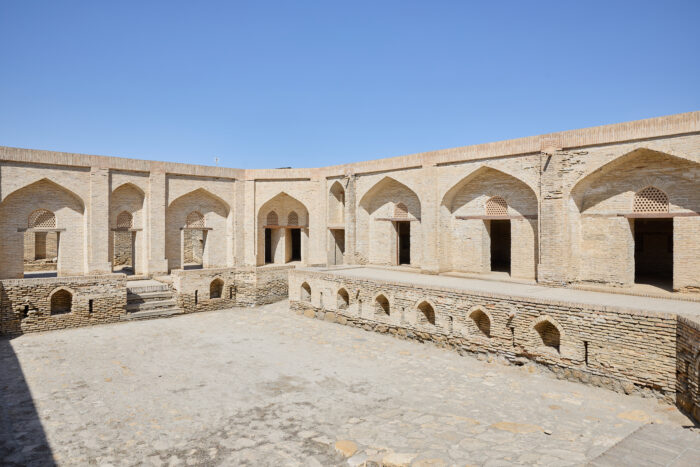
Fotkullojon Karavansaray picture courtesy of Uzbekistan Art and Culture Development Foundation. Photo credit: Uzbekistan Art and Culture Development Foundation (ACDF)
“Kazakhstan shares more than just a border, we are connected through heritage in language, history, traditions, and the Silk Road. There is an artistic dialogue and mutual interest in the ancient and contemporary. Naturally, cultural collaboration will likely continue to grow,” she added.
The friendly spirit is reflected in the exhibition, where participants from Kazakhstan play a vital role.
Saule Suleimenova is collaborating with a group of retired performers from Bukhara’s Shiru Shakar folk ensemble to explore women’s creative expression in Central Asian society. Her work will also be featured in Almaty.
A driving force behind Uzbekistan’s cultural renaissance
“There are many things that inspire me, but above all, I truly love what I do. For me, this is not just a job – it’s a lifelong mission. Uzbekistan’s history is extraordinary. We are a country shaped by many cultures, beliefs, and ideas – a place of convergence. That legacy gives us a profound foundation to create a dialogue between tradition and innovation with both local voices and global platforms,” said Umerova.
She noted her work is more than exhibitions – “it’s about shifting narratives and positioning Uzbekistan as a cultural force and that’s what drives her and her team every day.”
The initiatives spearheaded by the foundation are part of a long-term plan launched by the president of Uzbekistan. The country is committed to supporting culture for young creative talents in the country and abroad.
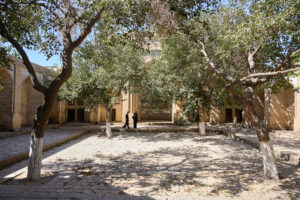
Abdurashid madrasah picture courtesy of Uzbekistan Art and Culture Development Foundation. Photo credit: Uzbekistan Art and Culture Development Foundation (ACDF)
“We are privileged that the foundation falls under the portfolio of Saida Mirziyoyeva, the head of the administration of the president of Uzbekistan – an alignment that enables us to effectively advance and implement the government’s cultural vision,” said the commissioner.
Uzbekistan’s cultural identity
Umerova believes there is a need to reinvigorate and modernize how officials create growth opportunities and raise awareness about the creative sector as an investment. This theme was explored at the World Conference on Creative Economy, held in October 2024 in Tashkent. The conference’s success demonstrated that joining technology with applied arts and creatives will bring impactful ideas.
“In the inaugural biennial, several young artists from Uzbekistan are reinterpreting crafts and working with artisans, some much older than them, for the first time. Elsewhere, Uzbekistan’s heritage has been featured and showcased internationally, including at exhibitions led by ACDF in Paris, Berlin, Florence, Venice and London. We are also now ready to announce the groundbreaking of the future Uzbekistan National Museum designed by Pritzker Prize winner Tadao Ando, offering to the National Collection a new home in the heart of Tashkent,” she said.
Uzbekistan’s cultural diplomacy
Initiatives both in Uzbekistan, such as the Bukhara Biennial, and internationally, including ACDF’s participation in Expo Osaka 2025 are central to the vision to reconnect with the rest of the world. They offer platforms to showcase not only Uzbekistan’s history and artistry but also its contemporary creativity.
“Internationally, we have so far secured representation of Uzbek artisans at Homo Faber in Venice and London Craft Week at the Victoria and Albert Museum in London. We have also started a collaboration with the King Charles School of Traditional Arts,” said Umerova.
The Aral Culture Summit, launched for the first time this year, has already demonstrated a tremendous impact on the local youth and has garnered a strong commitment from all local authorities and international partners. The summit has acted as a link to connect all the layers of the history of the region, from pre-Islamic to Islamic, then modernist architecture and the important Jadid movement.
“Over the next five years, I hope our cultural diplomacy will continue to evolve in this direction, through even more ambitious and meaningful collaborations, grounded not only in building awareness of the country’s heritage,but in actively investing in its future. This is my role as chairperson of ACDF, to ensure we are also working on the heritage of tomorrow. UNESCO granted Uzbekistan to host the 43rd General Conference in Samarkand. The world meets in Uzbekistan as it has been doing it for centuries,” said Umerova.
