
ASTANA — Burning Man in Nevada’s Black Rock Desert, became the stage for Tengri Camp, Kazakhstan’s first-ever contribution to the radical art festival from Aug. 25 to Sept. 2. The Astana Times spoke with organizers and participants who brought a traditional yurt to the desert, recounting how it endured the fiercest sandstorm in a decade and introduced thousands of visitors to the resilience and creativity of nomadic heritage.
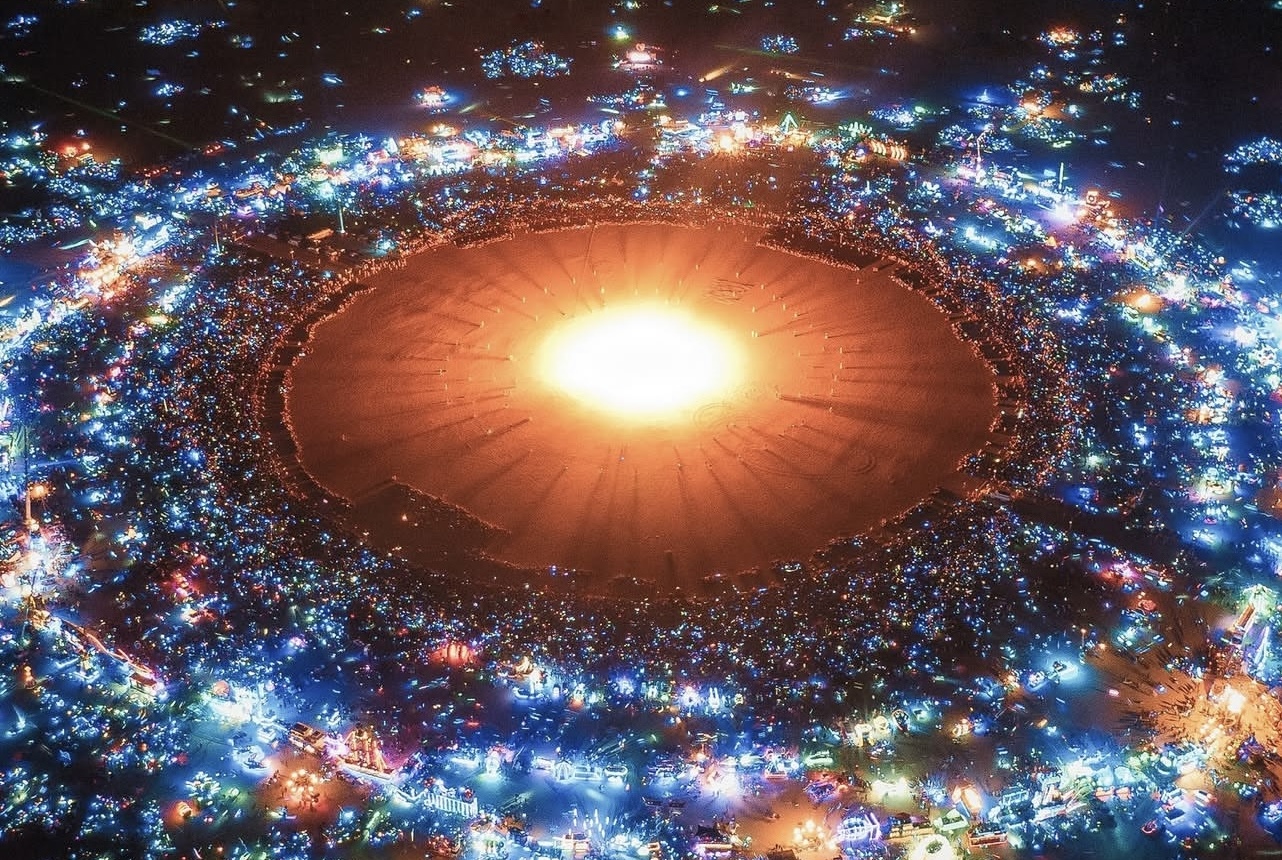
Night aerial view of Burning Man. Photo credit: Jacob Riglin
Bringing a nomadic home to Burning Man
Founded in 1986, Burning Man, which draws nearly 80,000 participants each year, has grown into a global movement guided by 10 principles, including radical inclusion, communal effort, and self-expression. Each year, the festival transforms Nevada’s Black Rock Desert into a temporary city of art installations, theme camps and performances.
Askhat Muratov. Photo credit: Muratov’s personal archives
This year, a group of enthusiasts from Kazakhstan, including artists, entrepreneurs, designers, and professionals from different fields who might not otherwise cross paths, united to form Tengri Camp. Together, they brought a Kazakh voice to the desert, reimagining nomadic traditions for an international community of creators.
“It took me a year to plan how to get here, because it is not easy. I considered it my mission to unite our talented citizens from Kazakhstan, Central Asia, and the Turkic world into a community around Tengri Camp. But we also welcomed Chinese, Uzbek, Kyrgyz people and others and I hope next year even more people will join us,” Tengri Camp organizer Askhat Muratov told The Astana Times.
“We funded everything ourselves, through the contributions of camp participants. The budget was not small. Everything from producing the yurt and handmade décor to logistics, customs, and storage required enormous effort and resources,” he said.
He added that the atmosphere of Burning Man was unlike any other gathering. Instead of social status, he said, what mattered was the intention to contribute and create.
“On average, you might meet two or three people like that a year. But here the concentration is immense, the highest per square meter, because when 80,000 people gather, each one is unique, with their own culture and worldview. It is incredibly interesting,” he said.
Sabina Omar, a travel entrepreneur, shared the sentiment, highlighting the diverse audience.
“From artists and startup founders to psychotherapists, architects, IT specialists, and yoga instructors (…) you can meet millionaires in glowing hose costumes and minimalists who arrived with just one backpack. What matters most is not status, but the intention to participate, create, and live the experience of community,” Omar told The Astana Times.
Yurt as art and shelter
At the center of Tengri Camp stood the handmade yurt, produced in Kazakhstan by Qazaq Yurt. It traveled by truck to China, by rail to Guangzhou, by sea to Los Angeles, and finally overland to Nevada before being assembled by hand in the desert. Inside, guests found felt carpets, embroidered hangings, chests, traditional hats and coats, and the dombyra.
“We assembled it for two days during the storm, and when it was finished, we realized we had created the best possible art object from Kazakhstan, one that spoke to who we are,” said Omar.
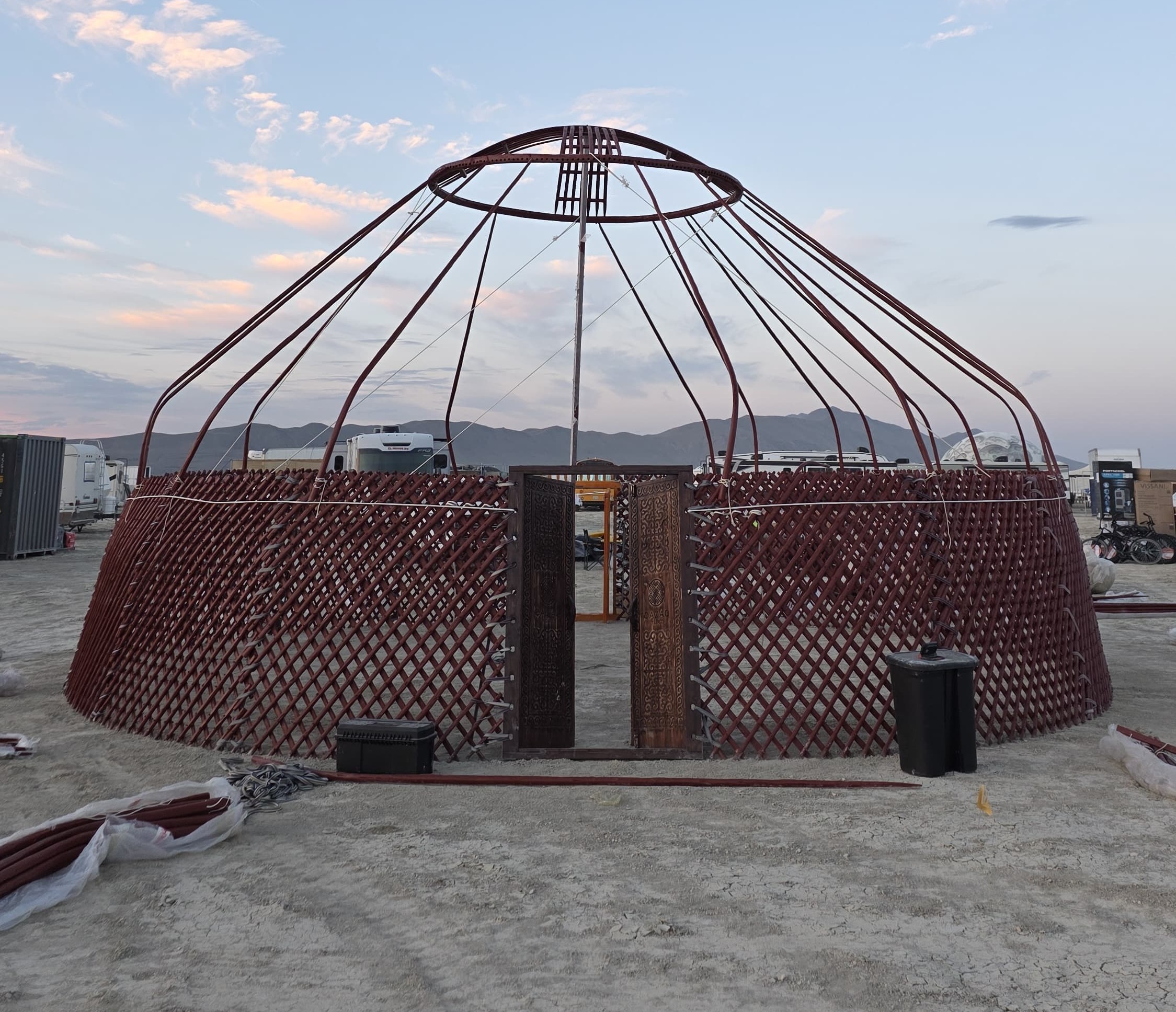
Kazakh yurt being built at the Burning Man 2025. Photo credit: Askhat Muratov’s personal archives
She explained that they witnessed the strongest sandstorm in 10 years, which was destroying neighboring camps and tents.
“We had heard about sandstorms, but seeing tents being blown away was a first. No one was ready for it, except our yurt (…) It felt almost as if it happened on purpose, just to test the yurt’s strength. But Kazakhs have lived in them for thousands of years, through winds far stronger than this,” said Omar.
“We didn’t use any special tricks. Everything was done just as our ancestors did. The design of the yurt was perfected long before us, and it remains incredibly sturdy,” she added.
By the end of the week, more than 1,500 people had visited the yurt and were welcomed with food, music, and a traditional chapan-dressing ceremony for foreign guests.
A stage for Kazakh fashion
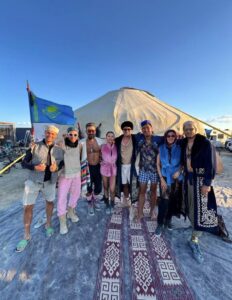
Kazakh and international visitors of Tengri Camp. Photo credit: Askhat Muratov
The yurt also became a stage for fashion designer Aydana Omarova, who presented an ethnic-style show there, blending national heritage with Burning Man’s creative freedom.
“This was not a traditional catwalk. We created a spontaneous show with camp members and international participants. I have presented in over ten countries, but showing Kazakh culture here, under our yurt, was unique,” Omarova told The Astana Times.
She shared that the reactions online were mixed. Some viewers questioned the combination of Kazakh motifs with Burning Man’s free-spirited style, while others embraced the performance as a natural fit for the festival’s openness.
“This is the style of Burning Man where people wear whatever they want, and no one judges (…) People were intrigued not only by the clothes but also by our music, our rituals, our energy. Some even said they now want to visit Kazakhstan,” she said.
Burning Man 2025: scale, camps, and culture
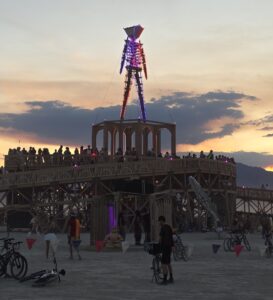
Burning Man 2025. Photo credit: Askhat Muratov’s personal archives
The very first event took place in 1986 on Baker Beach in San Francisco, when founders Larry Harvey and Jerry James built and burned an eight-foot wooden effigy of a man. The burning symbolized letting go, catharsis, and radical self-expression. That act became the central ritual of the festival: each year, participants build a massive wooden effigy known as the Man and set it on fire during the climax of the week-long gathering.
The event is also loyal to their philosophy of “Leave No Trace”, which asks participants to leave the desert as they found it. While not everyone adheres to this tenet, caring for the planet is a massive educational opportunity for all attendees. It also serves as a testing ground for sustainable innovations, from solar power to water purification, advancing its goal of a net-zero footprint.
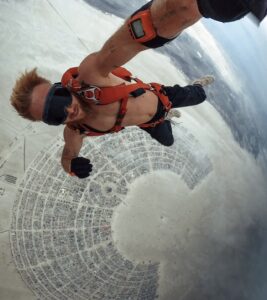
Skydiving man at the burning man. Aerial view of camps. Photo credit: Jacob Riglin
Camps usually operate as small collectives, pooling funds that can range from a few thousand dollars to more than $100,000, depending on size and amenities. Some groups focus on large-scale art installations and performances, while others provide communal kitchens, sound stages, or interactive spaces.
Despite its countercultural roots, Burning Man often draws high-profile figures from the worlds of technology, art, and entertainment. Past attendees have included Tesla founder Elon Musk, Google co-founders Sergey Brin and Larry Page, and celebrities such as Katy Perry, Heidi Klum, and Diplo. For many participants, the event has become both a creative playground and a transformative retreat, blurring the boundaries between festival, community, and experiment in living.
“Burning Man is an experience that can change the way you see yourself and the world. People do not come for a show, but for an inner journey to step beyond the familiar, shed social masks, and spend a week in an environment that values sincerity, participation and freedom,” said Omar.
