
ASTANA – Kazakhstan’s exporters discussed the impact of the European Union’s Carbon Border Adjustment Mechanism (CBAM) at a Sept. 25 webinar organized by QazTrade, the Ministry of Trade and Integration, and the International Trade Center, focusing on compliance requirements and trade implications for aluminum and other key sectors. The event was organized within the EU-funded Ready4Trade Central Asia project.
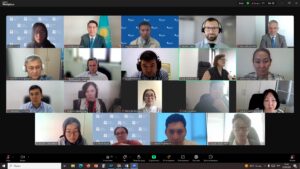
Photo credit: qaztradae.kz
According to the European Commission (2024), Kazakhstan’s exports to the EU are concentrated in six categories sensitive to CBAM. Fuels and mineral products dominated at €31.8 billion (US$37.3 billion) in 2024, over 95% of total supplies and most exposed to EU climate policy. Non-ferrous metals, including aluminum, reached €410 million (US$481.6 million) but fell by almost 40%, while iron and steel totaled €204 million (US$239.6 million), down by 27.1%, and both sectors fall directly under CBAM rules. Chemical products amounted to €667 million (US$783.4 million), showing growth of 26.5% but also at risk of regulation. Other semi-manufactures stood at €95 million (US$111.6 million) with a decline of 38.5%, while machinery and transport equipment reached €60 million (US$70.5 million), down by 11.5%.
Opening the webinar, QazTrade Deputy Director General Nurlan Kulbatyrov, stressed that adaptation to CBAM is urgent, noting the new rules could stimulate modernization and reinforce Kazakhstan’s role as a reliable EU supplier. The EU remains Kazakhstan’s largest trading partner, accounting for 37% of total exports in 2024. The sectors most sensitive to CBAM requirements are aluminum, fertilizers, and iron. Aluminum exports amounted to $662 million, of which more than $225 million went to the EU. Fertilizer exports to the EU reached $40 million, or 17% of the total, while 6.2% of iron exports were also destined for EU markets.
The webinar gathered industrial leaders such as Qarmet JSC and Eurasian Resources Group (ERG), alongside government institutions including the Ministries of Ecology and Natural Resources, Industry and Construction, and the State Revenue Committee of the Ministry of Finance.
Earlier, QazTrade and OECD prepared a Guide on Best Practices for Exporters in Hard to Abate Sectors, offering recommendations on CBAM adaptation, low-carbon technologies, and energy efficiency.
