
ASTANA – The Kazakh Khanate, formed around 1465 in the Semirechye Region, was the first national state of the Kazakhs. It emerged after the migration of Kerei and Zhanibek’s tribes from the khanate of Abulkhair and laid the foundations of modern Kazakh statehood. Over time, it played a decisive role in unifying the Kazakh people, though the process of becoming a single state was long and complex.
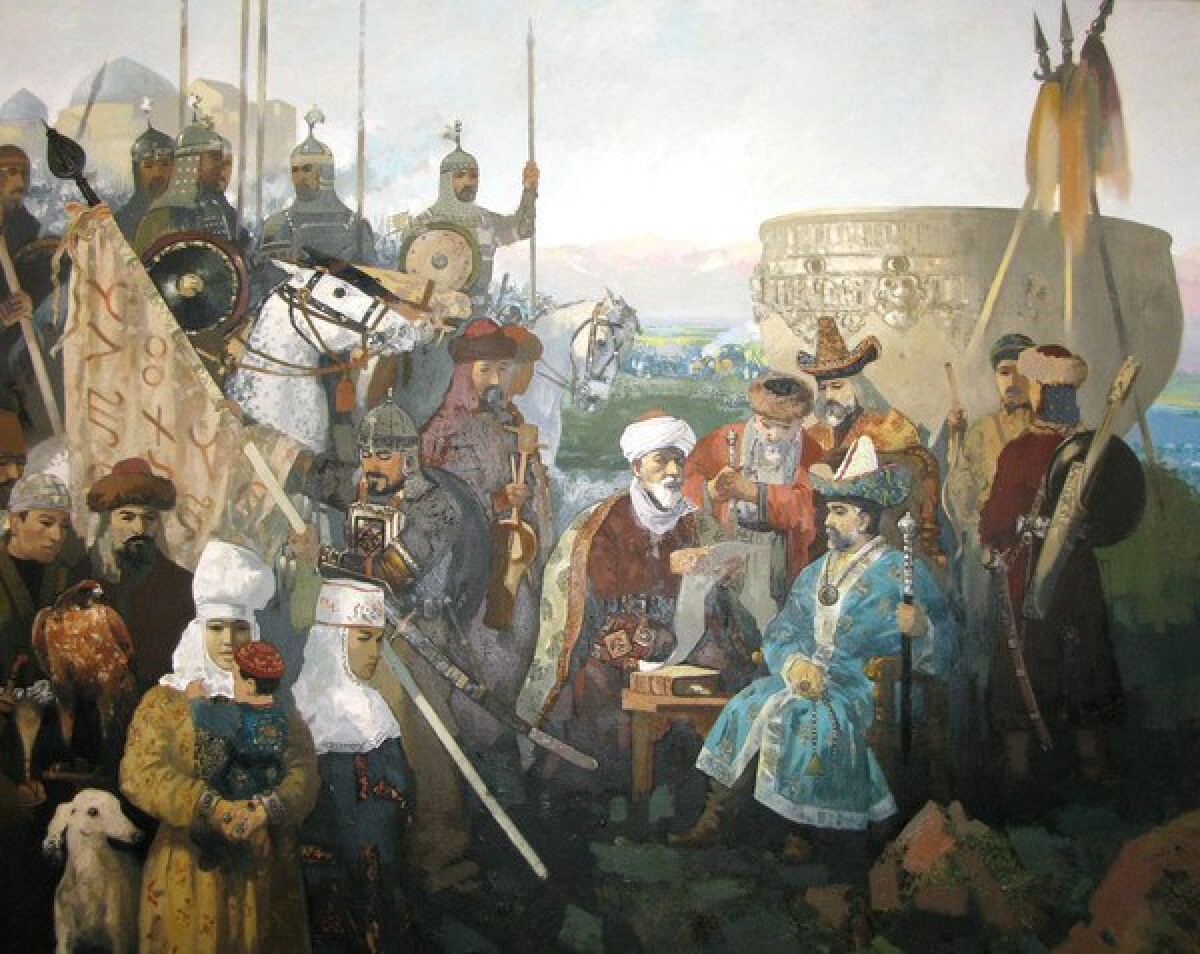
The Kazakh Khanate was a successor of the Jochi Ulus, and inherited its system of governance, structure, and judicial traditions. Photo credit: e-history.kz
The khanate was a successor of the Jochi Ulus, or Golden Horde, and inherited its system of governance, structure, and judicial traditions.
Adilbek Karatayev, a researcher at the Jochi Ulus Research Institute, told Kazinform the main principle of rule was based on the Chinggisid principle, rooted in The Yassa of Genghis Khan, a set of laws codified in 1206. Only direct male descendants of Genghis Khan could claim power. The lineage of tore, the descendants of Genghis Khan, preserved its authority in ruling Kazakh clans and tribes until the khanate’s fall.
According to Karatayev, the system’s weakness was the lack of a strict succession order.
“When the number of contenders grew too large, civil wars often erupted in the khanate, since any Chinggisid [direct male descendants of the four sons of Genghis Khan] could aspire to supreme authority,” he said.
Democracy on the steppe
Karatayev noted that references to democracy in the khanate should not be confused with modern concepts.

Adilbek Karatayev, a junior researcher at the Jochi Ulus Research Institute. Photo credit: inform.kz
“The right to rule belonged only to Chinggisids. There were hundreds, even thousands of them. To stand out, contenders needed authority, military leadership or wisdom in judicial matters,” he said.
When a khan died, or even during his reign, rival Chinggisid sultans could convene a kurultai [council] to seek recognition from biys [judges]. These gatherings often divided society, sometimes leading to multiple khans in the same zhuz [a large Kazakh tribal union].
“One striking case followed the death of Abulkhair, khan of the Younger Zhuz. The biys chose his son Nuraly, but Batyr Sultan, son of Kaip Khan, also gained strong support. The Younger Zhuz ended up with two khans at once – Nuraly and Batyr,” said Karatayev.
Such decisions were made at kurultais, where biys representing each clan voted for candidates. According to Karatayev, nominees were usually known in advance.
Two wings and three zhuzes
The khanate’s highest administrative division was divided into two wings, left and right, a system common across Turkic-Mongol states. The left wing was known as Alash myngy [a thousand of Alash], or simply Alash. The right was known as Katagan, after its dominant tribe.
“The origins of this division are debated. Qadyrgali Jalayiri, the first and only Kazakh chronicler, wrote that it dated back to Urus Khan, ancestor of Kerei and Zhanibek, who was not a Kazakh khan but a ruler of the Jochi Ulus. Another version attributes it to Urus Khan’s grandson, Barak Khan. A third theory, supported by historian Zhaksylyk Sabitov, links it to the time of Kerei and anibek,” said Karatayev.
The wings were not only political but also military divisions, reflecting the inseparability of governance and warfare in steppe states.
Another defining institution was the zhuz system.
“According to Sabitov’s version, which I also share, the zhuzes corresponded to the left wing, Alash, and were divided into three: the senior, middle, and junior zhuzes. The right wing did not include zhuzes,” said Karatayev.
In 1627, Yesim Khan, leader of the left wing, defeated Tursun Khan, leader of the right. Tursun was killed, and many Katagans fled south and east, to Kashgaria, Afghanistan, the Kyrgyz Republic, and Uzbekistan. From then on, only the left wing remained, composed of the three zhuzes.
“From the time of Yesim Khan, the classical political system of the Kazakh Khanate took shape, based solely on the three zhuzes,” said Karatayev.
Alash and Kazakh
Karatayev also highlighted the significance of the name Alash. The left wing’s name, Alash myngy, carried deep meaning. It was considered the first self-designation of the Kazakhs and traced back to Alash Bahadur, a high-ranking commander under Barak Khan. From the 15th to the early 20th centuries, Alash was widely used as a self-identifier, sometimes more often than Kazakh. The Alash Orda national movement also adopted the name.
“The term Kazakh, meanwhile, was first applied by other dynasties of the Jochi Ulus to Kerei and Zhanibek’s followers, who were seen as free nomads. It took a century or more before Kazakh became a true self-designation,” he said.
The article was originally published on Kazinform.
