
ASTANA – International financial institutions (IFIs) have reduced their real-term investments in Eurasia by 17% over the past 17 years, according to a new report from the Eurasian Development Bank (EDB) on non-sovereign financing, released on Sept. 18.

Photo credit: Shutterstock
The report draws on the EDB’s proprietary database of more than 2,000 approved projects by 16 IFIs across 11 Eurasian nations from 2008 to 2024. Analysts highlight ten long-term trends that reveal how private-sector financing is being reshaped.
Average annual non-sovereign funding fell by 17.4% between 2008–2010 and 2022–2024, reflecting high dollar inflation, weak nominal growth, and country-specific constraints.
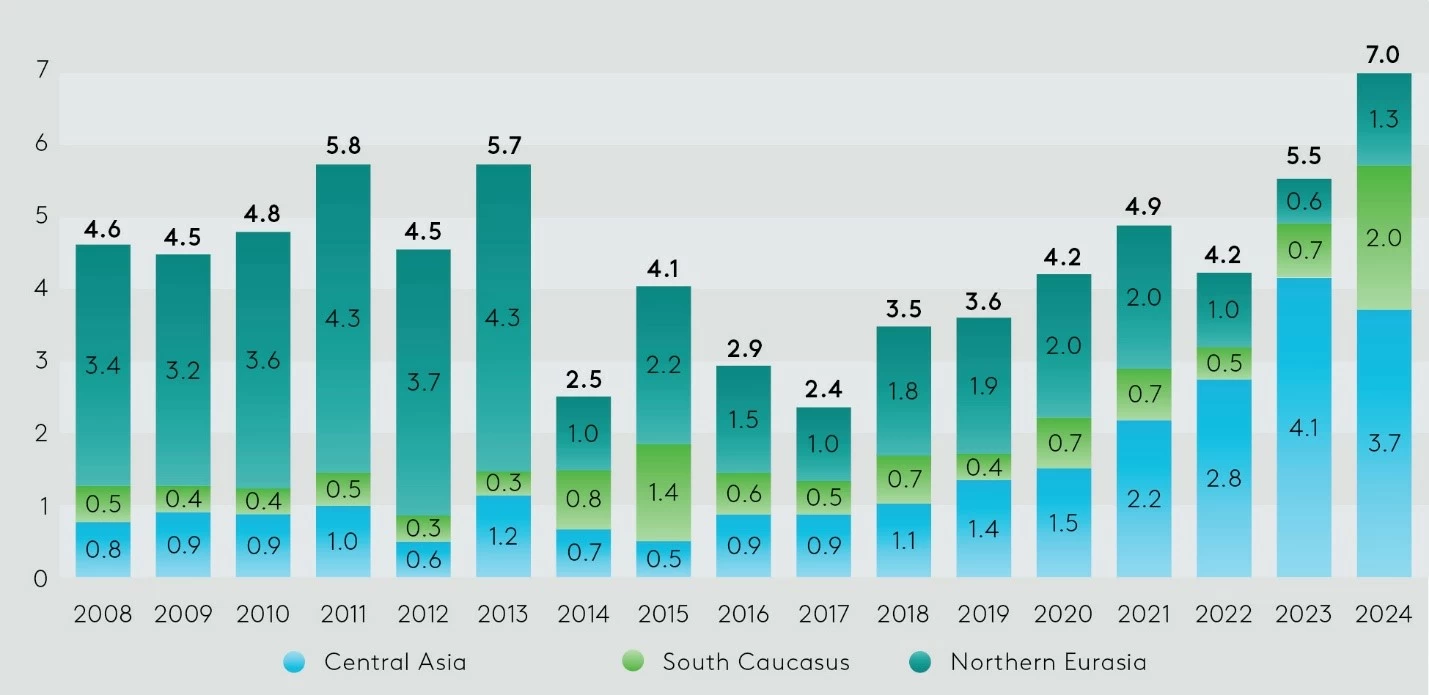
Non-sovereign financing of IFIs in the Eurasian region in 2008-2024 by subregion, $ billions Source: NSF database.
Leadership among IFIs has shifted, with the EDB emerging as the region’s top non-sovereign financier during 2022–2024, ahead of the European Bank for Reconstruction and Development and the World Bank Group’s International Finance Corporation. Central Asia has become the primary destination for these funds, its share of total financing soaring from 18% to 63% as annual investment more than quadrupled to about $3.4 billion, while the South Caucasus also strengthened its position, with its share rising from 9% to 20% and annual funding climbing from $400 million to $1.1 billion.
Sectoral priorities have changed dramatically: renewable energy projects, virtually absent in 2008, now account for 18% of all IFI investment, and the share of “green” projects across energy and finance has jumped from 8% to 32%, even as funding for financial services fell from 38.2% to 32.9%, manufacturing from 5.5% to 0.6%, and agribusiness from 7.7% to 3.5%.
According to EDB Chief Economist Evgeny Vinokurov, multilateral banks are clearly prioritizing climate finance, but the region also needs fast, broad-based growth.
“Greater investment in infrastructure and industry is critical to create jobs, boost productivity, and build human capital. That means larger allocations for manufacturing and agribusiness, top priority for cross-border transport, energy and water projects, and more funding for traditional low-carbon energy sources such as nuclear and gas conversion of coal plants,” said Vinokurov.
At the same time, on-lending to small and medium-sized enterprises grew by 31%, outpacing overall investment growth. Co-financing volumes, however, contracted by 33%, a decline linked largely to the European Bank for Reconstruction and Development’s withdrawal from Russia, though Central Asia has seen gradual co-financing growth. Bond issuance gained prominence, rising from just 0.5% to 7% of all financing instruments, while lending in national currencies expanded by 50%, from $800 million to $1.2 billion in annual terms.
The EDB’s findings underscore a fundamental transformation of IFI operations in Eurasia: a pivot to greener projects, a sharp geographic shift toward Central Asia and the South Caucasus, and a growing reliance on new financial instruments and local-currency lending. The full report, including a detailed analysis of all ten trends, is available on the EDB website.
